Introduction
Ibn Umar (RA) narrated: The Prophet (SAW) said, “This matter will continue to remain in Quraish as long as two people remain.” (Sahih Bukhari and Muslim)
The vast majority of scholars said based on this and other hadith that only Quraish is eligible for supreme authority i.e. khilafah, even if non-Quraishis can occupy lower offices.
Hadith rejecters like claiming that much of the hadith corpus was fabricated for the sake of the Umayyads or Abbasids, and this hadith is a quintessential hadith that they accuse of this type of fabrication.
So, I decided to use this hadith as a case study for showing the destitution of hadith rejection as an ideology.
The Fabricator Must Be In the Chain
Many people who doubt hadith claim that we cannot trust the chains of hadith, and thus think that it is possible for the fabricator of this hadith to not be in the chain in the first place.
There is something true in their intuition: It is possible the person who first came up with the text of the hadith or even first came up with the hadith may not be in the chain.
However, there must also be someone in the chain of the hadith who lied about who they got the hadith from, to propagate the chain as it is.
To conceptualize this, let us start simple: The hadith is in Sahih Bukhari. Bukhari claimed to transmit it from his teacher with a chain to Ibn Umar (RA).
Either Bukhari was lying in his claim that his teacher taught the hadith like this or he was telling the truth. If he was lying, Bukhari is the fabricator of this chain-hadith. If he was telling the truth, that means his teacher taught the hadith.
Then, the same question applies to Bukhari’s teacher (Ahmad ibn Yunus). Was Ahmad ibn Yunus lying in his claim that he received the hadith from Aasim as narrated or was he telling the truth?
We can ask this question about every narrator in the chain, and if the hadith is false, at least one narrator must be lying or deceiving us about whether he truly got the hadith from his claimed teacher in the chain.
Profile of the Fabricator
If a hadith was fabricated in favor of something, that entails a certain profile for the fabricator in line with the hadith he fabricated.
Since the central accusation is that the hadith must have been fabricated in favor of one of the ruling Quraishi dynasties, the fabricator must have been either pro-that-dynasty or pro-those-rulers in some sense.
If someone says, “the fabricator was just pro-Quraish, not pro- any dynasty,” that loses the original weight of their argument which was built on the assumption that those dynasties were able to influence narrators due to their wealth and power.
If the only objection to the hadith is that it is pro-X, hence the narrator must have been pro-X and fabricated in X’s favor, that is an unfalsifiable accusation and would apply to literally any X, whether relevant to dynasties or not. That is impugning on the honesty of Muslim narrators for no reason other than them supporting an X you dislike.
The fabricator having a profile also entails there are some things we don’t expect that fabricator to say or some things that would falsify that motive for fabrication.
If the fabricator was influenced by the rulers, whether Abbasids or Umayyads, we should not expect him to be critical of rulers of his time.
If the fabricator was influenced by the Umayyads, we expect him to be pro-Umayyad in some sense.
If the fabricator was influenced by the Abbasids, we expect him to be pro-Abbasid in some sense or at least anti-Umayyad.
So, someone cannot start out saying, “The hadith was fabricated for the Abbasids,” then say, “Actually, the narrator may not have liked the Abbasids very much, but he still fabricated the hadith for them anyway.” That would be an unfalsifiable theory that explains nothing.
Who are the suspects?
The chains of the hadith are depicted below.
The hadith originated with Ibn Umar (RA), then Ibn Umar transmitted it to his grandson Muhammad ibn Zaid, then Muhammad transmitted it to his son Aasim, then Aasim transmitted it to numerous students.
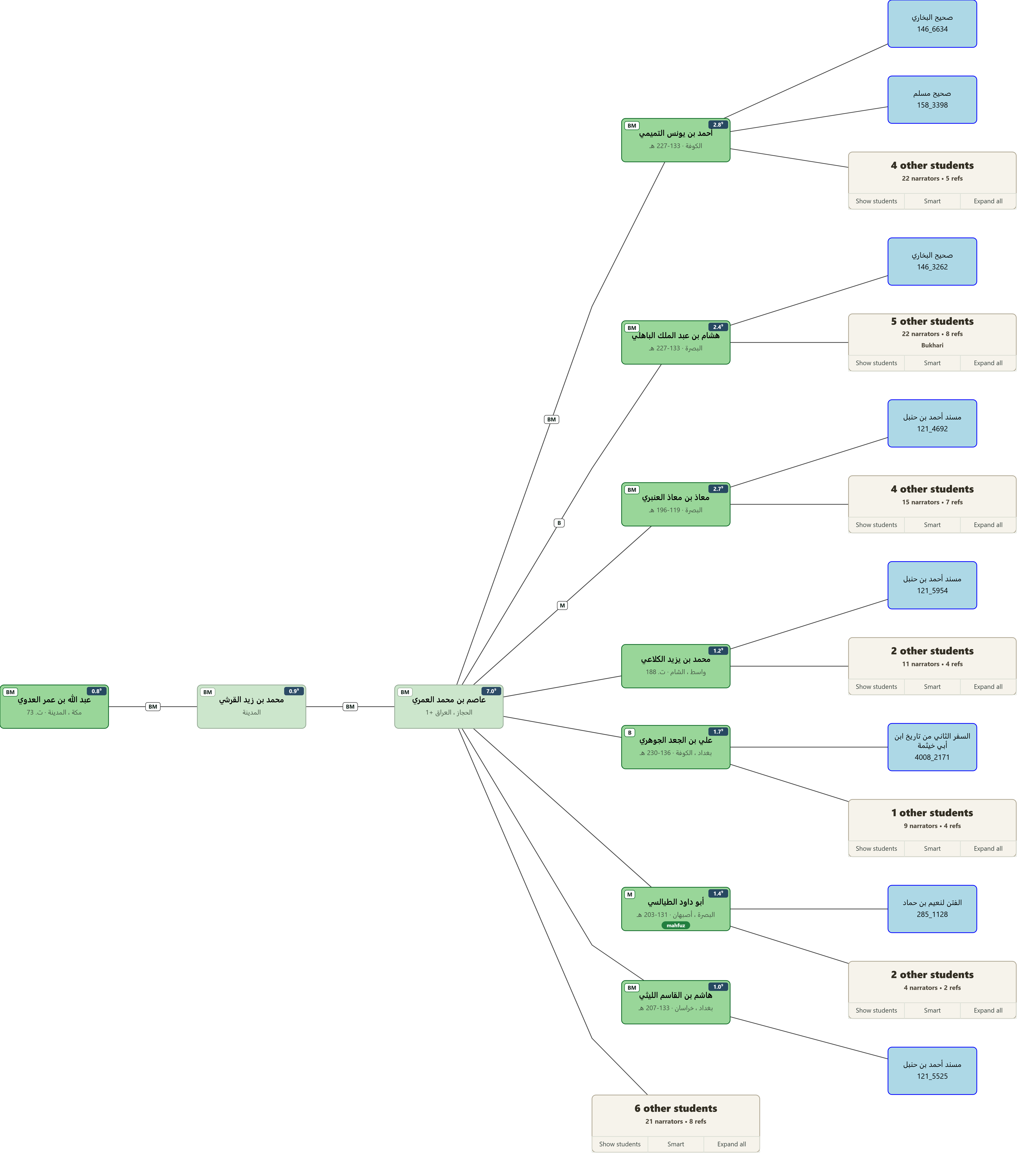
If someone claims the hadith is fabricated, he has no choice but to claim one of the following:
- The students of Aasim fabricated the hadith
- Aasim fabricated the hadith
- Muhammad ibn Zaid fabricated the hadith
- Abdullah ibn Umar (RA) fabricated the hadith
Did Aasim’s students fabricate the hadith?
The hypothesis that Aasim’s students could have fabricated the hadith is farfetched and clearly false. Too many students narrated the hadith from him, and most of them were established and reliable scholars from different cities.
Fabrication after Aasim would have required mass-collaboration between these numerous scholars without anyone discovering it, which is a ridiculous proposition.
We can be confident that Aasim narrated the hadith as reported.
Did Aasim fabricate the hadith?
Aasim’s Honesty
There are many ways to know Aasim was honest simply from his hadith corpus, without even relying on the judgement of the early hadith masters.
Firstly: Aasim narrated many hadith with chains to Ibn Umar (RA). He had a very short chain to Ibn Umar: Aasim from (his father) Muhammad from (his grandfather) Ibn Umar. That is the chain of this hadith about Quraish.
However, despite having access to this short chain, Aasim narrated many hadith from Ibn Umar (RA) through a variety of longer and more drawn-out chains.
Sometimes, Aasim narrated from his brother Zaid from Nafi from Ibn Umar. (Sahih Muslim) Sometimes, he narrated from his brother Umar from Salim from Ibn Umar (RA). (Musnad Ahmad)
Once, Aasim narrated from his brother Umar from Abdullah ibn Yasar (a lesser known narrator) from Salim from Ibn Umar. (Musnad Ahmad) These are three people between Aasim and Ibn Umar (RA) even though he had access to a chain with just one!
If Aasim were a dishonest narrator who fabricated hadith (and chains), he would not use these convoluted chains when he could easily use his extremely short chain.
Secondly: Even when narrating from his own father, Aasim sometimes narrated directly from his father and sometimes narrated through one of his brothers. This is not the hallmark of a dishonest narrator.
In several hadith, Aasim narrated from either Waqid or Umar or Zaid (his brothers) from (their father) Muhammad ibn Zaid from Ibn Umar (RA), instead of saying he heard it from his father directly.
In fact, in one hadith recorded in Sahih Bukhari, Aasim said, “I heard this hadith from my father but I didn’t memorize it so my brother Waqid reminded me of it”! (Sahih Bukhari)
Aasim was clearly an honest narrator. Dishonest narrators would not act as Aasim acted.
Aasim and the Umayyads
Keeping aside Aasim’s honesty and purely looking at motivations, Aasim’s life spanned from the end of the Umayyad period till the start of the Abbasid period. So, someone could argue he fabricated the hadith either in favor of the Umayyads or the Abbasids.
However, it is quite unlikely Aasim’s motive in this hadith was the Umayyads because he used to narrate this hadith long into the Abbasid period, as seen by which students got it from him (many of whom were born at the cusp of the Abbasid takeover).
If the hadith was specifically commissioned or influenced by the Umayyads, there would be no reason for Aasim to continue narrating it after their fall.
Additionally, in the Umayyad era, Aasim would have been young and without many students to teach the hadith to. So, it would have been strange for them to ask or commission Aasim to do it for them rather than someone more senior.
Another reason Aasim was unlikely to be pro-Umayyad is that he narrated a hadith from his father Muhammad from Ibn Umar (RA):
Some people asked Ibn Umar (RA), “When we enter upon our rulers, we say to them other than what we say about them when we leave (i.e. we praise them in front of them but acknowledge their evil when we’re not in front of them).”
Ibn Umar (RA) said, “We used to consider that hypocrisy.”
Sahih Bukhari
This hadith not only encourages criticizing rulers openly, but originates as an anti-Umayyad hadith as reported by other chains from Ibn Umar (RA).
The full report from another chain:
Ibn Umar (RA) saw some people coming from the gathering of (the Umayyad governor and Caliph) Marwan. He asked, “Where are you coming from?”
They said, “We are coming from the governor Marwan’s gathering.”
Ibn Umar (RA) asked them, “Did you speak every truth you know and encourage him to do it, and did you criticize every evil you saw and condemn him for doing it?”
They said, “No, by Allah, he said some things we considered wrong but we said, ‘You are right,’ then when we came out, we said, ‘May Allah curse him, how evil he is!'”
Abdullah ibn Umar (RA) said, “We used to consider this hypocrisy in the time of the Prophet (SAW).”
Musnad Ahmad
Someone might say: Aasim’s version does not contain the detail about the Umayyads, so why is this other version evidence?
I would say: Although Aasim’s hadith is shortened, it is still clearly about the Umayyads since anyone in the audience would have known the rulers that Ibn Umar (RA) used to criticize like that were the Umayyads. We will see more about this in the section about Ibn Umar (RA).
Aasim and the Abbasids
It is also quite unlikely that Aasim fabricated the hadith in favor of the Abbasids.
The Abbasids were very opposed to Umayyad figures, not least hated Umayyad figures like the second Umayyad Caliph, Yazid ibn Muawiyah.
However, Aasim ibn Muhammad narrated a report where his great grandfather Ibn Umar (RA) discouraged people from rebelling against Yazid:
Abdullah ibn Umar (RA) came to Abdullah ibn Mutee’, when the affair of Harrah (a rebellion against the Umayyads in Madinah) was happening in the time of Yazid ibn Muawiyah.
Ibn Mutee’ said, “Place a cushion for Abu Abd al-Rahman (Ibn Umar).”
Ibn Umar (RA) said, “I did not come to sit with you. I came to narrate to you a hadith I heard from the Prophet (SAW). I heard the Prophet (SAW) say, ‘Whoever removes his hand from obedience will meet Allah with no argument. Whoever dies without a pledge (when there is a united Caliph) dies an ignorant death.”
Sahih Muslim
There is some discussion about the exact authenticity of the above hadith to the Prophet (SAW), but there is no doubt Aasim ibn Muhammad narrated it.
If Aasim fabricated the hadith or was someone dishonest enough to fabricate hadith for the Abbasids, he would not also narrate a hadith like this discouraging rebellion against Yazid ibn Muawiyah.
Someone might say: This hadith about Yazid now implies Aasim was pro-Umayyad and was motivated to fabricate the hadith about Quraish for them.
The answer is: Beyond the fact that the hadith does not particularly paint Yazid in a positive light, we already showed why it is unlikely Aasim was pro-Umayyad. When you find someone you cannot decide whether he is in favor of X or whether he is against X, the obvious conclusion is that he was honest and was not in favor of anyone.
Aasim and Rulers
Aasim was not a person who liked rulers, and that is clear from his narrations.
We already mentioned before the narration encouraging open criticism of rulers.
Aasim also narrated a hadith with a chain to Abdullah ibn Masud (RA), that the Prophet (SAW) said, “There will be rulers after me who will say what they do not do, and they will do what they are not commanded. Whoever struggles against them with his hand is a believer. Whoever struggles against them with his tongue is a believer. Whoever struggles against them with his heart is a believer, and there is no faith lower than that.” (Musnad Ahmad and Sahih Ibn Hibban)
Aasim narrated this hadith, but there is a break in his chain to Ibn Masud (RA), so the hadith is not Sahih in itself.
However, it shows Aasim was not afraid to narrate hadith against rulers.
Someone might say: Aasim may not have been pro-Umayyad or pro-Abbasid but he was simply anti-rebellion. That is why he fabricated these hadith.
I would say: The above hadith which can be construed to be pro-rebellion “Whoever struggles against them with his hand is a believer” proves otherwise. Rather, it is clear Aasim was simply someone who was interested in political issues and he learned from different sources and honestly taught that information in classes, even when the narrations might ostensibly contradict (the hadith of Ibn Umar against rebellion vs. the above hadith of Ibn Masud).
Someone might say: Aasim was simply motivated by pro-Quraishi sentiment, because he was Quraishi.
I would say: Aasim and his family, despite being Quraishi, were not anywhere close to achieving power. It is meaningless to claim random pro-Quraishi sentiment motivated a person who by all accounts was honest into fabricating a hadith about the Prophet (SAW). What was the point? What was the end goal? There is no answer except that you don’t like the meaning of the hadith.
Anyway, this random pro-Quraishi sentiment cannot be attributed to either the Umayyads or the Abbasids since their major rivals were often also Quraishi. When this is the case, you are left with ad-hoc motives, far from the original claim that rulers influenced the fabrication of this hadith.
Did Muhammad ibn Zaid fabricate the hadith?
Muhammad ibn Zaid did not see the Abbasid period, so the only rulers he would have seen were the Umayyads.
There are many reasons to believe Muhammad ibn Zaid was generally anti-Umayyad.
Firstly, he narrated the hadith about criticizing rulers which originated as an anti-Umayyad hadith as noted before:
Some people asked Ibn Umar (RA), “When we enter upon our rulers, we say to them other than what we say about them when we leave (i.e. we praise them in front of them but acknowledge their evil when we’re not in front of them).”
Ibn Umar (RA) said, “We used to consider that hypocrisy.”
Sahih Bukhari
Secondly, he narrated pro-Ahl al-Bayt hadith from his father (Ibn Umar): Abu Bakr (RA) said, “Show respect to Muhammad (SAW) through his family.” (Sahih Bukhari)
Thirdly, Muhammad ibn Zaid witnessed Abdullah ibn al-Zubair and considered him a religious authority (as shown by him transmitting his mannerisms). It is also reported (here) that he witnessed the Umayyad attack against Makkah with catapults when it was under Ibn al-Zubair. It is unlikely then that he would have become positive enough about the Umayyads after that to fabricate hadith for them.
Fourthly, his grandfather whom he clearly respected (considering how much he narrated from him) was anti-Umayyad as shown in the next section.
Muhammad ibn Zaid also did not seek power for himself or his family such that he would fabricate the hadith in his own favor. He likely did not see rulership as a good thing to aspire to.
That is because he narrated the following:
Umar ibn al-Khattab included Abdullah ibn Umar (his son) in the shura council.
Someone came to him and said, “O Amir ul-Mumineen, make Abdullah ibn Umar your successor. He is a companion of the Prophet (SAW), one of the earliest muhajirun, and the son of the Amir ul-Mumineen.”
Umar (RA) said, “By Allah, you will stop this immediately! The family of Umar has had enough (with leadership). I wish it is neither for us nor against us.”
Fadhail by Ahmad
Did Abdullah ibn Umar fabricate the hadith?
Abdullah ibn Umar ibn al-Khattab (RA) was a devoted companion of the Prophet (SAW). Once the hadith is proven to him, a Sunni cannot have much doubt.
However, let us consider for the sake of argument: Did Ibn Umar (RA) fabricate the hadith?
Ibn Umar’s Sincerity
Ibn Umar (RA)’s devotion to the Sunnah of the Prophet (SAW) is widely known to the point it strains credulity to think he would intentionally lie about the Prophet (SAW).
Among the devoted acts reported from Ibn Umar (RA) is that whenever he traveled from Madinah to Makkah, he would stop at the exact stops the Prophet (SAW) stopped at and pray at the exact spots the Prophet (SAW) prayed it, even though that would obviously be inconvenient.
He also narrated an extremely detailed list of those stops and places as reported in Sahih Bukhari.
Ibn Umar (RA) was the Prophet (SAW)’s brother-in-law. His sister Hafsah was married to the Prophet (SAW).
When the Prophet (SAW) gently said, “Abdullah is a good man. If only he prays more at night.” After that Ibn Umar (RA) used to pray a lot at night until he passed away. (Sahih Bukhari and Muslim)
That is not the profile of a man who would be comfortable to lie about the Prophet (SAW).
Ibn Umar and the Umayyads
Ibn Umar (RA) was also hostile to the Umayyads as long as he lived.
He died critical of the Umayyads! Ibn Umar (RA) passed away only a few months after the Umayyad general Hajjaj conquered Makkah from Abdullah ibn al-Zubair (RA).
While Ibn Umar was performing Hajj at that time, a soldier accidentally pierced his foot with a spear. Hajjaj visited him and asked, “Who hurt you?” Ibn Umar said, “You are the one who hurt me. You carried weapons on a day they were not carried on before, and you brought weapons into the Haram even though weapons were not brought into the Haram before.” (Sahih Bukhari)
Ibn Umar (RA) was also extremely critical when the Umayyads killed Hussain (RA), the grandson of the Prophet (SAW), in the reign of Yazid.
Some people from Iraq asked Ibn Umar (RA) about what to do if a pilgrim kills a fly. Ibn Umar (RA) said: The people of Iraq ask about a fly after they killed the grandson of the Prophet (SAW). I heard the Prophet (SAW) say, ‘They are my two flowers in the world.'” (Sahih Bukhari)
Ibn Umar’s Ambitions
Ibn Umar (RA) was one of the best positioned to seek the Caliphate if he wished to do so. He was the son of the second Caliph, Umar ibn al-Khattab (RA), the brother-in-law of the Prophet (SAW), and a companion of the Prophet (SAW) who lived at a time most companions had passed away.
However, Ibn Umar (RA) never sought Caliphate for himself, and it is apparent he hated the idea. We already mentioned before the report that he forbade people from rebelling because of a hadith he heard from the Prophet (SAW).
People even asked him to seek this power:
Some people came to Ibn Umar (RA) during the civil war in the time of Ibn al-Zubair and asked him, “The people are fighting with each other, and you are the son of Umar, and the companion of the Prophet (SAW). What stops you from joining (and making a claim)?”
He said, “The fact that Allah forbade the blood of my brother stops me.”
They said, “Didn’t Allah say ⟪Fight against them until there is no more fitnah and the religion belongs to Allah⟫ (2:193)?”
Ibn Umar (RA) said, “We fought against fitnah (i.e. shirk) in the life of the Prophet (SAW) until the religion belonged to Allah alone. You all want to fight to cause more fitnah until the religion belongs to other than Allah.”
Sahih Bukhari
It is clear Ibn Umar (RA) did not seek power for himself and would not have fabricated a hadith for non-existent political ambitions.
The Magical Fabricator
We have seen that no one in the chain of this hadith is a likely candidate for having fabricated a hadith in favor of the Umayyads or the Abbasids.
Those who claim the hadith was fabricated depend on the ignorance of not having seen the chain. They decide the hadith must be false, then they imagine a magical fabricator to justify their assumption.
When you actually look at the chain and use basic logic, there is no room for a magical fabricator in the hadith.
The Quraishi Advocate
When no pro-dynasty motivation is available, hadith-rejecters are only left with claiming the fabricator was generally pro-Quraishi without affiliation to any particular dynasty. He simply opposed non-Arabs and non-Quraishi Arabs.
So, they might say: Aasim, Muhammad, and Ibn Umar were all from Quraish, so they must have been biased in favor of Quraish.
I would say: It does not seem any of them liked rulers or wanted leadership. So, to what end would they have specified leadership to Quraish?? Maybe if they were so biased for Quraish, they would have talked about knowledge or piety being with Quraish, but why leadership?
Ultimately, the Quraishi-advocate theory is a downgrade and a bait-and-switch from the original claim that the hadith was made under dynastic influence and is an ad-hominem attack on the narrators without evidence. Narrators being from Quraish does not prevent them from accurately transmitting information favoring Quraish as long as we know they are honest people.
By all accounts, Aasim, Muhammad, and Ibn Umar (RA) were honest and sincere people. No Muslim has the right to accuse them of lying about the Prophet (SAW), one of the greatest crimes anyone can commit, without evidence.
Does the hadith contradict the Quran?
At this point, the hadith denier has nothing left but to say: The hadith must be false because it contradicts the Quran. Even if there is no fabricator, someone in the chain must have forgot or said something incorrectly.
I would say: Was it Aasim who forgot, the one who was careful enough to say in a specific hadith “I did not memorize this hadith so my brother Waqid reminded me”? He forgot his carefulness in this one hadith? Or was it Muhammad ibn Zaid who forgot what he heard from his grandfather? Or was it Ibn Umar (RA) who forgot what he heard from the Prophet (SAW)?
A conclusion based on assumptions should be rejected based on assumptions.
Then, I would ask: What verse in the Quran does it contradict?
They might say: It contradicts Allah saying ⟪O mankind, indeed We have created you from male and female and made you peoples and tribes that you may know one another. Indeed, the most noble of you in the sight of Allah is the most righteous of you. Indeed, Allah is Knowing and Acquainted.⟫ (49:13)
I would say: Quraish being leaders does not contradict the fact that nobility in the sight of Allah is only based on righteousness. Leadership is not a pre-requisite of nobility, nor is the leader necessarily the most righteous of a group. Leadership is a responsibility and duty, not a prize or honor in itself. So, the argument is a non-sequitor.
Additionally, Allah says in the Quran ⟪Indeed, Allah chose Adam and Noah and the family of Abraham and the family of ‘Imran over the worlds⟫ (3:33) and ⟪O Children of Israel, remember My favor that I have bestowed upon you and that I preferred you over the worlds.⟫ (2:47) and ⟪And We gave to Him Isaac and Jacob and placed in his descendants prophethood and scripture.⟫ (29:27)
Allah chose Bani Israil for many generations with prophethood and scripture according to the Quran. If Allah can do that without contradicting the fact that mankind is equal in dignity regardless of tribe, it is even easier to imagine Allah choosing Quraish with leadership, since leadership is a much lower position than prophethood.
