Academia vs. Logic
Logic and Rationality refer to when someone uses a proper thinking process and evaluates evidence and arguments to reach a conclusion. In our view and as we have seen, hadith sciences are based on a logical procedure of evaluating whether narrations are likely to be from the Prophet (SAW).
Academia is something more specific. It can refer to two things: 1) The specific procedures of making arguments, writing papers, and reviewing them according to the methods of academia and the historical-critical method, and 2) The state of the field of what popular papers or scholars believe and what views on a subject are built upon and taught in academic contexts today.
The historical-critical method (HCM) refers to the investigative tools and arguments used by historians to study ancient texts. There are many aspects to the HCM which I will not delve into here, but it involves attempting to situate texts in their historical context while taking into account their motivations and intentions.
There are many foundational problems in the HCM, but one major problem is that it has a naturalistic bias. Meaning, the HCM by default rules out the possibility of the supernatural.
This procedural problem affects hadith because of the fact that many hadith describe supernatural events. As such, the procedure of academia will always be biased towards considering hadith as a whole inauthentic, because deeming the process of hadith scholars reliable would bring the field closer to accepting supernatural events.
However, much more bias comes from the state of the field, because popular views in academia, although moved or overturned by good arguments, still have a staying power and inertia, which means academia does not just represent the direct conclusions of logic and academic procedure but also the accumulated paradigms and perspectives of scholars who wrote influential works in the field.
In the case of Islamic sources and origins, several influential scholars in the 20th century were ultra-skeptical about both the Quran and Sunnah. Over time, the views of academia have softened and become less skeptical, but there is an inertia. For example, a few decades ago, it was a prominent view that the Quran may have been made in the time of the Umayyads, but now academia overwhelmingly accepts that the Quran was compiled in the khilafah of Uthman (RA), like what Muslim history reports.
So, both the procedure and state of academia impede their acceptance of hadith as authentic sources of knowledge.
Different Positions of Academia About Hadith
Some people in academia have even proposed doubting the attributions of books to their authors, like the attribution of the Muwatta to Imam Malik. This position has largely been abandoned even in academia, because of the numerous ways of proving the attribution of a text to its author. You may refer to this article which discusses this position and why even academics reject it.
To understand the other views in academia about hadith, you need to understand the idea of common links. Academics termed any narrator who was the locus of all the chains of a hadith the Common Link (CL).
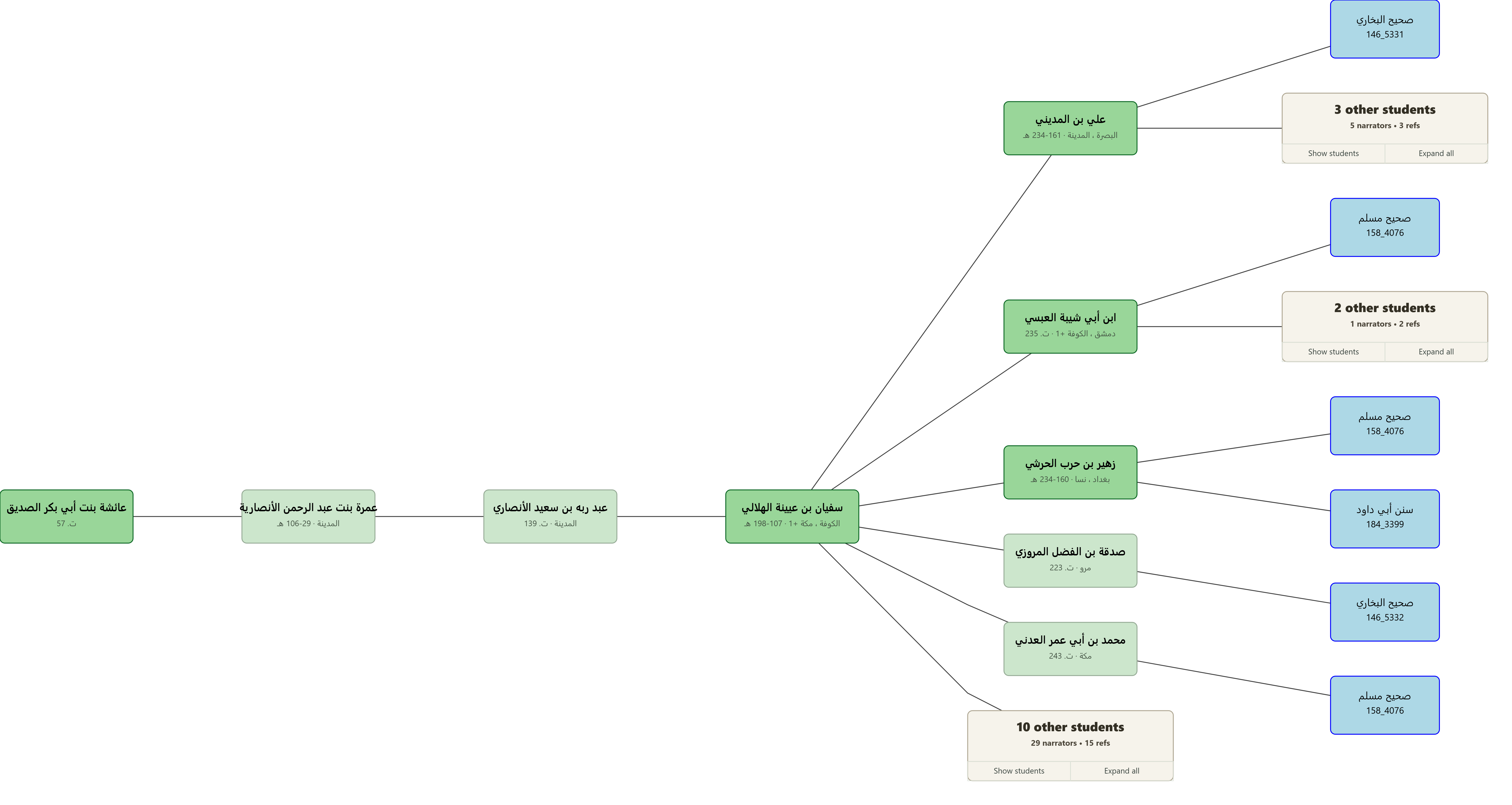
In the above hadith, Sufyan ibn Uyainah, a Makkan regional collector in the same generation as Imam Malik, would be termed the CL.
We already discussed how regional collectors like Zuhri and specialized teachers like Hisham ibn Urwah in the third and fourth generations could become the main source for a hadith because of them having better access to their teachers and disseminating hadith in large classes.
In this case, you can see Sufyan learned this hadith from this teacher and disseminated it to more than 10 students, which was then recorded in different hadith collections through different students.
A major opinion held in academia, advocated by prominent academics who studied hadith like Schact and Juynboll, is that CLs fabricated hadith, and that is why they were alone in transmitting a hadith.
They argue: If Abd Rabbih (Sufyan’s teacher) actually narrated this hadith, other students of his must have narrated it. In the same way, if Amrah or Aisha had narrated the hadith, other students must have transmitted it as well. The only reason Sufyan could be alone is if he fabricated it.
The answer is: The argument does not make sense once you understand the origin of hadith as we discussed before. The reason Sufyan is a CL is because he was a regional collector who learned from many teachers and taught hadith in classes. So, many students narrated the hadith from him. As for Abd Rabbih and Amrah and Aisha (RA), they did not have as many students nor did they teach hadith in classes. So, it is not surprising that a narration of theirs only got passed down through one student.
Another example of academics rejecting a hadith with this thought process is the hadith of Hisham ibn Urwah from Urwah from Aisha that she married the Prophet (SAW) when she was 9. Joshua Little theorized that Hisham fabricated this hadith because he was alone in transmitting it and mainly transmitted it to his Iraqi students.
As for us, we take into account the context of narrators to determine whether them being alone is justified, and we take into account the reliability of narrators to determine whether we should trust their narrations.
Urwah ibn al-Zubayr, despite being a prominent scholar of Madinah, had two main students who transmitted hadith from him: his son Hisham and the regional collector Zuhri. It is not at all surprising in this case that Hisham was alone in narrating the hadith from his father, and Hisham was a reliable student of his father.
Additionally, most of Hisham’s prominent students were Iraqi, so it is not very surprising that his Iraqi students were prominent in transmitting this hadith.
This is also putting aside the fact that there are indeed some narrations from Zuhri (the other student of Urwah) on this topic, which Little rejected for questionable reasons (which we will not go into here).
A more recent view, advocated by academics like Motzki, is that it is possible in some cases to trace hadith beyond CLs using a method called Isnad-cum-Matn Analysis.
Isnad-cum-Matn Analysis
Isnad-cum-Matn Analysis (ICMA) has gained prominence in academia today, and it is mainly done when one hadith has multiple strands and multiple CLs below the ultimate CL.
For example, consider the following simplified diagram for the hadith of Ibn Umar (RA) that the Prophet (SAW) forbade preventing women from going to masjid:
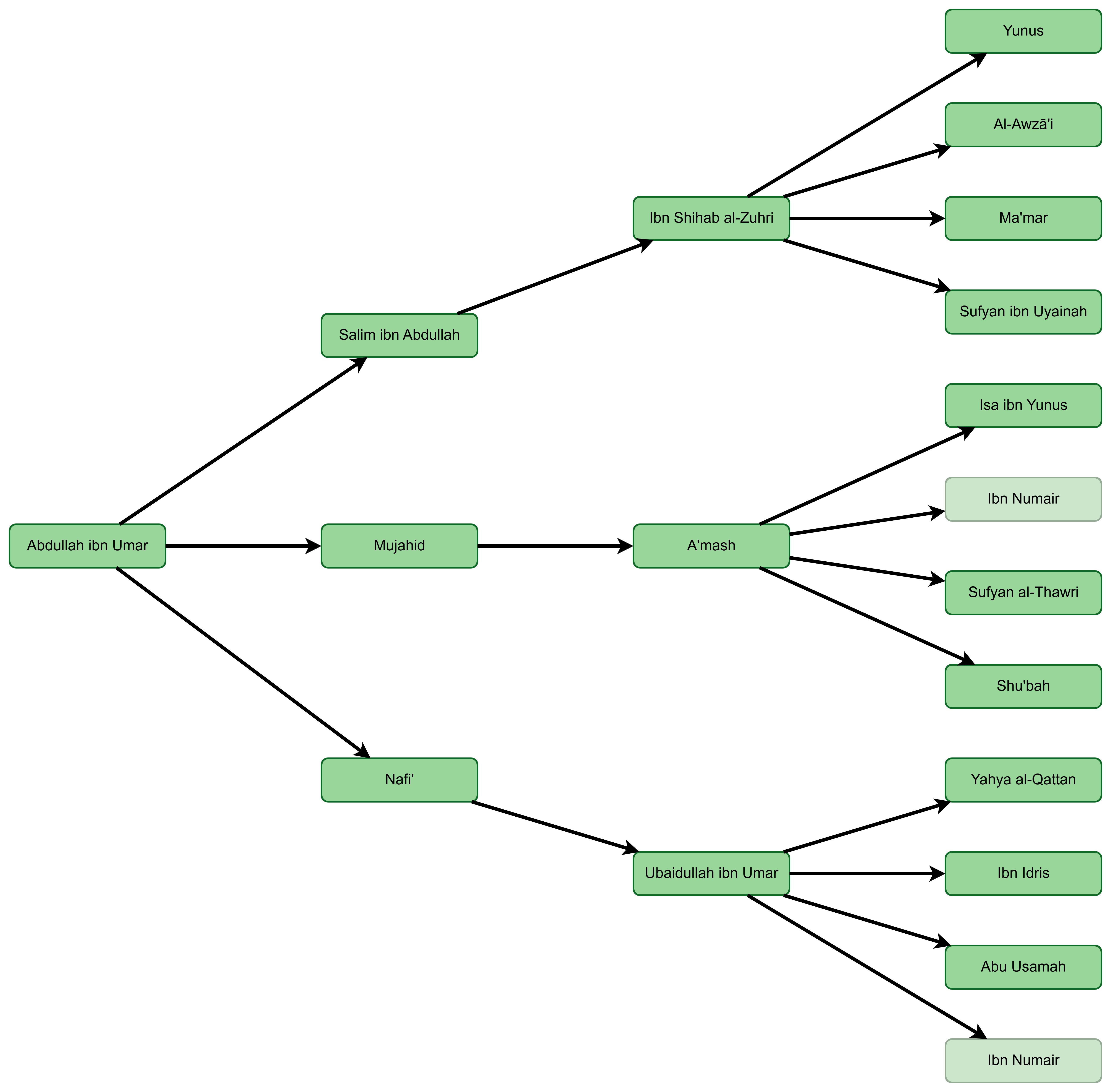
There are more chains for this hadith, but I am summarizing them for the example. In this hadith, Zuhri, A’mash, and Ubaidullah are CLs (also called partial common links or PCLs), but Abdullah ibn Umar is the ultimate CL. (Note: This is a simplified example, but ICMA practitioners often do not like tracing hadith back to Sahabah, so they generally do not agree with a companion being a CL.)
There are three steps to ICMA:
- Establishing the independence of the multiple strands and finding contamination
- Contamination is the idea that one of the narrators may have gotten all his report or parts of it from another person (not the one he claimed in his chain), perhaps one of the other PCLs
- Tracing back a core part of the matn to the ultimate CL.
One way they establish independence is by looking for unique aspects to the different strands of the hadith. These unique aspects can indicate, in their view, that the CLs did not get the hadith from each other.
In this hadith, Zuhri transmitted it, “If your wife asks your permission to go to the masjid, don’t prevent her.”
A’mash transmitted it, “Give your wives permission to go the masjid at night.”
Ubaidullah transmitted it, “Don’t prevent the female servants of Allah from the masjids of Allah.”
All of these transmissions have unique aspects not present in the others. Zuhri has the clause “If your wife asks your permission” which the others do not have. A’mash has the words “at night.” Ubaidullah has the phrase “female servants of Allah.”
This would be an example of how to establish independence using ICMA. The example is simplified and practitioners of ICMA may not agree on this particular hadith.
On the other hand, an ICMA practitioner can argue that the hadith is contaminated in one or more of the chains. Perhaps Zuhri got it from A’mash or vice versa. This argument is more often made if the content or wording of the hadith is too similar between the two transmitters or if they come from a common time and place.
As for Islamic hadith scholarship, although some of these methods might have merit to them, we have a more direct way of establishing independence: We know that Zuhri, A’mash, and Ubaidullah were all extremely honest and reliable scholars. So, we do not need to be skeptical of their chains or assume they got the narration from each other. We can trust what reliable narrators tell us about a hadith.
The second step to ICMA is tracing a core of the matn to the CL. In this case, the core of the matn all strands agree about is the aspect of allowing or not preventing women from going to the masjid. Practitioners of ICMA would only confidently trace back that agreed-upon matn to the CL. As for other parts of the hadith not common between the strands, they only confidently trace them back to their respective PCLs. Some on the skeptical side would call these parts of the hadith embellishments by those narrators.
As for us, we do not limit ourselves to only tracing back the agreed-upon part of the matn. We consider all the transmissions authentic because they were all transmitted by reliable narrators through reliable chains. We do not say the exact words of each transmission are accurate, but we say the meaning of all transmissions are Sahih (authentic).
So, A’mash’s transmission of “at night” would be authentic even if others did not transmit it. (In reality, others did transmit it, but I didn’t mention those chains in this simplified example.)
This is a simplified explanation of ICMA. The two steps have more sophisticated techniques academics can apply in different situations, including more aspects of the historical-critical method.
Biases of ICMA
Both steps of ICMA and their failure to take into account the reliability of narrators lead to biases in the conclusions ICMA can arrive at.
The first step, which is to establish independence (especially) using the unique qualities of the different strands, biases ICMA against those hadith that were transmitted exactly by multiple chains. So, ironically, this means ICMA can work better on hadith that had more problems in transmission so that the different strands have unique qualities.
The second step, tracing a core of the matn back to the CL, is more skeptical than rationally required. There is no reason to assume parts of a hadith only preserved by one strand are inauthentic, nor to assume two narrators matching closely in wording necessarily got it from each other.
In fact, this step of ICMA gives rise to another argument against the reliability of hadith: Situations like the example above where one strand preserves a piece of information that others do not or situations when the strands do not provide any convenient “core matn” are used by some practitioners of ICMA to argue that hadith are unreliable.
Some on the skeptical side of ICMA say: Only this part of the hadith is authentic while the others are inauthentic, thus proving that Muslim hadith science is unreliable.
The answer is: This argument is circular. It assumes that only the core matn matching between strands is authentic and the rest is inauthentic, then uses that assumption against hadith. It is only an assumption that we cannot trace back anything other than what matches between the chains.
If a teacher teaches something, it is unsurprising that one student remembers one aspect and another student remembers another aspect. It is also unsurprising that one student transmits it in one wording and another transmits it in another wording, as long as the meaning is preserved.
That is why our methodology evaluates the narrators and chains themselves to establish whether a hadith or part of it is authentic. It is not rational to evaluate hadith individually with the chains themselves without applying our wholistic knowledge about the reliability of narrators.
Grading of Narrators
The traditional methodology of grading narrators was an exercise of building networks from narrators in the hadith corpus.
First, they graded famous narrators, like Ibn Shihab al-Zuhri and Imam Malik, by looking at their reputation among their peers and students, their biographies and biases, and the consistency and reliability of their hadith as transmitted to different students. Based on this, they were able to build a reliability profile for these famous narrators. You can see an example of this process here: Ibn Shihab al-Zuhri: Reliable or Not? – Fussilat Blog
Then, they graded less famous narrators using several methods, including by investigating their biography and reports from their peers and students about them. They also established their accuracy by comparing them to known accurate narrators.
For example, students of Zuhri like Shuaib and Yunus were compared to known and established students like Imam Malik and Ma’mar (whose reliability in turn was determined with the first method). Since the narrations of Shuaib and Yunus closely matched Malik and Ma’mar, they were graded reliable themselves.
They graded a narrator unreliable if he tended to differ from reliable students or used to narrate hadith no one else narrated without being an established regional collector or specialized teacher.
The scholars of hadith also took into account nuances like when a narrator was reliable from one teacher but unreliable from another teacher. For example, Ma’mar was an established and reliable student of Zuhri (and this is clear when comparing his narrations to other students of Zuhri like Imam Malik), but was unreliable as a transmitter from A’mash (and this is clear when comparing his narrations to other students from A’mash). The reason for this was likely because he did not take proper notes or learn carefully when he learned from A’mash as compared to when he learned from Zuhri.
In this way, the scholars of hadith were able to create profiles for the narrators of hadith, and then they were able to use these profiles when making judgements on a specific hadith. If a reliable narrator narrated a hadith and it matched the conditions of Sahih, they were able to deem the hadith authentic.
Academia vs. Grading of Narrators
ICMA, in its current form, lacks the ability to evaluate hadith based on narrator reliability profiles. Instead, ICMA primarily relies on judging an individual hadith on its own terms.
There are many objections they give to traditional narrator grading, but we can consider some of them simplified.
Some of them say: You grade narrators reliable if they match other narrators. That is circular.
The answer is: It is not circular because there is an external way of grading famous narrators as mentioned and also because narrators matching each other is itself a data point that shows reliability. Two people speaking the truth tend to match each other while two liars tend to contrast with each other.
In fact, this is how natural human truth-finding works. For example, when considering news sources, you know there are some established channels that would not outright lie, like BBC or Al-Jazeera. Then, you would judge less well-known channels by how they compare and contrast with the most reliable channels. Through this process, you form a natural network of reliable news sources in your mind. The hadith scholars did the same natural process with narrators.
Some of them also say: Narrator grading is unreliable because scholars of narrator grading differ with each other often.
The answer is: The scholars of hadith differed about some narrators due to the difference of information that may have reached them, but they agreed about a large group of narrators. This is natural because there can be a patient about whom most doctors agree and there can be a patient whose symptoms are more complex and doctors differ about him.
Some of them also say: Narrator grading is unreliable because sometimes narrators who are deemed reliable are weakened in specific hadith or in specific circumstances
The answer is: This is a testament in reality to the precision of the science of hadith that they did not blindly accept every hadith of narrators deemed reliable. They took context and other chains into account when grading them. They also took into account the possibility that they lost precision in old age or were less reliable when narrating from specific teachers. The problem is people who like academia assuming that these decisions were arbitrary instead of the fact that they were clearly reasoned decisions.
For example, anyone today can see the difference between Ma’mar’s narrations from Zuhri and his narrations from A’mash and compare his narrations to other students of the respective teachers. It was not arbitrary that scholars of hadith deemed his hadith from A’mash unreliable.
There has been a recent trend in academia (like in the works of Schoeler) to consider some narrators like Zuhri honest and reliable, but this is in its early stages.
It is likely academia will never reach the level of hadith sciences in terms of evaluating narrators because of two reasons:
- Insistence to reinvent the wheel: Academics do not (or perhaps structurally cannot) rely on the judgements of the early scholars of hadith that studied narrators, like Imam Ahmad and others
- Loss of information: We do not have access today to a lot of information early scholars of hadith had access to, including original manuscripts, reports about people, and many more chains to compare to.
As for the first, it is aided by a structural problem in academia: the academic process requires publishing arguments in papers that can be reviewed by others. The early scholars of hadith who graded narrators, although they had reasons and arguments and often mentioned them, often did not mention their reasons. As such, academia is forced by its structure not to rely on their judgements.
Although this is how academia is structured, there is no rational justification not to rely on the judgement of experts when we have no reason not to. For example, if a doctor gives a man a prescription without explaining his full reasons and the man has no access to other doctors, the man would be rationally justified in trusting the prescription (and would indeed be foolish if he did not trust it).
The second reason exacerbates the first reason. When they refuse to take seriously the judgements of scholars of hadith like we do, the loss of information becomes a larger problem, because those judgements were based on that lost information.
And Allah knows best.
