Purpose of Hadith Collections
As discussed before, hadith collections by the generation of Bukhari and Muslim and after them were no longer collecting or compiling new hadith. They were rather arranging and classifying hadith.
The genre of Sahih aimed to collect Sahih hadith from the Prophet (SAW) arranged by topic.
The genre of Sunan aimed to collect useful hadith (whether Sahih or otherwise, but not outright fabricated) and arrange them by topic.
All these books have ways you can use them when verifying authenticity, but I will choose to discuss a few important ones.
Difference Between Judgements and Reality
In the following sections, we will discuss how to interpret the intentions of the writers of compilations, whether they judged a hadith to be Sahih or considered it weak or left it ambiguous without judging anything about it.
However, it is important to understand the difference between the judgement of those scholars and reality.
It is possible for example that Tirmidhi considered a hadith to be Hasan but another schholar considered it to be weak.
It is also possible Muslim considered a hadith to be Sahih but anoter scholar considered it Hasan or weak.
It is also possible, although much rarer due to the expertise and carefulness of Sahih Bukhari, that Bukhari considered a hadith to be Sahihh but another scholar deems it to be Hasan or weak.
So, recognizing the intention of a compiler does not mean everyone accepted the same judgement about a hadith. That being said, in the case of Bukhari and Muslim, there are an extremely small number of hadith where scholars disagreed with them, due to debates about the status of narrators or chains or defects.
Using Sahih Bukhari
Sahih Bukhari is the easiest to use if you can differentiate between fully connected narrations and muallaq (hanging) or disconnected narrations.
If the chain of a hadith in Bukhari starts with a word like حدثنا (“our teacher narrated to us”) and is a complete chain back to the companion of the Prophet (SAW), that hadith was considered Sahih by Imam Bukhari.
If the chain of a hadith in Bukhari starts like “XYZ said” or “From XYZ” without an explicit word indicating Bukhari’s teacher narrated it to him, this hadith is called muallaq. A muallaq hadith was neither claimed Sahih or weak by Bukhari. It was only used as supporting evidence for something.
For example, in Sahih Bukhari:
Yunus said: From Zuhri from Urwah from Aisha that the Prophet (SAW) said in the illness in which he died, “Aisha, I still feel the pain of the food I ate at Khaibar (a woman had given the Muslims a poisoned sheep to eat). Even at this time, I feel as if my aorta is being cut by the poison.”
Bukhari did not claim this hadith to be Sahih, and we know that because he did not start with حدثنا or any other explicit word of narration, but instead said “Yunus said.” Yunus was not even a teacher of Bukhari.
If there is an addition by a narrator after a hadith that does not have a fully connected chain, that is also not considered Sahih by Bukhari. He would only keep those additions sometimes for extra context or because that is how he received the hadith from his teachers.
An example of one such disconnected narration is the infamous story that the Prophet (SAW) became so distressed after revelation paused that he used to go to the top of mountains intending to throw himself off and Jibril would appear to stop him.
I wrote a more detailed article about this story: Hadith of Jumping Off of Mountains – Fussilat Blog
In summary, if a person can watch out for muallaq narrations and disconnected narrations or additions at the end of hadith, he can safely consider all the hadith of Sahih Bukhari as having been deemed Sahih by Bukhari.
Using Sunan Tirmidhi
Sunan Tirmidhi is the next easiest compilation to use because Tirmidhi graded most of the hadith in his book himself.
This grade is not always translated into English on many websites but it can be found in the Arabic. For example:
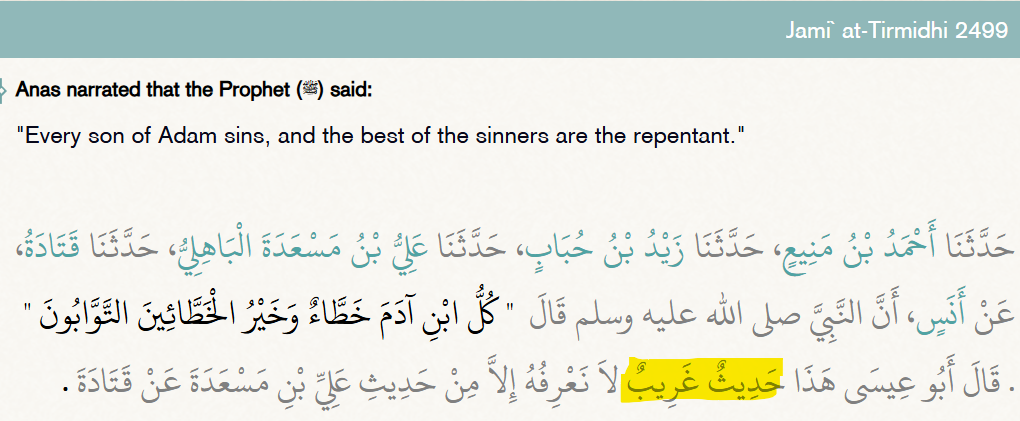
He classified hadith in his book into five categories:
- Hasan Sahih (or just Sahih)
- Hasan Sahih Ghareeb (or just Sahih Ghareeb)
- Hasan
- Hasan Ghareeb
- Ghareeb
There is much scholarly discussion on what Tirmidhi meant exactly with these categories, since Sunan Tirmidhi was written before the typical classification of hadith today into Sahih, Hasan, and weak properly solidified.
The following is the view I prefer and found accurate:
- Hasan Sahih (or just Sahih): Covers both Hasan and Sahih in our understanding today
- Hasan Sahih Ghareeb (or just Sahih Ghareeb): Hasan or Sahih, but slight weakness (due to uniqueness) compared to the first category
- Hasan: Weak but general message is supported by other sources
- Hasan Ghareeb: Even weaker than the above category
- Ghareeb: Extremely weak and unusable
It is important thus not to be confused and think just because Tirmidhi used the term Hasan to refer to a hadith that it is Hasan in our terminology.
Using Sahih Muslim
Sahih Muslim is more challenging than Sahih Bukhari and Sunan Tirmidhi because Muslim did not add comments or divide his hadith into connected and muallaq versions.
He also never divided his book into explicitly named sections/chapters. Later scholars divided his collection into sections, and those section titles are what are found on websites like Sunnah.com and other sources.
The methodology of Sahih Muslim is that he mentions a Sahih hadith then mentions many corroborating versions of that hadith. So, the narrations in Sahih Muslim can be divided into: 1) Primary, and 2) Supporting.
The primary narrations were claimed by Muslim to be Sahih. As for supporting narrations, he did not intend to deem their specific words Sahih, only what they support in the primary narration.
So, whenever you come across a hadith in Sahih Muslim, you must first determine whether it is primary or secondary. You can do this by checking previous narrations to see if it is a version of the same hadith. If so, the first narration on the topic is primary, and the later narrations are usually only meant for support.
For example, in Sahih Muslim:
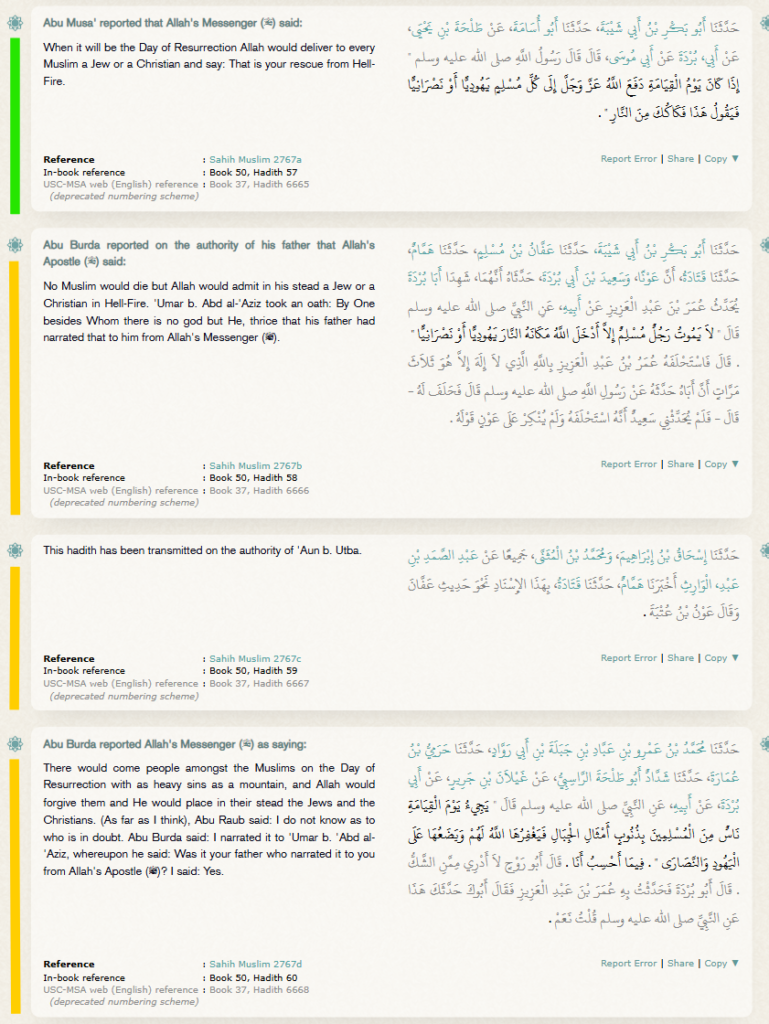
I marked above the primary narration with green and the supporting narration with yellow. The final supporting narration has very problematic words that even contradict the Quran ⟪No bearer of burdens will bear the burden of another⟫, so it is not Sahih in itself. It was only meant as support for the primary narration.
Determining whether a narration is primary or supporting requires close analysis and judgement and scholars can even disagree about it.
Using Sunan Abi Dawud, Nasai, and Ibn Majah
Sunan Abi Dawud and Nasai generally do not have very weak hadith. The quality of the hadith in Sunan Nasai is usually higher than the hadith in Sunan Abi Dawud.
Sunan Ibn Majah is the weakest of the major hadith collections and contains a lot of very weak hadith. If a hadith is only in Sunan Ibn Majah and not in the other books, that is grounds for suspicion.
