Introduction
Hijab is a common source of doubt and concern in the modern day. Non-Muslims often accuse hijab of being an oppressive or sexist obligation. In response, a few Muslims have attempted to argue that hijab is not actually obligatory in Islam but rather is a cultural practice.
So, this article will answer the question: Does Islam (or the Quran) say the hijab is obligatory, or is it just a cultural practice that people made part of Islam?
This article will not delve into other questions about hijab like why was hijab obligated, whether hijab is oppressive against women, or what exceptions allow women not to wear hijab. We will also not delve into discussions of whether covering the face is obligatory or not. Those questions have their answers in other places.
Rather, this article will only discuss how we know it is obligatory for a Muslim woman to wear a head-covering and to cover everything except her face and hands.
So, this article will be a demonstration of how laws are derived in Islam for a sincere believer looking for truth, not an article aimed at people who doubt Islam or the Quran. If you doubt the truth of Islam itself, then you should read Why should we believe in Islam?
How do we know laws in Islam?
Before determining whether hijab is obligatory, it is important to understand how Islamic laws are derived in the first place. Is there a methodology, or can scholars come up with any interpretation they want, or do scholars just follow traditions or culture, or is it a free-for-all?
There is a subject called Usul al-Fiqh (Methodology of Fiqh) which discusses how laws are derived in Islam.
There are two relevant topics within Usul al-Fiqh for this discussion:
- What are the sources of Islamic law?
- What are the principles of interpreting statements in the Quran or Sunnah?
There are four major sources of Islamic law relevant to our discussion:
- Quran
- The words of Allah taught to us by the Prophet of Allah (SAW)
- Sunnah of the Prophet (SAW)
- The Prophet (SAW)’s words and actions are sources of Islamic law because he was the guide sent for mankind and the best person who implemented the Quran.
- Allah says in the Quran ⟪There has certainly been for you in the Messenger of Allah an excellent example for anyone whose hope is in Allah and the Last Day and [who] remembers Allah often.⟫ (33:21)
- Allah says in the Quran ⟪And We revealed to you the message that you may make clear to the people what was sent down to them and that they might give thought.⟫ (16:44)
- Consensus of Muslim scholars
- The total agreement of Muslim scholars about a topic, especially the agreement of the companions or the early scholars, is evidence in Islam because Allah criticized anyone who opposes them as a whole.
- Allah says in the Quran ⟪And whoever opposes the Messenger after guidance has become clear to him and follows other than the way of the believers – We will give him what he has taken and drive him into Hell, and evil it is as a destination.⟫ (4:115)
- Allah also says ⟪You are the best nation produced [as an example] for mankind. You enjoin what is right and forbid what is wrong and believe in Allah.⟫ (3:110)
- Legal Analogy
- When one thing is analogous to another thing in terms of its legal purpose, we can extend the same ruling.
- For example, alcohol is prohibited for its intoxication, so weed and other drugs that intoxicate would receive the same prohibition.
After knowing the sources, you also need to know the principles that must be used when interpreting the sources. There are many principles, but four are relevant in this discussion:
- The words of Allah and the Messenger are interpreted according to the plain Arabic of their time.
- That is because Allah says he revealed the Quran in clear Arabic. (26:195)
- The default of a command is that we are obligated to obey it, until and unless there is evidence to prove otherwise.
- That is because Allah says ⟪Obey Allah and obey the Messenger⟫ (3:32)
- The default of general statements is that they cannot be specified, until and unless there is strong enough evidence to prove otherwise
- That is because the general statement is the direct word of Allah, and the words of Allah cannot be overturned without evidence from Allah.
- The default of specific words is that they cannot be generalized or overturned, until and unless there is strong evidence otherwise.
- That is because the specific words are the direct words of Allah, and the words of Allah cannot be overturned without evidence from Allah.
- The default of general verses is that they are not limited by their context, except if the words themselves are limited
- That is because the context only indicates the cause of legislation or revelation, not the cause of the command itself. There are ways of specifying a command to a cause that Allah can use, like saying “If this, then that.” But, if he keeps the command general, the words of Allah cannot be overturned by assumptions.
After knowing the three sources of law and these five principles of interpreting the sources, we have enough tools to understand whether hijab is obligatory in Islam.
Verses of the Quran
Because the Quran is the most clear source of Islamic law which no Muslim can have doubt in his or her mind about, we will center our discussion around how the Quran itself proves the obligation of hijab, while using the Sunnah and other sources supplementally.
There are two verses of the Quran on this topic.
Allah says ⟪And tell the believing women to reduce [some] of their vision and guard their private parts and not expose their adornment except that which [necessarily] appears of it and to wrap [a portion of] their khimars (i.e. head-coverings) over their chests and not expose their adornment except to their husbands, their fathers, [… etc.]. And let them not stamp their feet to make known what they conceal of their adornment. And turn to Allah in repentance, all of you, O believers, that you might succeed.⟫ (24:31)
Allah also says ⟪O Prophet, tell your wives and your daughters and the women of the believers to bring down over themselves [part] of their jilbabs (i.e. cloaks). That is more suitable that they will be known and not be abused. And ever is Allah Forgiving and Merciful.⟫ (33:59)
From a careful reading of these verses, there may be four questions:
- What does ⟪khimars⟫ mean? What does ⟪jilbabs⟫ mean? What is the difference?
- What does it mean when the Quran says ⟪and to wrap [a portion of] their khimars over their chests⟫? Is it only a command to cover the chest?
- What does it mean when the Quran says ⟪and not expose their adornment except what [necessarily] appears of it⟫? What does ⟪what [necessarily] appears of it⟫ mean?
- Is the command to wear jilbabs universal or contingent? Is it only when there is risk of abuse, because Allah says ⟪That is more suitable that they will be known and not be abused.⟫?
Meaning of Khimar and Jilbab
The first principle of Usul al-Fiqh we noted was that the Quran is interpreted according to plain Arabic from its time. The question becomes: How do we know Arabic of that time?
There are a few methods. Some major ones include: 1) Explanation of the Sahabah or early scholars, 2) Pre-Islamic and post-Islamic Arabic poetry, and 3) Arabic dictionaries.
Based on these methods, we can explain the meaning of khimar and jilbab.
Khimar means head-covering. This meaning of the word is attested in pre-Islamic Arabic poetry and post-Islamic dictionaries and explanations of the Quran. In fact, the word khimar is broad and can refer to both men’s and women’s head-coverings.
The word khamr (wine) also comes from the same root, and it is called so because it clouds a person’s head and covers his intellectual capacity.
As a result, the plain meaning of khimar as used in the Quran is “head-covering.” The verse means ⟪and to wrap their head-coverings [also] over their chests.⟫
See Lane’s Lexicon for more details.
The meaning of jilbab is a long, loose cloak worn over the clothes and over the khimar. It extends from the head down to the feet. This meaning is attested in pre-Islamic poetry and post-Islamic dictionaries and explanations of the Quran.
As a result, the plain meaning of jilbab as used in the Quran is “outer cloak.”
See Lane’s Lexicon for more details.
So, the khimar and jilbab are separate but related obligations. The khimar is the headcovering, while the jilbab is a loose cloak on top of the headcovering and the whole body.
Some people try to argue over the words khimar and jilbab to make them mean what they do not mean. However, the meaning of the words in the language of Arabic is quite difficult to deny, since the meanings of those words are attested in Arabic from before Islam and have consistently been understood in the same way after Islam.
Is the khimar obligatory or was it just customary?
Allah says ⟪And tell the believing women to reduce [some] of their vision and guard their private parts and not expose their adornment except that which [necessarily] appears thereof and to wrap [a portion of] their khimars over their chests and not expose their adornment except to their husbands, etc.⟫ (24:31)
Someone might say: I grant that the meaning of khimar is head-covering, however, is it not possible that the verse is only about covering the chest and Allah only mentioned khimars because it was customary among the Arabs of that time?
We can respond from the Quran itself, from the Sunnah, and from consensus.
From the Quran Itself
It is not possible from the words of the Quran, because of the fourth principle of interpreting Islamic law: Specific words cannot be generalized or overturned without evidence.
Since Allah obligates women to wrap specifically their khimars over their chests, the command cannot be generalized to mean any cloth covering the chest. The command is not fulfilled until a khimar itself is wrapped over the chest. Meaning, fulfilling this command requires a woman to wear a khimar.
If Allah wished to make it general, he would have made it general. Allah knew that not all cultures would have the culture of khimars, and He knew the Quran was for all time. He could have easily said ⟪Wrap some cloth over your chests⟫ or ⟪cover your chests⟫. However, he specifically said they need to wrap their khimars over their chests, and this forces us to believe wearing khimars itself is obligatory. Otherwise, Allah would not have specified it.
If someone wishes to generalize it, they must bring evidence from Allah, not just an assumption about cultures.
From the Sunnah
In addition to the argument from the Quran itself, we also have a hadith showing that this verse was understood to obligate wearing khimars when it was revealed.
Aisha (RA), the wife of the Prophet (SAW), said: When the verse ⟪and to wrap [a portion of] their khimars over their chests⟫ was revealed, women took their cloaks and tore off the corners to use as khimars. (Sahih Bukhari) Sahih Bukhari is the most authentic collection of hadith.
This report of Aisha (RA) proves that the verse was understood even when it was first revealed to be an obligation of wearing the khimar. So, women who did not wear the khimar consistently before the revelation of this verse started wearing it after the verse was revealed.
How do we know a hadith is true?
Someone might say: How can we know Aisha (RA) really said this? How can we trust Bukhari’s collection that was written 200 years after the Prophet (SAW)?
We can know Aisha (RA) said this because Ibrahim ibn Nafi’ narrated this from Hasan ibn Muslim from Safiyyah bint Shaibah from Aisha (RA).
All these narrators were reliable:
- Aisha (RA) (d. 57 AH): She was the wife of the Prophet Muhammad (SAW) and a major teacher who taught both men and women about the Prophet (SAW)’s Sunnah.
- Safiyyah (d. ~90 AH): She was a female student of Aisha (RA) who narrated several hadith from her.
- Hasan (d. 106 AH): He was a trusted Makkan scholar, and many hadith scholars who studied narrators considered him reliable in hadith.
- Ibrahim (d. 170 AH): He was a relative of his teacher in this hadith (Hasan), and Abd al-Rahman ibn Mahdi (one of the greatest hadith scholars of his generation) said, “He was one of the most reliable teachers of Makkah.”
Someone might say: How do we know Ibrahim ibn Nafi’ narrated the hadith with this chain? Can we just trust Bukhari?
This hadith is not just in Sahih Bukhari. Many students of Ibrahim ibn Nafi’ narrated the hadith, and it was recorded in several collections in addition to Sahih Bukhari, like Sunan Nasai, Sunan Bayhaqi, and Mustadrak al-Hakim.
This is how almost all hadith in Sahih Bukhari are. They are recorded by multiple chains and recorded in multiple books. All their narrators are reliable and learned from the one they narrated from.
Because of the expertise and close examination Bukhari used when writing his book, his Sahih became the most reliable book in Islam after the Quran.
There is also another supporting narration of this hadith, which is not as strong, but adds support to this already Sahih hadith:
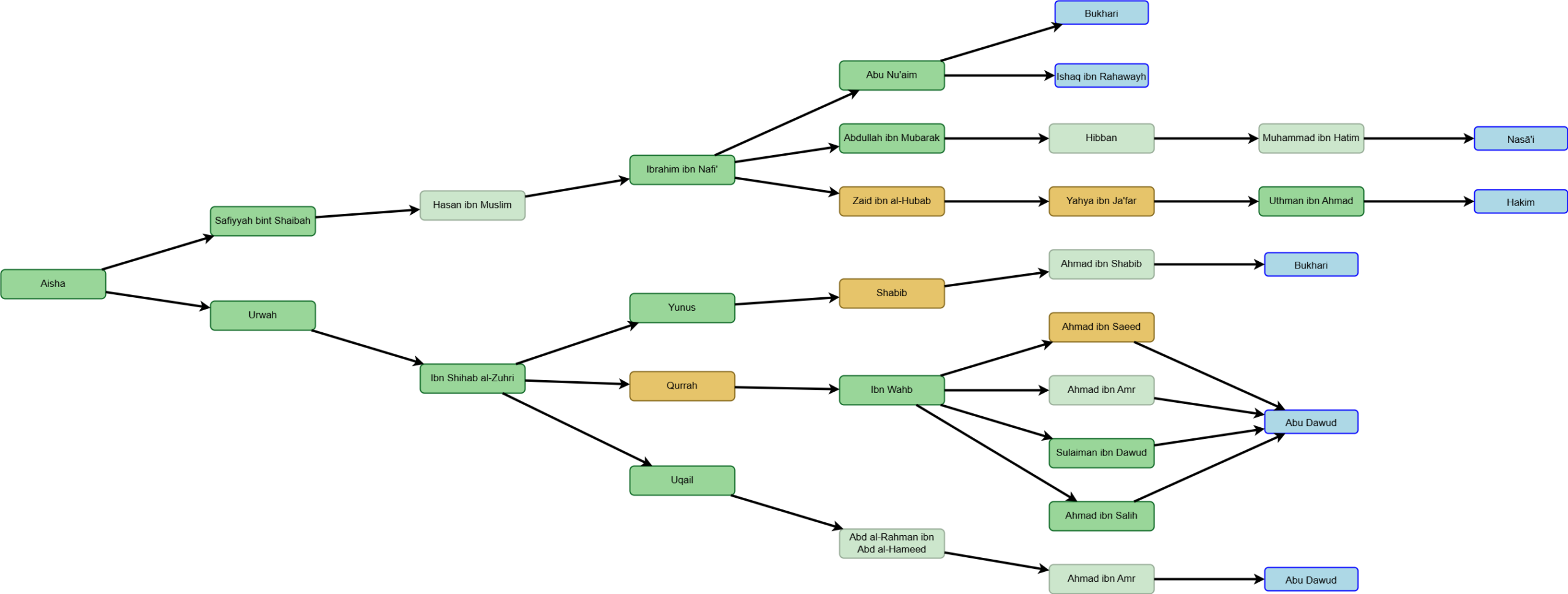
This hadith was transmitted by two women in the chain: Safiyyah bint Shaibah from Aisha (RA).
From Consensus
Muslim women have been wearing khimars to cover their hair since the time of the Prophet (SAW), generation by generation, until today. This reality cannot be denied by a person with open eyes.
Muslim scholars have also agreed since the time of the Prophet (SAW) till the modern day that women are obligated to wear khimars to cover their hair. No one challenged this clear understanding of the Quran and Sunnah until some people in the modern day.
Someone might say: How can we know this was the consensus of the scholars? What if some disagreed and we do not know about it?
The disagreements of early scholars are recorded in several books that collect disagreement, including the Musannaf of Abd al-Razzaq and Musannaf of Ibn Abi Shaibah. Ironically, there was disagreement over whether it is enough for a women to wear a jilbab that covers her head or whether she needs to wear a khimar under that too, but never any disagreement about the obligation of covering the head.
Islam also split into many different sects in the second and third generations. No early non-Sunni sect claimed khimar was not an obligation, let alone any reported disagreement from Sunni scholars.
How, in this case, can anyone doubt that there was consensus on this topic?
Allah says ⟪You are the best nation produced [as an example] for mankind. You enjoin what is right and forbid what is wrong and believe in Allah.⟫ (3:110)
How is it possible, then, that the truth was unknown and no one in this Muslim ummah taught it clearly until the modern day?
What does ⟪except what [necessarily] appears⟫ mean?
Allah says ⟪And tell the believing women to reduce [some] of their vision and guard their private parts and not expose their adornment except what [necessarily] appears.⟫ (24:31)
Someone might say: Is it possible for us to say that “except what necessarily appears” just means what is sexualized?
That is not possible, because that would be limiting something general to something specific without evidence (see principle 3). Allah was perfectly capable of specifying sexualized body parts. In fact, the verse starts out by already mentioning the private parts. This is an additional, more general command.
Additionally, the verse also says they should not expose their adornments ⟪except to their husbands, their fathers, their father-in-laws, their sons, their husbands’ sons, their brothers, their brothers’ sons, their sisters’ sons […]⟫ (24:31)
Who wishes to show their father-in-laws or step-sons or their brothers or their nephews sexualized parts of their body? The command of the Quran becomes incoherent in this interpretation. It is clear Allah is actually commanding people to cover a part of the body that is not necessarily sexualized but still must be covered in public i.e. the hair.
In that case, you may ask: How can we say that the hair is part of what is necessary?
The verse itself says the khimar must be worn.
Is it necessary for the hair to appear in itself? If the audience of the Quran wore khimars, then clearly not. Clearly, then, hair is very reasonable to cover and does not necessarily appear by any meaning of the word. If the audience of the Quran did not wear khimars, then the first part of the verse that mentions khimars obligates khimars!
So, either due to this part or that part, we are forced to believe that hair must be covered and the khimar must be worn.
Someone might say: Maybe the verse just means you can show what is normally shown in your culture, and you must hide what is normally sexualized or considered private in your culture?
Here, it is important to note that sometimes the rules of Islam can indeed be related to customs. However, in those cases, Allah mentions customs directly or references what people generally do.
For example, Allah says ⟪[Divorced] mothers may breastfeed their children two complete years for whoever wishes to complete the nursing [period]. Upon the father is the mothers’ provision and their clothing according to what is acceptable.⟫ The word “acceptable” here is in Arabic ma’roof. Ma’roof often refers to what is generally understood to be good in society.
So, Allah has ways He refers to customs in the Quran, when He wishes to refer to them.
In this verse, Allah does not say ⟪except what people show⟫ or ⟪except what is acceptable⟫ which would have been simple. He says ⟪except what appears i.e. necessarily⟫. He attributes the appearance to the part of the body itself, meaning that part of the body is in itself considered necessary to appear, not due to customs or society.
As a result, we cannot overturn Allah’s words based on assumptions or baseless theories about what he is referring to. His words are clear and we must act on them.
Someone might still say: What if the language in the verse was only limited to that time and the words of the verse are outdated?
The Quran is the speech of Allah sent as guidance until the Day of Judgement. The speech of Allah cannot be declared outdated by anyone other than Allah Himself.
Anyone who claims a verse of the Quran is outdated is required to bring his evidence from Allah. If there is no evidence, assumptions and conjectures cannot be used to overturn the words of Allah. Until there is evidence, we must obey Allah’s words as they are.
Someone might say: Aren’t there verses in the Quran about war and slavery that are outdated?
There is no verse in the Quran that is outdated. There is a difference between being contextual and being outdated.
Verses of war apply even today, and they apply to war whenever it happens.
Verses about slavery also apply today, and they apply to any slaves that exist. If slaves do not exist at this moment, they will apply to any slave that exists in the future.
So, the law of those verses never became outdated, even if we may not directly find a situation to apply them in the current situation.
Women still exist today, like women existed in the time of the Quran. So, women must wear the khimar as commanded by Allah. If women stop existing, only then will the verse stop applying in the moment.
Is the Jilbab obligatory?
Allah says in the Quran ⟪O Prophet, tell your wives and your daughters and the women of the believers to bring down over themselves [part] of their jilbabs. That is more suitable that they will be known and not be abused.⟫ (33:59)
The command here is general to ⟪the women of the believers⟫, and there is no direct limitation, so the command remains binding generally (See Principles 3 and 4) .
Someone might say: Since the verse says ⟪That is more suitable that they will be known and not be abused⟫, shouldn’t the obligation of jilbab be limited to when there is fear of harm?
Although the verse does say ⟪That is more suitable that they will be known and not be abused⟫, this is not phrased as a limitation. Allah does not say ⟪wear the jilbabs if you would be abused otherwise.⟫
For example, Allah says in the Quran that “Whoever is travelling or is sick during Ramadan can make up the fast on other days.” This verse clearly relates the law “making up fasts on other days” to its legal cause “travelling or being sick.” However, that is not the case in the verse of jilbabs.
An example like the jilbab is the prohibition of alcohol. Allah prohibits alcohol then says that alcohol causes argument and makes people forget the remembrance of Allah. Does this mean a person alone at home who has finished his prayers can drink alcohol? Of course not! That was only a wisdom for legislation, not a legal cause limiting the law.
In addition to this, the scholars of Islam have always understood this generally since the time of the Prophet (SAW) and his companions, which can be found in any of the works of tafsir explaining the Quran.
Several companions explicitly explained what jilbab women should wear. Some said they should even cover their faces. But, there is no report of anyone disagreeing or claiming that either the khimaar or the jilbab are not obligatory until the modern day.
Umm Atiyyah (RA), one of the companions of the Prophet (SAW), narrated: We were told to go to the Eid prayer. A woman asked the Prophet (SAW), “Messenger of Allah, what if one of us does not have a jilbab?” The Prophet (SAW) said, “Let her friend lend her a jilbab.” (Sahih Bukhari and Sahih Muslim)
This hadith is extremely authentic because it is in both Sahih Bukhari and Muslim.
If wearing the jilbab was culture, how would any of them lack it and why would they need to ask the Prophet (SAW) about it? Why would the Prophet (SAW)’s solution be to borrow a jilbab rather than just not wear it? It is clear the jilbab is obligatory in itself.
Someone may ask: How can we know Umm Atiyyah (RA) really said this about the Prophet (SAW)?
The answer is: This report was narrated from Umm Atiyyah by two students and was in turn narrated by many students from them. All of them were reliable and supported each other, so it would be extremely unreasonable to doubt.
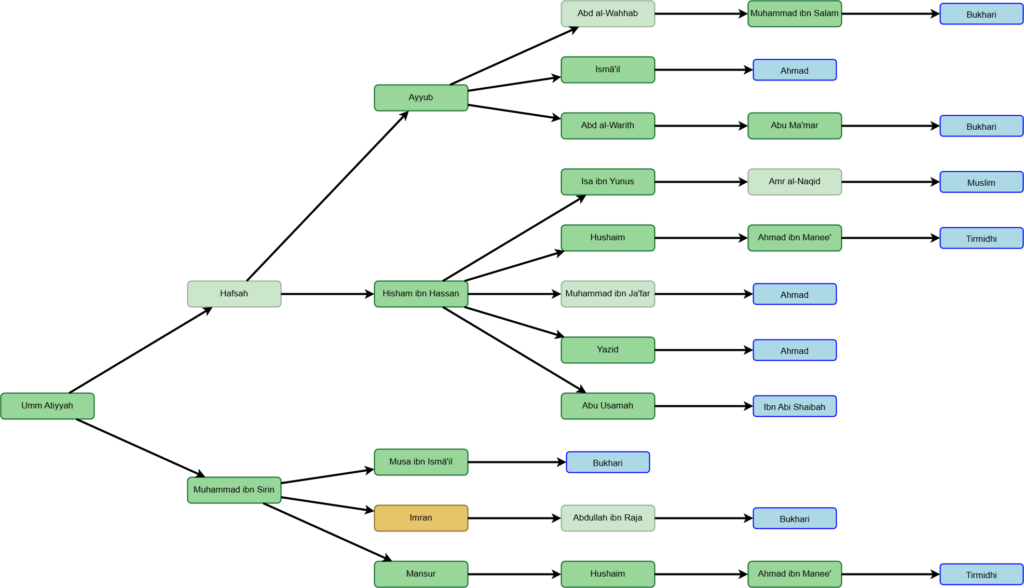
This was also a hadith transmitted by two women in the chain: Hafsah bint Sirin from Umm Atiyyah.
Other than this there are countless reports from the time of the Prophet (SAW) and the generations after of women wearing khimars and jilbabs and everyone considering it obligatory. No one disagreed about this topic until today.
Someone may ask: Would the specific type of outer cloaks the Arabs wore be obligatory for everyone?
The answer is: This is a place where you can use legal analogy. If another type of clothing covers the body in the same way, it can fulfill the same rule as the jilbab.
Notice how legal analogy can be used to extend the commands of the Quran to similar objects that function the same way but cannot be used to replace the command in the Quran or consider them outdated.
Conclusion
The laws of Islam are derived through proper sources using consistent principles. The laws of Islam cannot be derived from the opinions of men or from the opinions of women. Men and women can only do their best to use the proper sources and implement the correct principles to arrive at a conclusion.
Sometimes those conclusions are unclear, so people throughout history disagree about them. Other times, the conclusion is so clear everyone in history agrees about it until people in the modern day who feel like they can be loose with the words of Allah.
This article hopefully demonstrates how the obligation of hijab is clearly proven in the Quran and Islam when looking at them with proper principles and that this obligation was not invented by scholars because of any patriarchy or bias. Sound principles lead to believing in the obligation of hijab, if you follow them consistently.
To deny the obligation of hijab after knowing the evidence, you require one of three:
- Doubting the wisdom of Allah
- Maybe Allah used a cultural word that would no longer be applicable in the future
- Thinking the Quran is outdated in some way
- Maybe the specific laws of the Quran are just for their times, not for our times
- Believing specific words of the Quran should not be taken seriously
- Maybe the Quran is not directly the speech of Allah. Maybe just the general moral message is divinely inspired
These are the only ways to deny the obligation of hijab, and any sincere believer can see the obvious evil in those beliefs.
If Allah wanted, he could have only kept general moral lessons in the Quran. However, Allah chose to place these laws in the Quran as they are, and anyone who denies them denies Islam.
Allah says ⟪Do not fear the people but fear Me, and do not exchange My verses for a small price (i.e. small comfort in the world). And whoever does not judge by what Allah has revealed – then it is those who are the disbelievers..⟫ (5:44)
Allah says ⟪And who would be averse to the religion of Ibrahim except one who makes a fool of himself. And We had chosen him in this world, and indeed he, in the Hereafter, will be among the righteous.⟫ ⟪When his Lord said to him, “Submit”, he said “I have submitted [in Islam] to the Lord of the worlds.”⟫ (2:130-131)
Allah says ⟪Indeed, the Muslim (submitting) men and Muslim (submitting) women, the believing men and believing women, the obedient men and obedient women, the truthful men and truthful women, the patient men and patient women, the humble men and humble women, the charitable men and charitable women, the fasting men and fasting women, the men who guard their private parts and the women who do so, and the men who remember Allah often and the women who do so – for them Allah has prepared forgiveness and a great reward.⟫ (33:35)
And Allah knows best.
