Introduction
Bismillah.
I wrote an article before on the prohibition of music (Facing the Music: The Hadith of Instruments – Fussilat Blog), but I was not satisfied with the content after reading it again. So, after the suggestion of some of my friends, I decided to rewrite on the topic of music.
The greatest problem in the discussion of music is that, because the majority of scholars prohibit music, the people who follow the majority view are lax and rely on weak arguments to establish their point. They think they are secure in the fact that the majority is with them.
However, true discussion and convincing can only happen when you provide people with the most reasoned arguments for your position, not using weak arguments out of a sense of security.
Another great problem is that most people who talk about this topic do not have a deep understanding of the science of hadith. As a result, many who prohibit music use weak and baseless hadith in their discussions, and many who permit music refer to weak arguments they heard against the ahadith about music without knowing the merits of those arguments.
I will endeavor in this article to be honest and clear regarding the authenticity of hadith and arguments about them, and In sha Allah, good always comes from thoroughness and honesty.
The purpose of this article is to analyze the evidence showing music is prohibited, not to explain every hadith mentioned here or analyze the scholarly views on the topic. For example, I will not mention the complete evidence for permitting music for Eid and weddings or what different scholars said about it.
Hadith of Abu Bakr (RA)
Authenticity of the Hadith
Urwah ibn al-Zubair narrated from Aisha (RA): Abu Bakr (RA) entered the house of Aisha (RA) and the Prophet (SAW) on the day of Eid and two girls were singing and hitting the daff. Abu Bakr (RA) said, “The instruments of Shaitan in the Prophet’s house??” The Prophet (SAW) said, “Leave them Abu Bakr, because every nation has an Eid and today is our Eid.” (Sahih Bukhari and Muslim)
Three students of Urwah narrated this hadith from him: Ibn Shihab al-Zuhri, Hisham ibn Urwah, and Muhammad ibn Abd al-Rahman.

There are three aspects of this narration that are important to observe: 1) The information that the girls were playing the daff, 2) Abu Bakr (RA) saying, “the instruments of Shaitan,” and 3) The Prophet (SAW) saying, “Leave them because it is Eid.”
The transmission of Ibn Shihab al-Zuhri mentions the girls singing and beating the daff and says Abu Bakr (RA) “criticized them.” Then, the Prophet (SAW) said, “Leave them, because these are the days of Eid.” (Sahih Bukhari and Muslim)
The transmission of Hisham ibn Urwah mentions the girls singing and Abu Bakr (RA) saying, “the instruments of Shaitan?!” A few students mention the daff explicitly, but it is only implied in most of them by Abu Bakr (RA)’s statement. Then, the Prophet (SAW) said, “Leave them, because every nation has an Eid, and today is our Eid.” (Sahih Bukhari and Muslim)
Hisham and Zuhri were the most prominent and reliable students of Urwah, but this narration also comes from a third student.
The transmission of Muhammad ibn Abd al-Rahman mentions only the girls singing but notes Abu Bakr (RA) saying, “The instruments of Shaitan near the Messenger of Allah?” So, the daff is implied by Abu Bakr (RA)’s statement. Then, the Prophet (SAW) said, “Leave them.” (Sahih Bukhari and Muslim)
Meaning of the Hadith
The hadith’s indication that musical instruments are haram depends on two premises.
Firstly, Abu Bakr (RA) called the daff an instrument of Shaitan, and this would not be reasonable unless he thought using the daff was prohibited or sinful behavior.
Secondly, the Prophet (SAW) did not correct this conception of his. The Prophet (SAW) only gave an exception for Eid. If the Prophet (SAW) believed the daff or musical instruments to be generally permissible and not sinful, it would be necessary for him to correct this general understanding of Abu Bakr instead of giving an exception for Eid.
Those who disagree have to respond to one of these two points.
Some of them say: Abu Bakr (RA) calling them instruments of Shaitan could refer to karahah.
I say: It is a stretch to say you can attribute something makruh to Shaitan.
Some people say: The Prophet (SAW) giving an exception for Eid itself refutes Abu Bakr (RA)’s statement that the instruments are from Shaitan. So, the assumption that the Prophet (SAW) did not correct his conception is wrong.
I say: The Prophet (SAW) saying, “Every nation has an Eid, and today is our Eid,” is clearly not a general repudiation of Abu Bakr (RA)’s statement. It is meant to establish an exception for Eid.
They might say: How can something that belongs to Shaitan be allowed on some occasions? The very fact that the Prophet allowed it on Eid means Abu Bakr (RA)’s statement was wrong.
I say: Allah calls wine and gambling ⟪defilement from the work of Satan⟫ (5:90) but also says ⟪In them is great sin and [yet, some] benefit for people. But their sin is greater than their benefit.⟫ (2:219) So, it is possible for something that is sinful and defilement from Shaitan (i.e. haram) to have some benefit. As for wine, Allah made no exceptions for it despite its benefit. As for music, Allah decided to make an exception for Eid and marriage due to its benefit on those occasions.
Hadith of Abu Malik
Authenticity of the Hadith
Abu Malik al-Ash’ari (RA) narrated: The Prophet (SAW) said, “There will be groups in my Ummah who will legalize hirr (or khazz), silk, musical instruments, and wine […] Allah will destroy them at night and let mountains fall on them and turn some of them into monkeys and pigs until the Day of Judgement.” (Sahih Bukhari)
In another version: “People from my Ummah will drink wine, calling it by another name, and musical instruments will be played over their heads and (female) singers will sing. Allah will make the earth swallow them and turn some of them into monkeys and pigs.”
The hadith of Abu Malik al-Ash’ari has two major routes that converge at Abd al-Rahman ibn Ghanam:

A third supporting route is Ibrahim ibn Abd al-Hamid narrating from someone who informed him from Abd al-Rahman ibn Ghanam from Abu Malik al-Ash’ari.
Abd al-Rahman ibn Ghanam (d. 78 AH) was a very early Muslim. He was so early that scholars of hadith differed whether he counted as a companion or not. Many Egyptian hadith scholars like Layth ibn Saad, Yahya ibn Bukair, and Ibn Lahee’ah said he was a companion. Abu Hatim al-Razi denied that he was a companion. Imam Ahmad had a middle position and said he saw the Prophet but did not hear anything from him.
Either way, Abd al-Rahman ibn Ghanam was at least a very senior tabi’i and he was known to be pious.
Authenticity of the Malik ibn Abi Maryam Route
The first route is the route of Muawiyah ibn Salih (d. 158 AH) from Hatim ibn Huraith from Malik ibn Abi Maryam.
Muawiyah ibn Salih was a known, honest scholar that made many mistakes. So, he was of the level whose hadith are taken for corroboration and support. Abu Hatim al-Razi said, “Salih ul-Hadith (ok in hadith). His hadith are written but not used as [independent] evidence.”
Hatim ibn Huraith was an honest Syrian scholar but not well-known for hadith. Abu Hatim al-Razi said about him, “Shaykh.”
Malik ibn Abi Maryam was unknown, since he only narrated this one hadith. Unknown narrators can be used for support.
Authenticity of the Atiyyah ibn Qais Route
The second route is the route of Ibn Yazid (d. 153 AH) from Atiyyah ibn Qais.
As for Abd al-Rahman ibn Yazid himself, Bukhari and Muslim included him in their Sahihayn, so he was a reliable narrator. Abd al-Rahman ibn Mahdi used to say, “If you hear a Syrian mention Awzai or Saeed ibn Abd al-Aziz or Abd al-Rahman ibn Yazid, your heart can be at rest.” Abu Hatim said, “Saduq (honest), no problem with him.”
As for Atiyyah ibn Qais, he was an honest narrator with several hadith. Bukhari only included this hadith of music from him. Muslim included several ahadith from him, often for support and corroboration. Abu Hatim al-Razi said, “Salih ul-Hadith (ok in hadith).”
Atiyyah ibn Qais was not the highest quality of narrator, but he was at least to the level of hasan or at least to the level of using him for support and corroboration.
Some people say: This route is weak because Hisham ibn Ammar was alone in narrating it.
I say: Hisham ibn Ammar was reliable, and he was not alone in narrating this hadith. The hadith is attested also from Bishr ibn Bakr from Ibn Yazid.
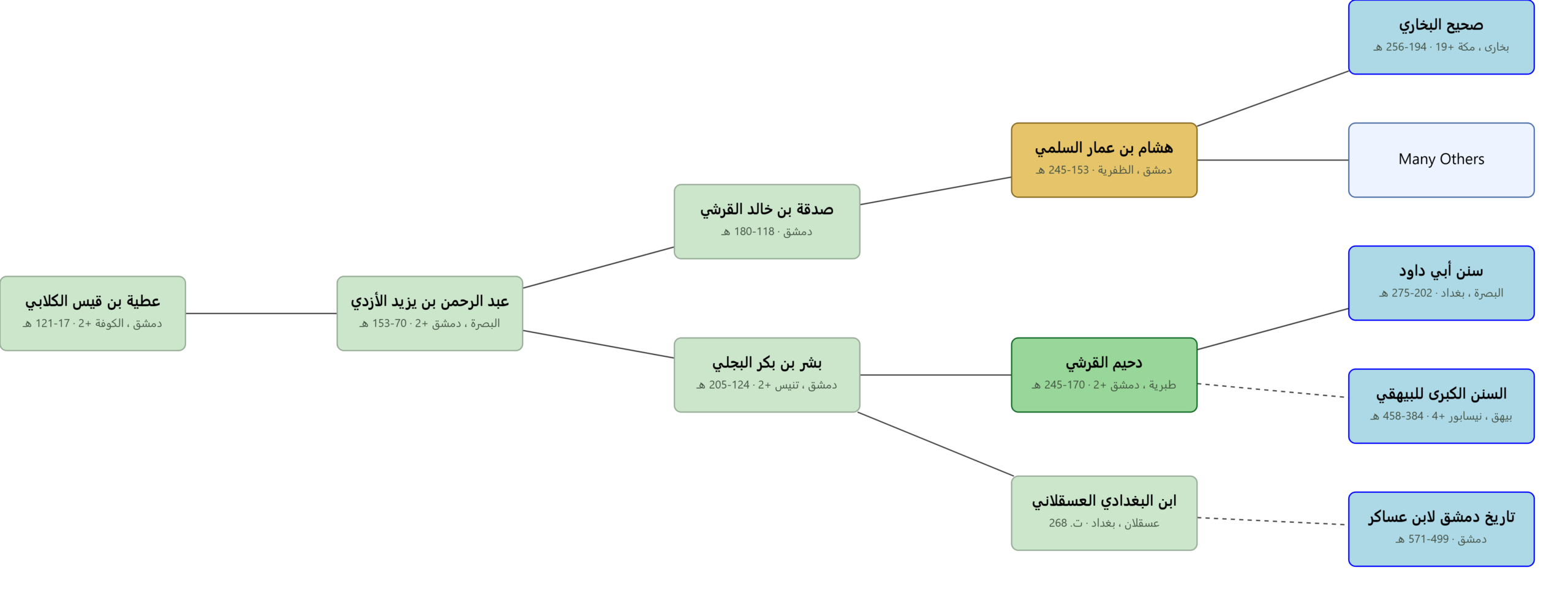
Note: Abu Dawud’s version is summarized and thus does not explicitly name musical instruments. He focused on a part of the hadith he was interested in and said, “He mentioned other things” to skip over the rest.
Support of the Ibrahim ibn Abd ul-Hamid Route
Bukhari reports in his Tarikh that: Ibrahim ibn Abd al-Hamid narrated from “someone who informed him” from Abd al-Rahman ibn Ghanam from Abu Malik al-Ash’ari or Abu Amir about wine and musical instruments.
Since the route of Malik does not mention doubt about the companion and the route of Atiyyah mentions doubt between Abu Malik and Abu Amir, that indicates Ibrahim is derivative of the Atiyyah route.
It is possible he learned the hadith from Atiyyah ibn Qais or Abd al-Rahman ibn Yazid, so he provides further support for their narrations. Ibrahim was the same generation as Abd al-Rahman, so Atiyyah is arguably more likely to be his teacher.
Authenticity of Overall Hadith
Of the two routes of the hadith to Abd al-Rahman ibn Ghanam, the route of Atiyyah is to the level of Hasan or corroboration and the route of Malik is to the level of corroboration (even if weak).
When these two chains are used to strengthen each other, they raise the hadith to the standard of Sahih li-Ghayrihi or at least strong Hasan.
Notes on the authenticity:
- The route of Atiyyah ibn Qais contains doubt about the companion. The chain says “Abu Malik or Abu Amir al-Ash’ari.” Bukhari however notes in his Tarikh that this doubt can be resolved with the route of Malik which specifies Abu Malik al-Ash’ari
Someone may ask: If you say the hadith is Sahih li-Ghayrihi, why would Bukhari keep the hadith muallaq in his Sahih? Doesn’t that imply he thought the hadith was weak?
I say: If Bukhari thought the hadith was weak, he would not have narrated the complete hadith in his Sahih, from the beginning of the chain to the end of the chain, from the beginning of the matn to the end of the matn. Clearly, Bukhari thought the hadith was valuable, perhaps at least to the level of Hasan.
As for why Bukhari kept it muallaq, there are several reasons why this hadith, even if ultimately maqbul (accepted) and binding, may not have met the high standards of Sahih Bukhari:
- There is doubt about the companion and Bukhari generally avoided hadith with doubts about the companion. This is the case even if ultimately he himself said the doubt can be resolved. He said in his Tarikh that the hadith can be resolved to come from Abu Malik (RA) rather than Abu Amir.
- Bukhari generally avoided hadith of the standard of Sahih li-Ghayrihi when the corroborating chains met at the level of the companion or similarly high. In this case, the corroborating chains meet at Abd al-Rahman ibn Ghanam, who was of a similar generation as the companions.
- Bukhari avoided hadith from narrators that did not reach his high standard. In this hadith, even if we may be able to conclude it is Sahih wholistically, neither of the two chains is limited to narrators that meet the standard of Sahih Bukhari.
All these reasons may have combined to incentivize Bukhari to keep this hadith muallaq despite him knowing the hadith is valuable (and thus quoting it fully in his Sahih).
Someone may say: There are many versions of the hadith which do not mention musical instruments and only mention wine, like the version of the hadith in Musnad Ahmad and Sunan Abi Dawud, so this addition of musical instruments is mudhtarib (conflicted) and cannot be binding evidence.
I say: This is what I heard from Shaykh Akram Nadwi about this hadith. However, a fair analysis of the two routes of the hadith, respectively meeting at Muawiyah ibn Salih and Ibn Yazid, cannot but conclude that musical instruments were part of both versions of the hadith and thus authentically trace back to Abd al-Rahman ibn Ghanam.
For example, Imam Ahmad’s transmission in the Musnad is from Zaid ibn Hubab from Muawiyah and is shortened and does not mention musical instruments. However, Ibn Abi Shaibah transmits from Zaid ibn Hubab in his Musannaf the full version with musical instruments! Numerous other transmitters transmit the same from Muawiyah ibn Salih. So, it is not justified to doubt the existence of this part of the hadith.
The same applies to the transmission of Ibn Yazid. Abu Dawud transmitted a version from Bishr from Ibn Yazid, explicitly saying that he summarized the hadith (and thus without musical instruments mentioned). But, we have transmissions in Sunan Bayhaqi and Tarikh Dimashq through Bishr from Ibn Yazid mentioning the full hadith with musical instruments. This is in addition to the transmission of Hisham ibn Ammar, attested by numerous students, from Sadaqah from Ibn Yazid with the inclusion of musical instruments in the hadith.
So, it is not justified to reject the existence of musical instruments in either of the two transmissions of the hadith even if some versions may have summarized the long hadith to focus on one aspect of it.
Someone might say: If you say the hadith is authentic to Abd al-Rahman ibn Ghanam, why are both chains so solitary?
I would say: The nature of Syrian hadith is that they tend to be solitary, because Syria was not a hub of hadith scholarship. Abd al-Rahman ibn Ghanam was not a habitual hadith narrator, so it is not surprising a hadith from him has only two recorded transmitters.
Then, as for the Malik route, until we get to Muawiyah ibn Salih, none of the narrators were known, prolific teachers. So, it is completely reasonable that the route is solitary until Muawiyah. Muawiyah was a prolific teacher, and he transmitted the hadith to many students.
As for the Atiyyah route, it is unsurprising the chains are solitary until Ibn Yazid, since Atiyyah was not a prolific teacher. Sahih Muslim contains two hadith by Atiyyah (used as corroboration and support), both hadith only having one transmitter from Atiyyah.
When these two routes corroborate each other on narrating the hadith about musical instruments from Abd al-Rahman ibn Ghanam from Abu Malik, that makes us confident in the authenticity of the hadith to Ibn Ghanam.
My friend asked me: Why are the chains even solitary to Ibn Yazid, since only two students (Sadaqah and Bishr) narrated it from him, and only Hisham ibn Ammar narrated from Sadaqah and only two chains narrated it from Bishr?
I said: The aforementioned nature of Syrian hadith scholarship meant that even great scholars like Ibn Yazid tended to have only few students transmitting their hadith. Of the 4 hadith of Ibn Yazid in Sahih Bukhari, one of them has only 2 students transmit it from him (one Sahih chain and one Hasan chain) and another of them has only 3 students transmit it from him. Of the 8 hadith of Ibn Yazid in Sahih Muslim, one only has 1 student transmit it, one only has 2 students transmit it, and two only have 3 students transmit it.
You also often see that chains to the students of Ibn Yazid are relatively solitary themselves.
Furthermore, Hisham ibn Ammar was the main source of Sadaqah’s hadith in the major hadith collections. Many students of Hisham transmitted the hadith from him because he was a prolific teacher. So, it is not surprising the route of Sadaqah comes from him alone.
The two transmissions from Bishr are also reliable and can be found in Tarikh Dimashq and Sunan Bayhaqi, in addition to the summarized version of Sunan Abi Dawud.
So, the hadith is not unreasonably ghareeb or solitary.
Support for the Hadith
The converging narrator, Abd al-Rahman ibn Ghanam, died around the year 78 AH and lived in Syria. So, we must look for support that is similar in time or from another region.
The part of the hadith that says people will drink wine calling it by another name has support from several companions.
The strongest is the Syrian narration of Abd al-Rahman ibn Muhayriz (d. 99 AH) that he heard from several companions that the Prophet (SAW) said, “A group of my Ummah will drink wine calling it by another name.” (Tayalisi)
Abd al-Rahman was reliable and a narrator of the Sahihayn. All other shawahid for this hadith are weak and questionable in authenticity and do not compare to the hadith of Abu Malik.
Some people say: The fact that this part of the hadith is supported by shawahid is proof that this is the authentic part of the hadith and the other parts are mistaken.
I say: There is no logic to this argument for two reasons. Firstly, all shawahid of this hadith are weak and questionable, so they cannot be used to negate any aspect of this hadith which is stronger than all of them.
Secondly, different companions narrating different parts of the Prophet (SAW)’s statements is not strange or unique. The narration of Ibn Muhayriz strongly implies that he asked different companions whether they heard a specific statement from the Prophet (SAW), and they confirmed they heard it. So, this narration and other narrations where companions mention one statement (if we concede their authenticity) are easily explained as companions focusing on this statement, not negating other aspects of the hadith. When these other aspects are reported by an authentic narration, they cannot be rejected.
More to the point, there is support for the part about musical instruments.
Multiple chains to the Makkan Abd al-Rahman ibn Sabit (d. 118 AH) say that he narrated from the Prophet (SAW), “My ummah will have collapsing (of the earth), transformation (into animals), and qadhf.” They asked, “Even though they testify that there is no god except Allah, O Messenger of Allah?” He said, “Yes, when musical instruments, wines, and wearing silk become widespread.” (Musannaf Ibn Abi Shaibah)
Ibn Sabit was a tabi’i, so this narration is mursal (disconnected and does not mention the companion).
Some people might say: How can this be support for Abd al-Rahman ibn Ghanam’s narration when it is from someone who died 40 years after him? Isn’t it possible he got it from Abd al-Rahman ibn Ghanam himself or his students?
I would say: If it does not support Abd al-Rahman ibn Ghanam’s narration from Abu Malik from the Prophet (SAW), it at least supports that the narration existed early on by his time. So, it is possible Ibn Sabit got the narration from other sources from the Prophet (SAW) or from Ibn Ghanam himself or from a student of Ibn Ghanam. Either way, it adds support to the two chains of the hadith of Ibn Ghanam.
Meaning of the Hadith
The routes of the hadith contain different wordings, and this leads to a debate over the meaning of the hadith.
Atiyyah ibn Qais route: There will be groups of people in my Ummah who will legalize hirr (or khazz), silk, musical instruments, and wine [… and they will be punished]. (Sahih Bukhari)
Malik ibn Abi Maryam route: People from my Ummah will drink wine, calling it by another name, and musical instruments will be played over their heads and (female) singers will sing. Allah will make the earth swallow them and turn some of them into monkeys and pigs. (Sunan Ibn Majah)
The route of Atiyyah ibn Qais is the superior route in terms of its chain, but the route of Malik has a wording that is supported by shawahid. So, both are plausible. It is possible Malik’s route is the mistaken one because he mixed up the wording with another famous narration on the same topic, or it is possible to argue Malik’s route is proven correct by the support from other narrations.
Someone might say: The route of Atiyyah contains doubt about the name of the companion. That implies the narrator was forgetful in this hadith, so we should trust that route less than the other one.
I would say: A narrator expressing doubt about a part of the narration does not cast doubt on the rest of the narration. There is no logic in that assumption, because his expression of doubt is limited to what he expressed doubt about.
They might say: Their doubt in one part raises the likelihood they were forgetful in the rest of the hadith as well.
I would say: This is a baseless assumption. In the same way, the fact that their memory was good enough to acknowledge what they forgot and them not saying they forgot the rest of the hadith raises the likelihood they did not forget in those parts of the hadith.
The scholars of hadith did not look for narrators that never forgot. There is no human like that. They looked for narrators that could acknowledge what they forgot when they forgot.
Meaning of the Atiyyah Route
The route of Atiyyah is plain in prohibiting musical instruments from three perspectives:
- The Prophet (SAW) says those people will “legalize” or do istihlal of the listed items, which implies they are not actually legal
- The people who are mentioned with this list of actions are considered worthy of punishment, and the context would not permit describing them with something permissible only to then describe them being punished. Clearly, the point is these actions must be avoided to avoid punishment.
- Allah lists musical instruments in a list with other sinful items like wine and silk (for men)
Meaning of the Malik Route
The route of Malik is also clear in prohibiting musical instruments but from two perspectives instead of three because of the missing word “legalize.”
But, the two other reasons still apply:
- The people who are mentioned with this list of actions are considered worthy of punishment
- Musical instruments are listed with other sinful items
Some people say: It is possible musical instruments are deemed haram only in that context, when paired with wine.
I would say: This does not make any sense because the purpose of punishment stories is to emphasize what is sinful to the listener. So, it would not make sense to mention something permissible they did along with sinful actions, even if that permissible action was tinted by the sinful actions around it. For example, it would not make sense to mention laughing in that context even though laughing during sin is condemnable.
The very fact that the Prophet (SAW) listed this group of items is a clear indication to the listener that this list is what we need to avoid, every single one of the items.
Even in the Quran, Allah talks about wine along with gambling and prohibits wine along with the prohibition of gambling, and no one can say wine and gambling are only prohibited when they are paired with each other.
Some people say: Silk mentioned in the hadith is only conditionally prohibited, since it is prohibited for men but not women. In the same way, hirr (which means sexual intercourse and is mentioned in the Atiyyah version) is also conditionally prohibited, when done with someone you are not married to. As such, it is possible musical instruments are also only conditionally prohibited.
I say: For the sake of argument, I grant you that they are conditionally prohibited and musical instruments can also be prohibited conditionally. So, tell me, under what conditions do you say musical instruments are prohibited?
They might say: Musical instruments are prohibited if they accompany evil songs.
I would say: If the hadith had talked specifically about singing, then you would have had a point. However, the hadith mentions musical instruments by name. Your proposal would remove all sinful nature from musical instruments and place them on singing instead.
In reality, our view is already that music is allowed on some occasions (Eid and weddings), so our position already entails musical instruments are conditionally allowed, like silk and hirr. On the other hand, your proposal, shifting the sin to singing or the context of where musical instruments are used, takes away the nature of sin from the instruments themselves, which would render their mention in the hadith meaningless, as if the hadith mentioned laughter (which is also bad if done in evil contexts).
Weak Arguments Against Music
A major problem in the prohibition of music is that people do not argue for it properly and thus do not conceptualize it properly either. So, it is valuable to address some weak arguments against music to show their weakness and to adjust people from using these arguments to using the actual arguments.
“Music Is Prohibited By Consensus”
You often see people online claiming there is consensus about the prohibition of musical instruments. There is no consensus, since there were several scholars in history, including Ibn Hazm and Al-Ghazali who allowed some amount of musical instruments.
Most conceptions of Usul al-Fiqh do not allow a claim of consensus when even one or two scholars disagreed.
Some people say there was consensus in the time of the Sahabah or the Salaf. If these people have evidence of consensus (not just a few of them condemning music), I would love to see it. In reality, there is no evidence like that.
“Music is Lahw al-Hadith as Mentioned in Quran 31:6”
Some people quote the verse in the Quran ⟪Among the people is one who buys lahw al-hadith (the amusement of speech) to mislead from the path of Allah without knowledge and to take it in ridicule. Those will have humiliating punishment.⟫ (31:6)
They say: This verse prohibits music because many of the Salaf said lahw al-hadith refers to music and singing.
This argument has weakness from a few perspectives.
Firstly, this argument is a specification of the actual Quranic text, which is general to all speech of amusement or falsehood, even if based on the tafsir of respected early scholars. So, it is not as straightforward as saying the prohibition comes from the Quranic text itself.
The plain Quranic text is a condemnation of all useless speech.
This general interpretation has precedent, since Qatadah said when explaining this verse, “It is enough misguidance for a person that he chooses useless talk over truthful talk and what harms over what benefits.”
Secondly, even if we accepted the limitation of lahw al-hadith to music and singing, the context of the verse mentions those who use it to mislead from the path of Allah and to take Allah’s religion in ridicule, not just all the time.
Ibn Zaid and Dhahhak reportedly said this verse refers to those who like speech about kufr and shirk. So, this specification has basis from the Salaf.
Thirdly, the majority of scholars do not take the view of some scholars of tafsir, even from the companions, as binding evidence until we get proof of consensus. However, some schools did take the views of some companions as binding evidence, like the Hanafis and Malikis.
Fourthly, most early scholars of tafsir said the verse applies to singing and singers and did not specify musical instruments. This is supported by the fact that Allah uses the word hadith, which means speech, and that applies more readily to singing than musical instruments.
In conclusion, views reported from the Salaf about this verse can only be supporting evidence at best and cannot be independent evidence to prohibit music.
Weak Arguments For Music
“Music Has Difference of Opinion”
A group of people say: Music has difference of opinion, so it is allowed.
The absurdity of this position is obvious. The truth of the matter does not depend on whether scholars of Islam agree or disagree.
“Music Is Beneficial and Part of Human Culture”
Some people say: Music is an inherent aspect of the human experience and prohibiting it is unnatural. Music also has many benefits.
I ask them: Do you get your morality from Islam or your own mind without reference to Islam?
If they say they get it from their own minds without reference to Islam, they are people beyond reach.
If they say they get it from Islam or from their mind guided by Islam, I ask them: Isn’t it true that wine is an ancient aspect of the human experience but Allah still prohibited it? So, it is possible for something to be prohibited despite being core to a lot of human culture?
They might say: But, wine is only harmful and not beneficial.
I would say: Allah says wine has benefit.
They might say: But, wine has harm, and music has no harms.
I would say: It is plainly obvious that music has harms sometimes since it can distract you, waste your time, and motivate you towards sin.
They might say: That is only if you use it wrongly, but not if you use it correctly.
I would say: Can the same not be said about wine? You can use it moderately to avoid its harms?
They might say: All of this is irrelevant since wine was prohibited by Allah, so no discussions of its harms and benefits can change its prohibition.
I would say: That is why I say music is prohibited. The Prophet (SAW) forbade it, and no discussion of its harms and benefits can change its prohibition.
“Music Is Not Prohibited In Clear Evidence”
Some people say: A prohibition such as music would require an explicit command instead of indirect commands. Even if granted that the hadith on its apparent seems to prohibit music, the evidence is clearly indirect. The hadith of Abu Malik is a description of the future. Why is there no explicit direct statement from the Prophet (SAW) prohibiting music? The lack of such a direct statement motivates us to interpret the hadith in other ways even though the apparent of the hadith indicates prohibition of music.
This is perhaps one of the strongest arguments, and it requires the most knowledge to answer.
The response is that many prohibitions and laws of Islam reach us in indirect ways. It is possible they were commanded directly at some point, but for a reason in Allah’s wisdom, the only texts we have for them are indirect.
An example is the prohibition of homosexual relationships. There is no verse in the Quran nor an authentic hadith which directly says “Homosexual relationships are sinful” or “are haram.” Instead, we have verses in the Quran which indirectly but clearly refer to this prohibition in the story of Lut (AS). Even in this story, there is no direct statement by Lut (AS) that it is a sin. Rather, the verses are rhetorical questions ⟪Do you approach men with desire instead of women? Rather, you are a transgressing people!⟫
Despite all of this, no one of knowledge disputes the prohibition of homosexual relationships.
Other examples are the prohibition of cannibalism and the obligation of burying the dead (and not cremating them). None of these have a very clear authentic hadith about them nor direct verses in the Quran. But, there is complete agreement that these are the laws of Islam.
One reason this would happen is that the law is assumed to be obvious. In that case, either the lawgiver would never need to say it explicitly or, even if the lawgiver did say it explicitly, the companions or later transmitters would not feel the need to transmit this obvious statement. So, they would rather say or transmit indirect statements which provide other information alongside prohibition.
The hadith of Abu Bakr (RA) gives the indication that the impiety of musical instruments was considered obvious enough that Abu Bakr (RA) could confidently call them instruments of Shaitan in front of the Prophet (SAW).
“Music Is Not Prohibited In the Quran”
Someone might ask: Why is the prohibition of music not mentioned in the Quran?
I am not interested in discussing Quranism or hadith-rejection in this article. This article is aimed at Sunnis who believe the Sunnah and Sahih hadith are an independent source of legislation in Islam. Those who doubt the authority/preservation of hadith should read my articles that focus on that topic.
However, there is still an interesting question here: Most sins are mentioned in the Quran or at least referenced, so why is music not mentioned or referenced in the Quran?
I say: The Quran is generally a broad moral text which avoids delving into the minutiae of what to do and what not to do. The Prophet (SAW) in his Sunnah elaborated on the broad texts of the Quran and added details and features.
Someone might ask: Then, is there a broad command which the Sunnah could have elaborated upon regarding music?
I say: Yes, Allah mentions the avoidance of laghw in the Quran in many verses:
- When describing the believers who enter Jannah, Allah says ⟪And those who turn away from laghw⟫ (23:3)
- When describing his chosen servants, Allah says ⟪And those who do not testify to falsehood, and when they pass by laghw, they pass with dignity.⟫ (25:72)
- Allah says ⟪And when they hear laghw, they turn away from it and say, “For us are our deeds, and for you are your deeds. Peace will be upon you; we seek not the ignorant.”⟫ (28:55)
Laghw refers to useless or meaningless speech. It is possible that the prohibition of music is an extension of this criticism of laghw in the Quran, since there is no sound more useless and meaningless than music.
As mentioned before, the Sunnah often does add details to the general or broad moral maxims of the Quran, and the prohibition of musical instruments is one such detail.
What does the prohibition of music entail?
Is the difference of opinion acceptable?
Whenever I get asked a question like this, I become confused, because I do not know what “acceptable” means.
If they mean, “Is the prohibition of music the same as difference of opinion about where to place your hands in Salah,” clearly not, since this is about a sin, not about two options where both are acceptable.
If they mean, “Is someone sinful if he follows that opinion,” then the person is sinful if he adopted that opinion following his desires and simply because he found a fatwa allowing what he likes. Allah knows people’s hearts and he will hold them accountable, and we hope he forgives the Muslims.
If they mean, “Are the scholars who opined the view sinful,” then no one can read those scholars’ minds and whether they had proper access to the evidence and whether their rejection was based on sincere analysis or bias. Only Allah knows all that, and we hope they are forgiven for their mistakes.
If they mean “Can I adopt this position if I like it,” the answer is no. The prohibition of music is based on strong evidence and it was the view of the majority of scholars. You cannot adopt whatever view you want because you like it.
How major is the prohibition of music?
Allah revealed Islam with a proper balance, and he prohibited sins with proper balance. Anyone who alters that balance ruins the experience of Islam for people and makes Allah’s religion harder than it was meant to be.
Some people misunderstand the prohibition of music and put it to the level of major sins and avoid it like they avoid major sins.
Music is a sin but not inherently a major sin, because there is no evidence to prove it to be a major sin. All hadith that are extremely severe about music are weak and questionable. Music could become a large sin based on its context and content, but it is not by itself a major sin.
Some of the arguments made by people who allow music are actually valuable arguments but only to prove that music is not meant to be considered a major sin. For example, the fact that Allah and the Prophet (SAW) did not make explicit and clear statements about it or the fact that there is difference of opinion or the fact that there are exceptions for Eid and weddings are all indications that music is not a major sin.
When you understand music is not a major sin but a minor sin or misdemeanor, the extent to which it needs to be avoided become more clear.
Some people ask: Is it allowed to watch videos that have background music?
The answer is: Yes, because hearing music is not inherently a major sin, and the nature of minor sins is that they are excused when done without intention or for purpose.
This can be compared to a man looking at women who are not his mahrams or his wives.
Allah says ⟪Those who avoid major sins and immoralities except for lamam (slight mistakes)⟫ (53:32) Ibn Masud (RA) and other companions said, “Looking is minor zina, and it is part of lamam (forgiven slight mistake),” meaning when you do it without it being the intention.
So, if you go to the market, your eyes will inevitably fall on a woman you should not be looking at, but as long as you do not persist in that intentionally or without purpose, you are fine. Going to the market does not become haram because there are women you would inevitably look at.
In the same way, if you go to the market, and there is music playing in the background, you are not there to listen to the music but for your purpose, and thus it is fine.
As such, if you watch videos that contain slight awrah or background music where the intention is not to watch what the haram or hear the haram, that is all In sha Allah excused and acceptable.
This is completely different from someone who puts on headphones to intentionally listen to songs, or someone who plays songs at his home, or learns to play musical instruments, or adds music to his own videos.
Someone may say: How can you compare going to the market, which is necessary, to watching videos, which is unnecessary?
I would say: If going to the market were only allowed when necessary, due to the presence of women and music, that would mean you cannot go to the market to buy unnecessary items and would need to carefully figure out when you truly need something before going to the market. All of this is clearly absurd by the consensus of Muslims. It can be better to avoid going there, but it is clearly not haram.
In reality, the operative principle is not whether going to the market is necessary but the reality that looking at women is a slight, minor sin which is forgiven when done without intending it specifically, and the same applies to music.
Someone may say: What is your evidence that listening to music should be treated like looking at women or a slight or minor sin?
I would say: We have evidence that music is sinful but no evidence about its magnitude. So, the default assumption is that it is a minor sin, and when music is so ubiquitous that is difficult to avoid, we can see that it is comparable to looking at women.
Anyone who does that intentionally is sinful. Anyone who does that incidentally, while his intention is something other than looking at women or listening to music, we hope is forgiven.
You may note that the prevalence of music to this extent is a modern phenomenon. In the past, listening to music would require going to a place where music is being played or specifically hiring musicians to play it for you. Nowadays, music is as ubiquitous as looking at women, if not more.
And Allah knows best.

I respect the seriousness of the article and welcome its honesty in acknowledging that there is no consensus on the prohibition of music. That is a genuine improvement.
The central claim, however — that the Abu Malik report with the wording on musical instruments reaches the level of ṣaḥīḥ li-ghayrihi or strong ḥasan — remains unestablished.
The report does not securely reach Ibn Ghanm
Ibn Ghanm was a senior, trustworthy figure. If a report of this legal weight truly came from him, we would expect it to appear through his well-known, prolific, and reliable students. It does not. Instead it surfaces through Atiyyah ibn Qays, whose clearest classical grading (Abu Ḥātim’s ṣāliḥ al-ḥadīth) means only that his transmissions are written for consideration (iʿtibār), not that his solitary reports are independently acceptable for legislation. Elevating the report to Ibn Ghanm on the basis of a narrator of this rank is methodologically weak. The absence of the report among Ibn Ghanm’s major students is itself a significant indicator against that elevation.
The so-called corroborations do not establish independence
Mālik ibn Abī Maryam is unknown. Nothing demonstrates that he did not receive the report from Atiyyah or from another weak source in the same circle.
The third route contains an unidentified intermediary (“someone who informed him”). The article’s own language (“it is possible”) shows that independence is assumed, not proven.
Counting these routes as mutual strengthening therefore remains circular.
On the weak supporting reports
The other shawahid the article cites are populated by matrūk and severely criticised narrators. Such transmitters can easily receive a circulating story and then construct chains for it. One of the reports attributed to ʿAlī is narrated by a Ḥimṣī who later settled in Baghdad; that single transmitter can explain both the geographic spread of the story and the variation in the name of the Companion. Even if that specific detail is set aside, extremely weak routes simply cannot be used as shawahid.
On Ibn Sābit’s mursal
Ibn ʿAsākir explicitly records that ʿAbd al-Raḥmān ibn Sābit travelled to Damascus. Labelling him “Makkan” therefore does not establish geographic independence from the Syrian circulation. The probability that he took the report from Atiyyah or from the same Syrian pool is real and cannot be dismissed. Almost all these mursal shawahid are Syrian routes; this is highly problematic because it simply shows the report is circulating in one area, making it entirely plausible that Ibn Sābit took it from there.
The deeper problem: Atiyyah as the head of the difficulty
Even if one grants that the various routes ultimately converge on Atiyyah, that does not strengthen the report — it places the entire burden on him. Atiyyah is a narrator whose highest classical standing is only for consideration. A report of this legal significance, transmitted solely through him while the major students of Ibn Ghanm remain silent, falls under the category of munkar for precisely that reason: a narrator of his rank is not permitted to be the sole transmitter of such a consequential ruling.
Conclusion on authenticity
The article repeatedly moves from possibility to confidence. Until genuine independence of the corroborating routes is demonstrated, and until the silence of Ibn Ghanm’s major students is adequately addressed, the disputed addition of al-maʿāzif remains unestablished at the level required for independent legislation. A report that has not been securely established cannot serve as a ḥujjah for a general prohibition.
On the Abu Bakr incident
Even if the contested report is set aside, the article’s use of the authentic Abu Bakr narration does not establish what it claims. The sequence is clear: Abu Bakr objects and calls the performance “the instrument of Satan,” yet the Prophet ﷺ is present, hears it, and responds: “Leave them, O Abu Bakr, for these are days of Eid.” They continue. Ibn ʿAbd al-Barr explicitly notes that the Messenger of Allah heard that and did not forbid them.
Abu Bakr’s spontaneous characterisation is therefore not the Prophet’s ruling. The legally decisive act is the Prophet’s own response. Extracting Abu Bakr’s phrase and treating it as independent proof that the act was intrinsically forbidden reverses the evidentiary direction of the ḥadīth.
Nor does the expression “instrument of Satan” automatically function as a technical declaration of intrinsic prohibition. Parallel Prophetic language (e.g., “a devil following a female devil” for a man chasing a pigeon) shows that such attributions can express blame for distraction or frivolity without establishing that the object itself is forbidden in every circumstance.
The claim that the permission is merely a narrow Eid exception cannot be assumed in order to prove a general prohibition. That would be circular once the general prohibition is itself made to rest on the contested Abu Malik report. The authentic evidence shows Prophetic permission of the daff and singing in a real incident; any broader prohibition requires a stronger, independent proof than the one offered here.