Introduction
Many scholars, if not the majority, believed that women are more rewarded if they pray at home than if they pray at the masjid.
Although a majority of scholars appear to have held this view, there was no consensus on the topic. Ibn Hazm was one famous scholar who disagreed, and his argument about this in the Muhalla was translated by Shaykh Akram Nadwi and can be found here: Ibn Hazm on the Lawfulness of Women Attending Mosque.
Since there is no consensus on the topic, it becomes necessary to analyze the evidence before coming to a conclusion.
A claim about reward requires evidence from Allah and the Prophet (SAW) and cannot come from pure ijtihad. However, when we analyze the actual evidence on this topic, it becomes clear that the only evidence supporting the majority view are weak hadith.
In addition to that, the view that women are not more rewarded for praying in the masjid contradicts both the Quran and Sunnah of the Prophet (SAW), and thus must be rejected in favor of the evidence.
Women being more rewarded for praying in the masjid will be proven in this article with three facts:
- There is undeniable general evidence that congregational prayer is better than singular prayer, with no gender specification.
- There is a plethora of evidence that the female companions used to attend prayer in the time of the Prophet (SAW).
- There is strong evidence that the Prophet (SAW) forbade preventing women from the masjid, which does not make sense if not going to the masjid contains more reward.
After all this, we will discuss:
- The evidence often used for saying women’s prayer at home is better and show how it is not strong enough to rival or specify the previously mentioned facts.
- The etiquettes of women going to the masjid.
- The fact that, by Allah’s mercy, women are not required to come to the masjid in the same way as men.
Congregational Prayer Is Better Than Singular Prayer
There is a lot of evidence that praying in congregation is better for the prescribed prayers than praying at home which does not specify gender.
Allah says ⟪And establish prayer and give zakah and bow with those who bow [i.e. in congregation].⟫ (2:43) This does not specify gender.
Congregation Is 25 Times Better
Ibn Umar (RA) said: The Prophet (SAW) said, “Prayer in congregation is 27 levels above prayer alone.” (Sahih Bukhari and Muslim)
Abu Saeed al-Khudri (RA) said: The Prophet (SAW) said, “Prayer in congregation is 25 levels above prayer alone.” (Sahih Bukhari and Muslim)
Abu Hurairah (RA) said: The Prophet (SAW) said, “Prayer in congregation is 25 levels above prayer alone.” (Sahih Bukhari and Muslim) One transmitter from Abu Hurairah (RA) said, “A man’s prayer in congregation,” but the rest kept it general, so “man” in that transmission should be understood in a general sense to include everyone, not to specify gender.
This general hadith about the superiority of congregational prayer was narrated by at least three companions, so it is extremely Sahih.
Fardh Prayer Is Better in Congregation
Zaid ibn Thabit (RA) said: The Prophet (SAW) said, “A person’s prayer is best at home, except for the prescribed prayers.” (Sahih Bukhari and Muslim) The word used for “person” is الْمَرْء, which can be translated as “man”, but is more general than that. It is used to include both men and women in the Quran and Sunnah.
All of this is extremely strong general evidence that Muslims should pray the prescribed prayers (Fajr, Zuhr, Asr, Maghrib, and Isha) in congregation in the masjid. None of it specifies the encouragement to men rather than women.
Female Sahabah Attended Congregation
Maryam (AS) in the Quran
Allah said ⟪O Maryam, indeed Allah has chosen you and purified you and chosen you above the women of the worlds.⟫ then said ⟪O Maryam, be devoutly obedient to your Lord and prostrate and bow with those who bow.⟫ (3:42-43)
Maryam (AS) was chosen as the greatest example for women, and Allah told her to pray in congregation. The default understanding of when Allah describes pious people of the past is that we should take them as an example unless there is strong evidence otherwise. Allah says ⟪Those are the ones whom Allah has guided, so from their guidance take an example.⟫ (6:90)
Female Sahabah Attending Salah In the Masjid
Aisha (RA) said: The believing women used to attend Fajr with the Prophet (SAW), covered with veils, then they would return to their homes as soon as prayer finished, and no one would be able to recognize them due to the darkness. (Sahih Bukhari and Muslim)
Abu Qatadah (RA) narrated: The Prophet (SAW) said, “Sometimes, I come out intending to lengthen the prayer, but I hear the crying of a baby, so I shorten the prayer so the mother is not distressed.” (Sahih Bukhari)
Anas (RA) said: I have not prayed behind an imam who prayed a lighter or more complete Salah than the Prophet (SAW). He sometimes used to hear the crying of a baby and shorten the Salah so that the mother would not be distressed. (Sahih Bukhari) The Prophet (SAW) did not tell mothers with young children to just not come to the masjid.
Umm Salamah (RA) said, “When the Prophet (SAW) used to say salam (to end prayer), the women would get up as soon as he said salam, but he would remain in his place for some time before standing.” Umm Salamah or one of the narrators commented, “I believe he waited so that women could leave before the men.” (Sahih Bukhari)
Some men used to have short clothes, so women in the time of the Prophet (SAW) were told to not lift up their heads until the men had gotten up. (Sahih Bukhari) Even in this situation, the Prophet (SAW) did not discourage women from coming to the masjid.
Nafi’ narrated from Ibn Umar: A wife of Umar (RA) used to attend Fajr and Isha in congregation at the masjid. People asked her, “Why do you go out even though you know Umar (RA) does not like that?” She said, “What prevents him from telling me not to go then?” What prevented him was that the Prophet (SAW) said, “Do not prevent the female servants of Allah from the masjids of Allah.” (Sahih Bukhari)
Abu Dharr (RA) said (in a long hadith): [When three nights remained of Ramadan], the Prophet (SAW) called his family and wives and led us [in Qiyam ul-Layl at the masjid] until we feared missing suhur. (Sunan Tirmidhi; Hasan Sahih)
Reward of Praying in the Masjid
A woman became ill, so she vowed to pray in Bayt al-Maqdis if Allah healed her. When Allah healed her, she prepared for the journey. When Maimunah (RA), the wife of the Prophet (SAW) heard of this, she said to her: Stay and pray in the Masjid of the Prophet (SAW), because I heard the Prophet (SAW) say, “Prayer in my Masjid is a 1000 times better than prayer anywhere else, except the Masjid of the Ka’bah.” (Sahih Muslim; Hasan In sha Allah)
If praying at home was better for women than praying in the masjid (even better than praying in the Masjid of the Prophet (SAW) according to one weak hadith!), then it would not make sense for Maimuna (RA), the wife of the Prophet (SAW), to give her this advice. In fact, she should have said, “Go pray in your home because that is even better than praying in the Prophet’s Masjid.”
The Prophet’s Lectures
The Prophet (SAW) used to teach and give khutbahs to both men and women, and when he felt the women could not hear his speech (because they used to be in the back while the men were in the front), he would go to them and speak to them directly as well.
Ibn Abbas (RA) narrated: The Prophet (SAW) came out with Bilal and he thought that women could not hear [his sermon to the men] so he gave them a sermon and told them to give charity. The women started taking off their earrings and rings, and Bilal was collecting them in his robe. (Sahih Bukhari and Muslim)
Abu Saeed al-Khudri (RA) narrated: The Prophet (SAW) went out on Eid to the Musalla [of Eid]. [After he prayed], he turned to people and told them [in the khutbah] to give charity. Then, he went to the women [and gave them khutbah] and said, “O women, give charity. […]” (Sahih Bukhari and Muslim)
Amrah bint Abd al-Rahman narrated from her sister: I learned Surah Qaaf from the lips of the Prophet (SAW) on Fridays, because he used to recite it on the minbar every Friday. (Sahih Muslim)
Abu Saeed al-Khudri (RA) narrated: A woman came to the Prophet (SAW) and said, “Messenger of Allah, only the men benefit from your speeches, so set a day for us yourself so that we can come and you can teach us what Allah taught you.” The Prophet (SAW) said, “Gather on this or that day in this or that place.” So, they gathered, and the Prophet (SAW) came and taught them what he learned from Allah. […] (Sahih Bukhari and Muslim)
The Prophet Forbade Preventing Women From the Masjid
Ibn Umar (RA) narrated a hadith from the Prophet (SAW) that it is prohibited to prevent women from attending the masjid. Many of his students narrated this hadith from him.
If praying at home were better than praying at the masjid, it would have been allowed for husbands to prevent their wives from going to the masjid, since they would only be encouraging them to good deeds.
Narrations from the Major Students of Ibn Umar
Nafi’ narrated from Ibn Umar (RA): The Prophet (SAW) said, “Do not prevent the female servants of Allah from the masjids of Allah.” (Sahih Bukhari)
Salim narrated from Ibn Umar (RA): The Prophet (SAW) said, “When your wife asks permission to go to the masjid, do not prevent her.” (Sahih Bukhari)
Mujahid narrated from Ibn Umar (RA): The Prophet (SAW) said, “Do not prevent women from going to the masjids at night.” (Sahih Bukhari)
Bilal ibn Abdullah ibn Umar heard this hadith his father Ibn Umar narrated and said, “We will definitely prevent them!” Ibn Umar became angry and said, “I tell you ‘The Prophet (SAW) said’ and you tell me ‘We will definitely prevent them’??” (Sahih Muslim)
Nafi’ was the freed slave of Ibn Umar, and Salim was the son of Ibn Umar. They were together the best students of Ibn Umar (RA). Mujahid was an extremely well-known scholar of Makkah and student of Ibn Abbas and also a reliable transmitter from Ibn Umar according to Bukhari and Muslim.
This is how they all narrated the hadith: Prohibiting the prevention of women from the masjid. They did not mention anything about women’s prayer at home being better.
Habib ibn Abi Thabit’s Narration from Ibn Umar
Awwam ibn Hawshab narrated from Habib ibn Abi Thabit from Ibn Umar (RA): The Prophet (SAW) said, “Do not prevent your wives from the masjids, and their homes are better for them.” (Sunan Abi Dawud & Sahih Ibn Khuzaymah)
There is no strong evidence Habib ever met Ibn Umar (RA).
The last part of the hadith “their homes are better for them” must be a mistake by Awwam or Habib, because if that was part of the hadith, it would have been necessary for the major narrators from Ibn Umar to mention it. Them not mentioning a crucial element of the hadith entails it was not part of the hadith. Perhaps it was an explanatory comment by Habib according to his opinion that got confused into the hadith.
None of the early scholars of hadith accepted the authenticity of this part of the hadith. Ibn Khuzaymah only included it in his Sahih with the caveat that, “I do not know any evidence Habib heard this hadith from Ibn Umar.” (Ibn Khuzaymah) Ali ibn al-Madini, Bukhari’s teacher, said Habib didn’t hear from Ibn Umar at all. Some said he did learn from Ibn Umar. Balancing between these two, Imam Ahmad narrated from Yahya al-Qattan that Habib only learned three hadith from Ibn Umar directly, and this was not one of them. (Ahmad)
Hadith of Abu Hurairah
Abu Hurairah (RA) narrated: The Prophet (SAW) said, “Do not prevent the female servants of Allah from the masjids of Allah, but they should go out unperfumed.” (Sunan Abi Dawud; Hasan)
If it was better for women to pray at home than the masjid, it would be allowed for husbands to prevent their wives from going to the masjid, since it is allowed to tell people to do good things, and raising the reward of prayer is a good thing.
Is Praying at Home Better for Women?
If praying at home were better, it would have been necessary for the Prophet (SAW) to teach this very openly and clearly to the women in his time that used to pray in the masjid. If he taught it clearly, there would have been a clear Sahih hadith on the topic. However, there is no clear Sahih hadith that says women praying at home is better.
All the hadith on the topic are problematic and weak. However, Ibn Masud (RA) used to say it is better for women to pray at home, and this statement of his was wrongly raised to the Prophet (SAW) in some transmissions. There are also other much weaker hadith on the topic.
If the Prophet (SAW) had made it clear to women, we would not need to rely on weak hadith to prove the concept.
Hadith of Ibn Masud (RA)
Abu al-Ahwas narrated from Ibn Masud (RA), “A woman’s prayer in her home is better than her prayer elsewhere (or in the masjid).” Then, he said, “Whenever a woman goes outside, Shaitan is in anticipation.” (Musannaf Abd al-Razzaq; Sahih to Abu al-Ahwas, and Abu al-Ahwas was honest)
A weak, solitary chain in Sunan Abi Dawud raises this hadith to the Prophet (SAW). (Sunan Abi Dawud) Only Amr ibn Aasim narrated it from Hammam from Qatadah from Muwarriq from Abu al-Ahwas.
There are up to five problems in the prophetic version of this hadith.
The first two problems combine to cast great doubt in its authenticity:
- Amr ibn Aasim was honest but had problems in memory.
- Bazzar pointed out the solitariness of Amr ibn Aasim’s hadith from Hammam from Qatadah and said, “We don’t know this being narrated from the hadith of Abu al-Ahwas from Ibn Masud except through this isnad.”
The hadith is too ghareeb. No one narrated it other than Amr ibn Aasim from Hammam from Qatadah.
It is inconceivable that a Sahih hadith of Qatadah, who was a great teacher with many students, would only be transmitted by Amr ibn Aasim, a relatively weak student. This is enough reason to doubt its authenticity.
Then, a third and fourth reason take us from doubt to certainty about weakness:
- Humaid ibn Hilal and Abu Ishaq, both reliable narrators, opposed Qatadah’s transmission from Muwarriq from Abu al-Ahwas. They narrated the hadith as a statement of Ibn Masud (RA) from Abu al-Ahwas.
- Another student of Ibn Masud (Abu Amr al-Shaybani) narrated the hadith mawquf as well.
- Abu Amr al-Shaybani said: I heard Ibn Masud (RA) take an oath that no place of prayer is better for a woman than her house, except in Hajj or Umrah, except for a woman who is no longer at the age of marriage (i.e. is elderly). (Musannaf Abd al-Razzaq; Sahih)
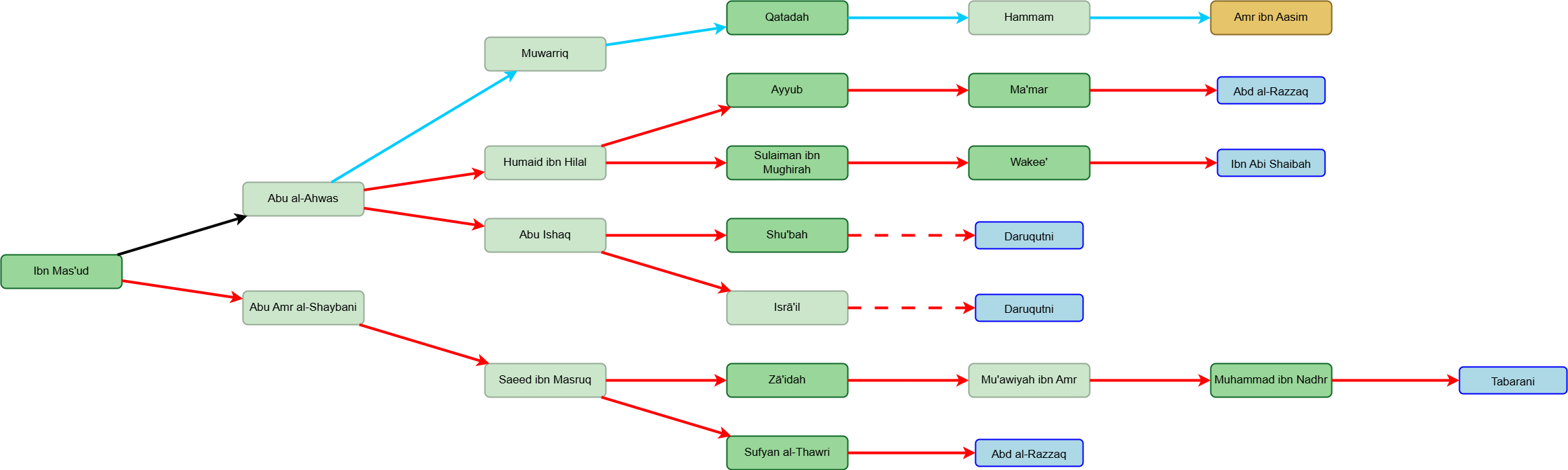
The above are only some chains to demonstrate the point. Daruqutni mentioned more chains.
Daruqutni concluded that Abu Ishaq and Humaid narrated it mawquf while Qatadah narrated it marfu’. (Ilal of Daruqutni) However, I do not think even Qatadah narrated it marfu’ because of the first two reasons. It seems weaker students of Qatadah confused the hadith into being marfu’.
Even if Qatadah did narrate it marfu’, two are clearly stronger than one.
A fifth reason only adds to the weakness:
- Qatadah was known for skipping his sources (tadlees) and he never mentioned that he heard this hadith directly from Muwarriq. Ibn Khuzaymah said, “I don’t know any evidence that Qatadah heard this report from Muwarriq.” (Ibn Khuzaymah)
As a result, this hadith is not Sahih to the Prophet (SAW). It can only be reliably traced back to Ibn Masud (RA), as his own statement.
None of the early scholars of hadith accepted the raising of this hadith to the Prophet (SAW). Ibn Khuzaymah only included the hadith in his Sahih while noting its weakness as mentioned above. Tirmidhi graded the hadith, “Hasan Ghareeb.” (Sunan Tirmidhi) In his terminology, that amounts to weak.
In summary, there is no way to argue this hadith is authentic to the Prophet (SAW). It was only a statement of Ibn Masud (RA) that was wrongly raised to the Prophet (SAW) by some narrators.
Opinion of Ibn Masud (RA)
Despite the fact that it is clear there is no prophetic hadith on the topic, it is also proven that Ibn Masud (RA) used to believe that women should pray at home rather than praying at the masjid.
Abu Amr al-Shaybani said: I heard Ibn Masud (RA) take an oath that no place of prayer is better for a woman than her house, except in Hajj or Umrah, except for a woman who is no longer at the age of marriage (i.e. is elderly). (Musannaf Abd al-Razzaq; Sahih)
Abu al-Ahwas narrated from Ibn Masud (RA), “A woman’s prayer in her home is better than her prayer elsewhere (or in the masjid).” Then, he said, “Whenever a woman goes outside, Shaitan is in anticipation.” (Musannaf Abd al-Razzaq; Sahih to Abu al-Ahwas, and Abu al-Ahwas was honest)
Abu Amr al-Shaybani said: I saw Ibn Masud (RA) expelling women from the masjid on Jumuah, saying, “Your homes are better for you.” (Musannaf Abd al-Razzaq; Sahih In sha Allah)
A’mash narrated: Ibrahim al-Nakha’i (who studied with the major students of Ibn Masud) had three wives, but he did not let them go to Jumuah or any congregation. (Musannaf Ibn Abi Shaibah; Sahih)
All of these reports represent Ibn Masud’s opinion that it is better for women to pray at home. It is possible he opined this because most women in his time did not dress properly when going to the masjid or for another reason. Whatever that reason may be, it is not allowed to use his opinion to disregard direct commands from the Prophet (SAW) and the example of women in his time.
An opinion made from ijtihad for reasons in the circumstance can be overturned with new ijtihad based on the new circumstances. It is unjustifiable to take his view and make it a binding claim about all women for all time. How is it possible to reject the clear statement of the Prophet (SAW) that we cannot prevent women from the masjid in favor of the ijtihad of one companion?
Also, note that Ibn Mas’ud (RA)’s opinion was about generally discouraging women from going outside (especially dressed inappropriately). He said, “Whenever a woman goes outside, Shaitan is in anticipation.” But, some people today do not prevent women from going to the market and to school but then prevent them from going to the masjid, the one place the Prophet forbade preventing them from going and the one place it is good for them to go!
Some people say: We do not say women should be prevented from the masjid, but we only believe it is better for them to pray at the masjid.
The response is: The only authentic evidence on this topic is the opinion of Ibn Masud (RA). As we will discuss, all other hadith that claim women praying at home is better are inauthentic. So, how can you accept one part of Ibn Masud (RA)’s opinion (that it is better for them to pray at home) but also reject his opinion that they can also be prevented and expelled from the masjid? That is inconsistent and contradictory.
Hadith of Umm Humaid
Abdullah ibn Suwaid narrated from his aunt Umm Humaid that she came to the Prophet (SAW) and said, “Messenger of Allah (SAW), I love to pray with you.” The Prophet (SAW) said, “I know you love to pray with me. But, your Salah at home is better than your Salah in your courtyard, your Salah in your courtyard is better than your Salah in your neighborhood, your Salah in your neighborhood is better than your Salah in your people’s masjid, and your Salah in your people’s masjid is better for you than your Salah in my masjid.” (Musnad Ahmad & Sahih Ibn Khuzaimah)
Abdullah ibn Suwaid and his aunt Umm Humaid were both unknown, so the hadith is very weak.
Additionally, the pronouns used in this hadith “your” are all singular, so it was possibly specific to Umm Humaid, perhaps because of her distance from the masjid or another reason.
Hadith of Umm Salamah
Abu al-Samh narrated from Saa’ib from Umm Salamah: The Prophet (SAW) said, “The best masjids for women are the insides of their homes.” (Musnad Ahmad & Mustadrak)
Abu al-Samh was weakened by the scholars of hadith, and Saa’ib was unknown. So, the hadith is very weak.
There are many much weaker hadith than this reported on this topic. All of these weak hadith cannot be used to rival the undeniably strong general evidence that praying in congregation is better than praying alone and that women used to pray in the masjid in the time of the Prophet (SAW).
It is not reasonable or logical to make an exception to strongly proven hadith based on weak hadith or opinions of companions.
Opinion of Aisha (RA)
Amrah narrated that Aisha (RA) said, “If the Prophet (SAW) saw what women do now, he would have prevented them from the masjid like the women of Bani Israil were prevented.” Amrah asked, “They were prevented from the masjid?” Aisha (RA) said, “Yes.” (Sahih Bukhari and Muslim)
Urwah narrated that Aisha (RA) said, “The women of Bani Israil used to wear wooden stilts to appear taller (and more attractive) to men, so Allah forbade masjids for them […].” (Musannaf Abd al-Razzaq; Sahih)
Ibn Masud (RA) said, “Men and women of Bani Israil used to pray together. So, a woman who had a boyfriend would wear wooden shoes to appear taller for her boyfriend […]” (Musannaf Abd al-Razzaq; Sahih)
The meaning is only that women should not dress up when going to the masjid in a way that attracts men, and those women who do that should be prevented from the masjid. This hadith also proves the Prophet (SAW) never actually forbade women from the masjid or recommended them to pray at home, because she said, “he would have prevented them” and did not mention that he recommended women to pray at home.
Some people extend this hadith to mean all women should be forbidden from the masjid because Aisha (RA) said the Prophet (SAW) would have prevented them if he saw their state. That is legislating in the place of Allah and the Messenger (SAW). Allah knew the future, and He would have forbidden them if He wished.
In fact, Aisha (RA) herself never advised women not to pray in the masjid in this hadith! There is no report from Aisha (RA) advising such a thing.
However, the hadith does prove it is necessary for women to dress appropriately when going to the masjid. If they go wearing inappropriate clothes or wearing perfume or for bad intentions, then they turn a rewarded act into an accursed act.
Verse ⟪And Settle in Your Homes⟫
Some people say: Since Allah generally says to women ⟪And settle in your homes⟫ (33:33), that means they are generally commanded to stay at home. This entails they should not go to the masjid and are more rewarded if they pray at home.
First of all, the verses are as follows:
O wives of the Prophet, you are not like anyone among women. If you fear Allah, then do not be soft in speech [to men], lest he in whose heart is disease should desire, but speak with appropriate speech.
And settle in your homes and do not display yourselves like the display of the former times of ignorance. And establish prayer and give zakah and obey Allah and His Messenger. Allah intends only to remove from you the impurity [of sin], O people of the [Prophet’s] household, and to purify you with [extensive] purification.
Quran 33:32-33
There are four things to note:
- The verses are addressed first and foremost to the wives of the Prophet (SAW) and not generally to all women. The passage starts with ⟪O wives of the Prophet⟫ and ends with ⟪O people of the [Prophet’s] household⟫.
- The wives of the Prophet (SAW) were meant as role models for all women, so commands to them become ideals or recommendations to all other women.
- As we saw above, there are reports of both Aisha and Umm Salamah (RA) praying in the masjid in the life of the Prophet (SAW), and there is no report that they stopped praying in the masjid after the revelation of this verse. If the primary audience of this verse did not understand it as discouragement from praying in the mosque, why should other women who are the secondary audience?
- No one in history has ever understood ⟪settle in your homes⟫ to be a general obligation for all women to never leave their homes. In fact, this interpretation would be innovation, since Muslim women have been going to markets and other places since the time of the Prophet (SAW) until today. Allah explains that ⟪settle in your homes⟫ means ⟪do not display yourselves like the display of the former times of ignorance⟫. Hence, it is allowed for women to go out for good reasons while dressing properly and modestly, including going to the market, and thus this verse cannot be used to limit them going out for a better purpose than markets: praying in the masjid, which has clear general evidence about its benefit.
Etiquettes of Going to the Masjid for Women
Women must only go outside while dressing modestly and without wearing perfume, and this applies especially to the masjid.
Modest Dress
Allah says ⟪And tell the believing women to reduce [some] of their vision and guard their private parts and not expose their adornment except that which [necessarily] appears and to wrap their headcovers over their chests.⟫ (24:31)
Allah also gave the Prophet (SAW)’s wives advice that applies to all women ⟪And settle in your homes and do not display yourselves as [was] the display of the former times of ignorance.⟫ (33:33)
Aisha (RA) said: The believing women used to attend Fajr with the Prophet (SAW), covered with veils, then they would return to their homes as soon as prayer finished, and no one would be able to recognize them due to the darkness. (Sahih Bukhari and Muslim)
Umm Salamah (RA) said, “When the Prophet (SAW) used to say salam (to end prayer), the women would get up as soon as he said salam, but he would remain in his place for some time before standing.” Umm Salamah or one of the narrators commented, “I believe he waited so that women could leave before the men.” (Sahih Bukhari)
It is not allowed to stand around the masjid such that men and women mix together.
Not Wearing Perfume
The Prophet (SAW) said to the female companions, “If any of you comes to Isha, do not wear perfume that night.” (Sahih Muslim)
Abu Hurairah (RA) narrated: The Prophet (SAW) said, “Do not prevent the female servants of Allah from the masjids of Allah, but they should go out unperfumed.” (Sunan Abi Dawud; Hasan)
Abu Musa al-Ashari (RA) said himself or narrated from the Prophet (SAW), “When a woman perfumes herself and passes by people so they can smell her, she is this and that (an adulteress).” (Sunan Abi Dawud; Hasan)
In a weak hadith, Abu Hurairah (RA) passed by a woman and smelled perfume from her. He asked, “Where are you going?” She said, “I am going to the masjid.” Abu Hurairah said: I heard the Prophet (SAW) say, “No prayer is accepted from a woman who perfumes herself for going to the masjid until she returns and washes herself.” (Sunan Abi Dawud; Weak)
This is a weak hadith that supports the idea that women should not wear perfume to the masjid, but the idea that no prayer is accepted is not necessarily reliable.
Women Are Not Required to Go to the Masjid
There is consensus that women are not commanded to go to the masjid for prayer in the same way men are. This is a mercy from Allah for them. Allah knew it would not always be convenient for them to leave their homes and children or bring their children to come to the masjid.
As for men, they are very strongly recommended, if not required, to come to the masjid if it is close to their house.
The Prophet (SAW) said, “By Allah, I almost felt like telling someone to gather firewood, telling someone to give azan, and telling someone to lead the prayer, then going and burning down the houses of the men [that did not come to the masjid]. If they heard that they would get a piece of meat, they would have attended Isha.” (Sahih Bukhari)
It is well-known that the female companions did not always pray in the masjid.
Aisha (RA) said: The believing women used to attend Fajr with the Prophet (SAW). […] (Sahih Bukhari and Muslim) This implies they did not attend the other prayers with as much diligence.
Nafi’ narrated from Ibn Umar: A wife of Umar (RA) used to attend Fajr and Isha in congregation at the masjid. People asked her, “Why do you go out even though you know Umar (RA) does not like that?” She said, “What prevents him from telling me not to go then?” (Sahih Bukhari) This indicates she would not pray Dhuhr, Asr, or Maghrib in congregation.
Additionally, if women were commanded in the same way as men, no one would tell her not to go because of Umar (RA)’s likes or dislikes.
The most important prayers to attend in congregation are Fajr and Isha.
If a woman desires to go to the masjid but is unable to go, she is In sha Allah rewarded for her desire despite not going.
Allah says ⟪Allah does not waste your iman.⟫ (2:143)
The Prophet (SAW) said: Allah said to the angels, “[…] If my servant intends to do a good deed but does not do it, write the good deed for him. […]” (Sahih Bukhari)
The Prophet (SAW) said, “Two sentences are beloved to Allah, light on the tongue, and heavy on the scales: Subhanallahi wabihamdih, Subhanallahil-Azeem.” (Sahih Bukhari)
And Allah knows best.

Pingback: ivermectin for cats