Introduction
Purpose
The purpose of this article is to demonstrate how Usul al-Hadith and Usul al-Fiqh affect questions of Islamic law and to dispel simplistic notions about how law can be derived and simplistic arguments against particular schools of thought. Understanding this topic should lead to respect for scholars of all schools of thought that tried their best to use evidence to determine law.
This will be done in three sections that make up the body of this article:
- Evidence: Where we discuss all the evidence on this topic, including all hadith.
- Four Imams: Where we discuss the views of the four imams of fiqh and what evidence they used
- Why is there difference of opinion: Where we discuss the reasons why the scholars came to differ on this topic.
I chose the topic of combining prayers because the narrations on this subject are confusing and I could not find a book properly organizing them in terms of their chain and content, so the secondary purpose of this article is to organize all the hadith on this topic so that their authenticity and meaning becomes clear.
The purpose of the article is not to give a fatwa answering the combination question. The purpose is to understand how different views came to be on this topic. At the end of the article, you may come away convinced of one view, but you should come away understanding that each school had an argument for their view.
What is the Combination Question?
Before discussing any topic, it is necessary to first understand its essence, separate from understanding terminology.
If you ask any group of Muslims whether they believe in combining prayers, they would say yes because of the plethora of narrations from the Prophet (SAW) on the topic.
However, some Muslims allow praying Zuhr and Asr in Zuhr time and some do not. So, clearly “Is combining prayers allowed?” is not good at defining the essence of the debate on this topic.
Rather, there are two definitions of what combining means:
- Apparent Combination: Delaying one prayer to the end of its time (either Zuhr or Maghrib) while bringing up the other prayer to the beginning of its time (either Asr or Isha respectively), and so praying them soon after each other at one time but each within its own time.
- Actual Combination: Praying Zuhr and Asr together in one of their times and praying Maghrib and Isha together in one of their times.
There is also an underdiscussed third type which can be the implication of several narrations on the topic and can be found in the statements of some early scholars:
- Pseudo-Apparent Combination: Delaying one prayer to the beginning of the second prayer’s time and praying them together. For example, praying Maghrib and Isha together at the beginning of Isha time.
Within Actual Combination, there are two types:
- Actual Late Combination: Praying Zuhr and Asr together in Asr time.
- Actual Early Combination: Praying Zuhr and Asr together in Zuhr time.
Then, there is also the question: Is combining prayers in any of the definitions allowed all the time while travelling or specifically when you are in a hurry?
Then, there is the question: Is combining prayers ideal or non-ideal? Is it the preferred option when it can be avoided?
As a result, when you see evidence given in this topic, you need to determine whether that evidence actually proves one side of the debate or just appears to prove it as a matter of terminology.
If Ibn Umar said the Prophet (SAW) used to combine Maghrib with Isha if he was in a hurry, does that prove actual combination or just apparent combination? Does that prove combination is always allowed or sometime allowed?
This is a necessary prerequisite because people who don’t know proper methodology are easily enamored by arguments like, “Ibn Umar’s hadith in Bukhari and Muslim says the Prophet combined prayers, so the Hanafis oppose the Sunnah and the hadith by not believing in actual combination!”
There are arguments to be made against the Hanafi position on this topic, and in fact, against any position, but it is not as simple as them rejecting a hadith.
Evidence
Evidence in Islam primarily revolves around four things:
- Quran
- Sunnah
- Consensus
- Qiyas (Analogy)
In this section, I will analyze the evidence on this topic from the first three sources of evidence. As we will see, the main evidence on this topic comes from the Sunnah of the Prophet (SAW).
Although there is other evidence relevant to this discussion like how the normal times of prayer were defined, we will only discuss narrations about combining prayer. Otherwise, this article would have no end.
Qiyas will be left for later when discussing how the scholars argued for their positions, since qiyas depends heavily on scholarly argument and cannot be analyzed separate from that as opposed to the Quran, Sunnah, and consensus.
Consensus
All four schools of thought (Hanafis, Malikis, Shafi’is, and Hanbalis) agree that Fajr, Zuhr, Asr, Maghrib, and Isha generally have defined times separate from each other:
- Fajr time starts at dawn
- It ends at sunrise
- Zuhr time starts after the sun’s decline from its zenith
- It ends when Asr time starts
- Asr time starts either when the shadow is twice to the object’s length (minus its length at the zenith) according to the Hanafis or when the shadow is equal to the object’s length according to others
- It ends at sunset
- Maghrib time starts at sunset
- It ends when Isha time starts
- Isha time starts when the twilight disappears. Abu Hanifah said twilight is the white light and the others said twilight is the red light.
- Some say it ends at a third into the night, some say half of the night, and some say when Fajr time starts
They all agree it is generally sinful to delay Zuhr into Asr time without excuse and to delay Maghrib into Isha time without excuse. They also all agree it is generally sinful and possibly invalid to pray Asr in Zuhr time and Isha in Maghrib time without excuse.
Everyone agrees Fajr cannot be combined with any prayer and Asr cannot be combined with Maghrib. The only area of debate is combining Zuhr with Asr and Maghrib with Isha.
All four schools of thought agree that Zuhr and Asr are combined in Zuhr time at Arafah and Maghrib and Isha in Isha time at Muzdalifah during Hajj. This is because of a number of reports from different companions that the Prophet combined prayers at those times in those places and because of the general practice of Muslims during Hajj since the time of the Prophet (SAW).
However, they disagree about combining prayers outside those two times and places. Is it allowed to actually combine Zuhr and Asr or Maghrib and Isha while travelling or when it is raining or when you are sick? Some people say it is allowed to actually combine prayers for some or all of those excuses (while disagreeing on the exact excuse), and others say it is only allowed to apparently combine prayers.
Quran
Allah says ⟪Prayer is upon the believers a timed obligation.⟫ (4:103)
This sets the general rule that prayers must be prayed on their time, and thus evidence is required to overturn this law.
Sunnah
The Sunnah of the Prophet (SAW) comes to us through two sources:
- Communal Generational Practice
- Reports
As for the first, the communal generational practice of the Muslims is recorded in the section of consensus.
As for the second, reports or hadith of the Prophet (SAW) are of two types:
- Prophetic Statements: When the Prophet himself says something.
- Prophetic Actions: When companions describe something the Prophet did.
All the reports on this topic are prophetic actions, and the limitation of using prophetic actions as evidence is that it becomes difficult to separate what part of the hadith is prophetic and what part is the perception of the companion who narrated it.
If someone says, “The Prophet delayed Zuhr until Asr time started,” is that just his perception that Asr time started or did the Prophet (SAW) also think Asr time had started. Obviously, they did not have watches or Azan apps at the time to have very black and white boundaries with no room for disagreement.
Another example: If someone says, “The Prophet used to combine prayers while travelling when he was in a hurry,” is it just his own perception that he did it when he was in a hurry or did the Prophet (SAW) indicate it somehow?
All of this becomes important when analyzing the narrations on the topic closely.
Methodology
The reports in this section will be organized according to their chains and content.
Only the root of the chain will be mentioned. For example, if Malik, Ma’mar, and Shuaib narrated a hadith from Zuhri > Salim > Ibn Umar, this article will just mention “Zuhri > Salim > Ibn Umar” because that is the root of the chain.
Whenever there is a questionable narrator in a chain, that narrator will be marked with a grade like hasan or acceptable or weak. A questionable narrator is any narrator that is not entirely reliable.
For every hadith, the relevant content will be summarized so that the reader knows what to pay attention to when reading the hadith.
The goal of this article is to be comprehensive in terms of useful prophetic hadith on the topic but there is no intention to be comprehensive about scholarly statements.
Reports Against Combining While Travelling
The main school of thought that opposes actually combining prayers while travelling is the Hanafi school, which is the successor of the Kufan school of Ibn Masud and his students. As such, it is no surprise that the main evidence against combining prayers comes from Ibn Masud and his students.
Hadith of Ibn Masud
Umarah ibn Umair narrated from Abd al-Rahman ibn Yazid from Ibn Masud that the only prayers the Prophet shifted from their times were Maghrib and Fajr during Hajj.
عَنْ عَبْدِ اللَّهِ رَضِيَ اللَّهُ عَنْهُ ، قَالَ : ” مَا رَأَيْتُ النَّبِيَّ صَلَّى اللَّهُ عَلَيْهِ وَسَلَّمَ صَلَّى صَلَاةً بِغَيْرِ مِيقَاتِهَا إِلَّا صَلَاتَيْنِ جَمَعَ بَيْنَ الْمَغْرِبِ وَالْعِشَاءِ ، وَصَلَّى الْفَجْرَ قَبْلَ مِيقَاتِهَا “
A’mash > Umarah ibn Umair > Abd al-Rahman ibn Yazid > Ibn Masud: I never saw the Prophet (SAW) pray a prayer outside its time except two prayers: when he combined Maghrib and Isha at Jama’ (in Hajj), and he prayed Fajr before its time.
Bukhari and Muslim
Abu Ishaq narrated this hadith in longer form and did not clearly say these were the only prayers shifted but still specified these were special.
عَنْ عَبْدَ الرَّحْمَنِ بْنَ يَزِيدَ ، قَالَ : حَجَّ عَبْدُ اللَّهِ رَضِيَ اللَّهُ عَنْهُ ، فَأَتَيْنَا الْمُزْدَلِفَةَ حِينَ الْأَذَانِ بِالْعَتَمَةِ أَوْ قَرِيبًا مِنْ ذَلِكَ ، فَأَمَرَ رَجُلًا فَأَذَّنَ وَأَقَامَ ، ثُمَّ صَلَّى الْمَغْرِبَ وَصَلَّى بَعْدَهَا رَكْعَتَيْنِ ، ثُمَّ دَعَا بِعَشَائِهِ فَتَعَشَّى ، ثُمَّ أَمَرَ أُرَى فَأَذَّنَ وَأَقَامَ ، قَالَ عَمْرٌو : لَا أَعْلَمُ الشَّكَّ إِلَّا مِنْ زُهَيْرٍ ، ثُمَّ صَلَّى الْعِشَاءَ رَكْعَتَيْنِ ، فَلَمَّا طَلَعَ الْفَجْرُ , قَالَ : ” إِنَّ النَّبِيَّ صَلَّى اللَّهُ عَلَيْهِ وَسَلَّمَ كَانَ لَا يُصَلِّي هَذِهِ السَّاعَةَ إِلَّا هَذِهِ الصَّلَاةَ فِي هَذَا الْمَكَانِ مِنْ هَذَا الْيَوْمِ ” ، قَالَ عَبْدُ اللَّهِ : هُمَا صَلَاتَانِ تُحَوَّلَانِ عَنْ وَقْتِهِمَا ، صَلَاةُ الْمَغْرِبِ بَعْدَ مَا يَأْتِي النَّاسُ الْمُزْدَلِفَةَ ، وَالْفَجْرُ حِينَ يَبْزُغُ الْفَجْرُ ” , قَالَ : رَأَيْتُ النَّبِيَّ صَلَّى اللَّهُ عَلَيْهِ وَسَلَّمَ يَفْعَلُهُ
Abu Ishaq > Abd al-Rahman ibn Yazid: We performed Hajj with Ibn Masud and we arrived to Muzdalifah and prayed Maghrib and Isha with supper between them. When dawn happened, Ibn Masud said, “The Prophet (SAW) did not pray at this time except this prayer at this place on this day. These are two prayers moved from their time: Maghrib until after people come to Muzdalifah (i.e. after Isha time starts) and Fajr as soon as dawn appears. I saw the Prophet (SAW) doing this.”
Bukhari
This narration of Abd al-Rahman ibn Yazid indicates the Prophet (SAW) did not use to combine prayers while travelling. If he had done so, Ibn Masud, who used to accompany the Prophet (SAW) in most of his journeys, would not find the shifted time for Maghrib in Hajj special and exceptional.
There are also other implications of the hadith:
- Since Ibn Masud did not mention Zuhr and Asr and only mentioned Maghrib and Isha, especially Umarah’s version implies Ibn Masud did not believe Zuhr and Asr are combined at Arafah. However, I do not know any later scholar who accepted this view. Perhaps Umarah’s version is just mistaken.
- What does it mean when Ibn Masud said Fajr is also shifted from its time when Fajr is still prayed on time according to everyone in Hajj? The implication is Ibn Masud believed Fajr is meant to be prayed later in its time, a bit before sunrise, not right after dawn. So, it being prayed right after dawn is it being shifted from its time.
- The hadith implies you should eat supper between Maghrib and Isha when praying them together at Muzdalifah. Other companions did not support this practice.
School of Iraq
Kufa: Aswad and Ibraim al-Nakha’i (Students of Ibn Masud)
Jarir > Mughirah > Ibrahim al-Nakha’i: Aswad and his companions used to stop at the time of every prayer while on a journey. They would pray Maghrib at its time, then they would eat supper, then wait some time, then pray Isha.
Thawri > Hammad: Aswad used to stop for every Salah on its time, even if he had to stop on a rock.
Thawri > Mughirah > Ibrahim al-Nakha’i: You cannot combine on a journey. (Sahih)
Basra: Hasan al-Basri and Qatadah
Hisham > Hasan al-Basri: Pray every prayer on its time.
Ayyub > Qatadah > Abu al-Aaliyah: Umar (RA) wrote to Abu Musa al-Ashari, “Know that combining two prayers without an excuse is a major sin.” (Disconnected between Abu al-Aaliyah and Umar)
Reports For Combining While Travelling
There are many reports that mention the Prophet (SAW) combining prayers when he was travelling.
The main reports, in order of reliability, are as follows:
- Hadith of Ibn Umar (Extremely Sahih)
- Hadith of Anas ibn Malik (Sahih)
- Hadith of Muaz ibn Jabal (Hasan or Sahih)
- Hadith of Ibn Abbas (Hasan or Weak)
Each of the reports have different transmissions with slightly different wordings, so it is necessary to pay attention at what exactly each transmission says before determining what side of the debate it supports.
Hadith of Ibn Umar
Ibn Umar narrated that the Prophet (SAW) used to combine Maghrib and Isha while travelling when he was in a hurry. The description of this combination is interesting and differs according to transmission, so it needs to be analyzed closely to determine whether it was actual or apparent or pseudo-apparent combination.
Transmission of Salim & Nafi > Ibn Umar
عن عَبْدَ اللَّهِ بْنَ عُمَرَ، قَالَ: كَانَ رَسُولُ اللَّهِ ﷺ إِذَا عَجِلَ بِهِ السَّيْرُ جْمَعَ بَيْنَ الْمَغْرِبِ وَالْعِشَاءِ.
Salim ibn Abdullah ibn Umar and Nafi both narrated from Ibn Umar that the Prophet (SAW) used to combine Maghrib and Isha when he was in a hurry while travelling.
جَاءَهُ خَبَرٌ عَنْ صَفِيَّةَ ابْنَةِ أَبِي عُبَيْدٍ أَنَّهَا وَجِعَةٌ، فَارْتَحَلَ بَعْدَ أَنْ صَلَّى الْعَصْرَ، ثُمَّ أَسْرَعَ السَّيْرَ، فَسَارَ حتَّى حَانَتْ صَلَاةُ الْمَغْرِبِ، فَكَلَّمَهُ رَجُلٌ مِنْ أَصْحَابِهِ، فَقَالَ: الصَّلَاةَ، فَلَمْ يَرْجِعْ إِلَيْهِ، ثُمَّ كَلَّمَهُ آخَرُ فَلَمْ يَرْجِعْ إِلَيْهِ، وَكَلَّمَهُ آخَرُ فَلَمْ يَرْجِعْ إِلَيْهِ شَيْئَا، ثُمَّ كَلَّمَهُ آخَرُ، فَقَالَ: إِنِّي رَأَيْتُ رَسُولَ اللَّهِ – ﷺ – إذَا اسْتَعْجَلَ أَخَّرَ هَذِهِ الصلَاةَ حتَّى يَجْمَعَ بَيْنَ هَاتَيْنِ الصَّلَاتَيْنِ.
Both Salim and Nafi said: Once, Ibn Umar (RA) was in a hurry on a journey because his wife was on her deathbed, so he did not pray Maghrib when its time started but delayed it until he prayed Maghrib and Isha together. They both said he used to combine Maghrib and Isha if he was in a hurry while travelling.
Bukhari and Muslim
Ismail ibn Umayyah added from Nafi: Ibn Umar used to pray every Salah on its time while travelling except once when he got the news that his wife was dying.
Many narrated the gist of this hadith from Ibn Shihab al-Zuhri from Salim, and many narrated it from Nafi.
Salim’s narration does not mention twilight. Nafi’s transmission differs between his students:
- No mention of twilight or the time of combining.
- By Malik and others from Nafi.
- He prayed Maghrib and Isha when twilight disappeared.
- By Ubaidullah and Musa ibn Uqbah, both from Nafi.
- He prayed after a fourth of the night passed.
- By Abd al-Aziz ibn Abi Rawwad from Nafi.
- He prayed Maghrib when twilight was about to disappear, then prayed Isha after it disappeared.
- By Ibn Jabir, by Attaf ibn Khalid (hasan), and by Muhammad ibn Fudhail (hasan) > Fudhail, all three from Nafi.
This difference affects whether the combining of Maghrib and Isha mentioned in this hadith was true or apparent combination. It seems Nafi was not consistent in this part of the hadith.
Transmission of Ismail ibn Abd al-Rahman (trustworthy) > Ibn Umar
Another transmission from Ibn Umar more explicitly says they prayed Maghrib after twilight disappeared:
عن إِسْمَاعِيلَ بْنَ عَبْدِ الرَّحْمَنِ بْنِ أَبِي ذُؤَيْبٍ الأَسَدِيَّ ، يَقُولُ : ” خَرَجْنَا مَعَ ابْنِ عُمَرَ إِلَى الْحِمَى ، فَلَمَّا غَرَبَتِ الشَّمْسُ هِبْنَا أَنْ نَقُولَ لَهُ : انْزِلْ فَصَلِ ، فَلَمَّا غَابَ الشَّفَقُ نَزَلَ ، فَصَلَّى الْمَغْرِبَ بِنَا ثَلاثًا ثُمَّ سَلَّمَ ، وَصَلَّى الْعِشَاءَ رَكْعَتَيْنِ ، ثُمَّ الْتَفَتَ إِلَيْنَا ، فَقَالَ : هَكَذَا رَأَيْتُ رَسُولَ اللَّهِ صَلَّى اللَّهُ عَلَيْهِ وَسَلَّمَ فَعَلَ “
Ibn Uyainah > Ibn Abi Najeeh > Ismail ibn Abd al-Rahman (trustworthy): We were travelling with Ibn Umar when the sun set but we were afraid to say, “Let’s stop and pray.” When the twilight disappeared, we stopped and he prayed Maghrib with us three rakahs and Isha two rakahs. Then, he turned towards us and said, “This is what I saw the Prophet (SAW) do.”
Nasai
School of Ibn Umar
Ibn Umar’s son Salim allowed combining prayers while travelling by comparing it to Hajj.
Zuhri: I asked Salim, “Can you combine Zuhr and Asr while travelling?” He said, “Yes, there’s no harm in that. Don’t you see people praying them (together) at Arafah?” (Sahih)
Musannaf Abd al-Razzaq
Ibn Umar used to combine prayer when it was raining as well.
Nafi: When the governor used to join Maghrib and Isha because of rain, Ibn Umar would join the two prayers with them. (Sahih)
Musannaf Abd al-Razzaq
Hadith of Anas ibn Malik
Anas ibn Malik narrated from the Prophet (SAW) that he would combine Zuhr and Asr on the journey if he left before Zuhr time started but would pray Zuhr before leaving (with no mention of combining it with Asr) if he left on a journey after Zuhr time started.
Transmission of Aqeel > Zuhri > Anas
There are several routes of this hadith to Anas ibn Malik, the most prominent comes from Aqeel from Zuhri. All of them mention that the Prophet (SAW) used to delay Zuhr until the time of Asr then prayed them together.
From Mufaddhal > Aqeel:
عَنْ أَنَسِ بْنِ مَالِكٍ، قَالَ كَانَ رَسُولُ اللَّهِ صلى الله عليه وسلم إِذَا ارْتَحَلَ قَبْلَ أَنْ تَزِيغَ الشَّمْسُ أَخَّرَ الظُّهْرَ إِلَى وَقْتِ الْعَصْرِ ثُمَّ نَزَلَ فَجَمَعَ بَيْنَهُمَا فَإِنْ زَاغَتِ الشَّمْسُ قَبْلَ أَنْ يَرْتَحِلَ صَلَّى الظُّهْرَ ثُمَّ رَكِبَ
Mufaddhal (hasan) > Aqeel > Ibn Shihab al-Zuhri > Anas ibn Malik: When the Prophet (SAW) used to leave on a journey before the decline of the sun (the starting time of Zuhr), he would delay Zuhr until the time for Asr. Then, he would stop and combine them. But, if the sun declined before he left, he would pray Zuhr then get on his mount.
Bukhari and Muslim
From Shababah > Layth > Aqeel:
شَبَابَةُ بْنُ سَوَّارٍ الْمَدَايِنِيُّ، حَدَّثَنَا لَيْثُ بْنُ سَعْدٍ، عَنْ عُقَيْلِ بْنِ خَالِدٍ، عَنِ الزُّهْرِيِّ، عَنْ أَنَسٍ، قَالَ كَانَ النَّبِيُّ صلى الله عليه وسلم إِذَا أَرَادَ أَنْ يَجْمَعَ بَيْنَ الصَّلاَتَيْنِ فِي السَّفَرِ أَخَّرَ الظُّهْرَ حَتَّى يَدْخُلَ أَوَّلُ وَقْتِ الْعَصْرِ ثُمَّ يَجْمَعُ بَيْنَهُمَا .
Another version: Shababah (hasan) > Layth ibn Sa’d > Aqeel > Zuhri > Anas: When the Prophet (SAW) wanted to combine two prayers on a journey, he would delay Zuhr until the beginning of Asr time started, then he would combine the two.
Muslim
This is how all the narrators of this hadith narrate it. In Sunan Bayhaqi, you can find one lonesome chain (Jafar al-Firyabi > Ishaq ibn Rahawayh > Shababah) which says, “If the sun declined before the Prophet (SAW) left, he would pray Zuhr and Asr together before leaving.” This is clearly a mistake, probably by Jafar, since numerous narrators narrated it as mentioned above.
From Jabir ibn Ismail > Aqeel:
عَنْ أَنَسٍ ، عَنْ رَسُولِ اللَّهِ صَلَّى اللَّهُ عَلَيْهِ وَسَلَّمَ ، أَنَّهُ كَانَ ” إِذَا عَجِلَ بِهِ السَّيْرُ يُؤَخِّرُ الظُّهْرَ إِلَى وَقْتِ الْعَصْرِ فَيَجْمَعُ بَيْنَهُمَا وَيُؤَخِّرُ الْمَغْرِبَ حَتَّى يَجْمَعَ بَيْنَهَا وَبَيْنَ الْعِشَاءِ حَتَّى يَغِيبَ الشَّفَقُ ”
Another version: Ibn Wahb > Jabir ibn Ismail (acceptable) > Aqeel > Zuhri > Anas: When he was in a hurry in a journey, he would delay Zuhr until the time of Asr then combine them and delay Maghrib until he combined Maghrib and Isha when the twilight disappeared.
Although all these narrations have somewhat questionable narrators in them, it is possible to combine all them to conclude the hadith is Sahih li-Ghayrihi. As a result, the best transmission, the transmission of Mufaddhhal, is included in Sahih Bukhari and Sahih Muslim.
That being said, it is strange that only Aqeel narrated this hadith from Zuhri, and none of the other students of Zuhri narrated this hadith.
Transmission of Hafs ibn Ubaidullah (hasan) > Anas
Secondly, there is a hadith of Hafs ibn Ubaidullah ibn Anas (hasan) from Anas. Two people narrated it from him:
عَنْ أَنَسِ بْنِ مَالِكٍ ، قَالَ : كَانَ رَسُولُ اللَّهِ صَلَّى اللَّهُ عَلَيْهِ وَسَلَّمَ ” يَجْمَعُ بَيْنَ الظُّهْرِ وَالْعَصْرِ ، وَالْمَغْرِبِ وَالْعِشَاءِ ، فِي السَّفَرِ ”
Yahya ibn Abi Katheer > Hafs ibn Ubaidullah ibn Anas > Anas Ibn Malik: The Prophet (SAW) used to combine between Zuhr and Asr and between Maghrib and Isha when he was traveling.
Bukhari
عَنْ حَفْصِ بْنِ عُبَيْدِ اللَّهِ بْنِ أَنَسٍ ، قَالَ : كُنَّا نُسَافِرُ مَعَ أَنَسٍ إِلَى مَكَّةَ , فَكَانَ إِذَا زَالَتِ الشَّمْسُ وَهُوَ فِي مَنْزِلٍ لَمْ يَرْكَبْ حَتَّى يُصَلِّيَ الظُّهْرَ , فَإِذَا رَاحَ فَحَضَرَتِ الْعَصْرُ صَلَّى الْعَصْرَ , فَإِنْ سَارَ مِنْ مَنْزِلِهِ قَبْلَ أَنْ تَزُولَ الشَّمْسُ فَحَضَرَتِ الصَّلَاةُ قُلْنَا : الصَّلَاةَ , فَيَقُولُ : سِيرُوا , حَتَّى إِذَا كَانَ بَيْنَ الصَّلَاتَيْنِ نَزَلَ فَجَمَعَ بَيْنَ الظُّهْرِ وَالْعَصْرِ , ثُمَّ قَالَ : رَأَيْتُ النَّبِيَّ صَلَّى اللَّهُ عَلَيْهِ وَسَلَّمَ إِذَا وَصَلَ ضَحْوَتَهُ بِرَوْحَتِهِ صَنَعَ هَكَذَا ” .
Ibn Ishaq (hasan) > Hafs: We were traveling with Anas to Makkah. Whenever the sun declined (Zuhr time started) while he was still at his stop, he would pray Zuhr before riding his mount. Whenever he left before the sun declined, when the time of Salah came, we would say, “Salah! Salah!” but he would say, “Keep going,” until it was (the time) between the two prayers. Then, he would stop and combine Zuhr and Asr. Then, he said, “I saw the Prophet (SAW) do this when he reached noon while on a journey.”
Transmission of Hamzah al-Dhabbi (acceptable) & Mishaaj al-Dhabbi > Anas
Thirdly, there is a narration from two people of Banu Dhabbah from Anas that supports the idea that the Prophet used to pray Zuhr before leaving a place while he was travelling and does not mention him praying Asr along with it.
Hamzah was not that well-known, but he narrated the hadith as follows:
عَنْ أَنَسَ بْنَ مَالِكٍ ، يَقُولُ : ” كَانَ رَسُولُ اللَّهِ صَلَّى اللَّهُ عَلَيْهِ وَسَلَّمَ إِذَا نَزَلَ مَنْزِلًا لَمْ يَرْتَحِلْ حَتَّى يُصَلِّيَ الظُّهْرَ ، فَقَالَ لَهُ رَجُلٌ : وَإِنْ كَانَ بِنِصْفِ النَّهَارِ ؟ قَالَ : وَإِنْ كَانَ بِنِصْفِ النَّهَارِ “
Shu’bah > Hamzah al-Dhabbi (acceptable): Anas ibn Malik said, “Whenever the Prophet (SAW) stopped in a place (on a journey), he would not leave until he prayed Zuhr.” A man asked, “Even in the middle of the day?” He said, “Even in the middle of the day.”
Mishaaj was also not particularly well-known:
Abu Muawiyah > Mishaaj al-Dhabbi (acceptable) > Anas ibn Malik: Whenever we were with the Prophet (SAW) on a journey, whether we said the sun had declined from its peak or not, he would pray Zuhr then leave.
Abu Dawud opined that these hadith are about travelers praying when they are unsure whether the time started or not. However, the apparent of the second version at least implies they prayed Zuhr before Zuhr time started and this cannot be taken too seriously with this questionable of a chain.
Hadith of Muaz ibn Jabal
Abu al-Tufail narrated from Muaz ibn Jabal that the Prophet (SAW) used to combine prayers in the expedition of Tabuk. The description of how he used to combine is interesting and needs to be analyzed to determine whether it was apparent or actual combination.
Transmission of Abu al-Zubair (hasan) > Abu al-Tufail > Muaz ibn Jabal
The most prominent transmission was the transmission of Malik, Thawri, Qurrah, and others from Abu al-Zubair from Abu al-Tufail:
عَنْ مُعَاذٍ، قَالَ خَرَجْنَا مَعَ رَسُولِ اللَّهِ صلى الله عليه وسلم فِي غَزْوَةِ تَبُوكَ فَكَانَ يُصَلِّي الظُّهْرَ وَالْعَصْرَ جَمِيعًا وَالْمَغْرِبَ وَالْعِشَاءَ جَمِيعًا .
Malik, Thawri, Qurrah, and others > Abu al-Zubair (hasan) > Abu al-Tufail > Muaz ibn Jabal: The Prophet (SAW) used to combine between Zuhr and Asr and between Maghrib and Isha during the expedition of Tabuk.
Muslim
Malik added more details in his transmission. The relevant parts are as follows:
We journeyed with the Prophet (SAW) in the expedition of Tabuk and he used to combine prayers. He would pray Zuhr and Asr together and Maghrib and Isha together.
One day, he delayed prayer, then came out and prayed Zuhr and Asr together, then went back in(side his tent). Then, he came out and prayed Maghrib and Isha together.
Muslim
Qurrah added: I asked, “What caused him to do that?” He said, “He did not want his ummah to be in hardship.”
This hadith is only hasan because Abu al-Zubair was only a hasan narrator. Muslim included it as a supporting narration.
Transmission of Hisham ibn Sa’d (weak) > Abu al-Zubair > Abu al-Tufail > Muaz ibn Jabal
There are transmissions of this hadith that add an explicit claim that the Prophet combined Zuhr and Asr in Zuhr time.
Hisham ibn Sa’d was a weak narrator and he narrated the hadith from Abu al-Zubair as follows:
عَنْ مُعَاذِ بْنِ جَبَلٍ ، ” أَنَّ رَسُولَ اللَّهِ صَلَّى اللَّهُ عَلَيْهِ وَسَلَّمَ كَانَ فِي غَزْوَةِ تَبُوكَ إِذَا زَاغَتِ الشَّمْسُ قَبْلَ أَنْ يَرْتَحِلَ جَمَعَ بَيْنَ الظُّهْرِ وَالْعَصْرِ ، وَإِنْ يَرْتَحِلْ قَبْلَ أَنْ تَزِيغَ الشَّمْسُ أَخَّرَ الظُّهْرَ حَتَّى يَنْزِلَ لِلْعَصْرِ ، وَفِي الْمَغْرِبِ مِثْلُ ذَلِكَ إِنْ غَابَتِ الشَّمْسُ قَبْلَ أَنْ يَرْتَحِلَ جَمَعَ بَيْنَ الْمَغْرِبِ وَالْعِشَاءِ ، وَإِنْ يَرْتَحِلْ قَبْلَ أَنْ تَغِيبَ الشَّمْسُ أَخَّرَ الْمَغْرِبَ حَتَّى يَنْزِلَ لِلْعِشَاءِ ، ثُمَّ جَمَعَ بَيْنَهُمَا “
Yazid ibn Khalid > Mufaddhal ibn Fadhalah & Layth ibn Sa’d > Hisham ibn Sa’d (weak) > Abu al-Zubair > Abu al-Tufail > Muaz:
In the expedition of Tabuk, if the sun declined (Zuhr time started) before the Prophet (SAW) left, he would combine Zuhr and Asr. If the sun had not declined when he left, he would delay Zuhr until he stopped for Asr.
Abdullah ibn Salih supported this narration from Layth. Several others narrated a similar hadith directly from Hisham ibn Sa’d.
This hadith claims the Prophet (SAW) would pray both Zuhr and Asr before leaving, contradicting the hadith of Anas (RA) which only mentions praying Zuhr before leaving and adding more detail to the narration of the major scholars from Abu al-Zubair as mentioned before.
Hisham ibn Sa’d was a weak narrator and since his details contradict or add on top of the details found in the narration of others who narrated the hadith from Abu al-Zubair, the details cannot be taken seriously.
Transmission of Qutaibah > Layth > Yazid > Abu al-Tufail > Muaz ibn Jabal
Qutaibah was alone in narrating a version with similar details (combining Zuhr and Asr in Zuhr time explicitly) from Layth from Yazid from Abu al-Tufail (without Abu al-Zubair in the chain).
مُعَاذِ بْنِ جَبَلٍ ، أَنّ النَّبِيَّ صَلَّى اللَّهُ عَلَيْهِ وَسَلَّمَ كَانَ فِي غَزْوَةِ تَبُوكَ إِذَا ارْتَحَلَ قَبْلَ أَنْ تَزِيغَ الشَّمْسُ أَخَّرَ الظُّهْرَ حَتَّى يَجْمَعَهَا إِلَى الْعَصْرِ فَيُصَلِّيَهُمَا جَمِيعًا ، وَإِذَا ارْتَحَلَ بَعْدَ زَيْغِ الشَّمْسِ صَلَّى الظُّهْرَ وَالْعَصْرَ جَمِيعًا ثُمَّ سَارَ ، وَكَانَ إِذَا ارْتَحَلَ قَبْلَ الْمَغْرِبَ أَخَّرَ الْمَغْرِبَ حَتَّى يُصَلِّيَهَا مَعَ الْعِشَاءِ ، وَإِذَا ارْتَحَلَ بَعْدَ الْمَغْرِبِ عَجَّلَ الْعِشَاءَ فَصَلَّاهَا مَعَ الْمَغْرِبِ “
Qutaibah ibn Saeed (alone) > Layth ibn Sa’d > Yazid ibn Abi Habib > Abu al-Tufail > Muaz: In the expedition of Tabuk, whenever the Prophet (SAW) left before the decline of the sun (Zuhr time), he would delay Zuhr until he combined it with Asr and prayed them together. Whenever he left after the decline of the sun (Zuhr time), he would pray Zuhr and Asr together then leave.
Tirmidhi: Hasan Ghareeb
Although the chain of this hadith is only reliable narrators:
- Qutaibah was alone in narrating this from Layth from Yazid from Abu al-Tufail. In turn, no one else narrated this hadith from Yazid other than (supposedly) Layth. It is a totally solitary and ghareeb hadith.
- There is no other narration of Yazid from Abu al-Tufail, so there is no clear evidence the chain is connected.
As a result, it is possible that Qutaibah mixed up the content of one transmission (the previously mentioned transmission of Layth from Hisham ibn Sa’d) with the chain of another hadith (Layth > Yazid). This is what Abu Hatim theorized in the Ilal of Ibn Abi Hatim.
Since Hisham ibn Sa’d was not a reliable narrator and Qutaibah’s (apparently reliable) chain is most likely a mistake, this version of the hadith that explicitly mentions combining Zuhr and Asr before leaving is likely unreliable.
Hadith of Ibn Abbas
There are reports from Ibn Abbas that describe the Prophet (SAW) used to combine prayers while travelling. The description in different transmissions must be analyzed carefully to determine whether it is actual or apparent combination. None of of the transmissions are strongly authentic.
Transmission of Abu Qilabah > Ibn Abbas
Hammad ibn Zaid and Hammad ibn Salamah narrated the hadith from Ayyub from Abu Qilabah which seems to imply actual combination but it is not completely clear.
Ibn Zaid was not sure whether the hadith was prophetic or simply Ibn Abbas’s view.
Hammad ibn Zaid > Ayyub > Abu Qilabah > Ibn Abbas: When he stopped at a place he liked, he would combine Zuhr and Asr before leaving. When he was travelling and did not like any stop, he would delay Zuhr until he combined Zuhr with Asr.
Ibn Zaid said, “لا أعلمه إلا قد رفعه.” He said, “I can’t imagine anything but that it is prophetic.”
However, Ibn Salamah narrated it entirely as a view of Ibn Abbas.
Hammad ibn Salamah > Ayyub > Abu Qilabah > Ibn Abbas: If you are travelling and do not find a stop, keep going until you combine the two of them. If you are stopped somewhere and something is making you hurry, combine them and leave.
In total, there are two problems in the chain of this hadith:
- Ibn Zaid and Ibn Salamah not agreeing on raising it to the Prophet (SAW). Hence, the hadith is possibly just a view of Ibn Abbas.
- There is no evidence Abu Qilabah learned from Ibn Abbas and many scholars said he did not learn from him, so it is likely the chain is disconnected.
Transmission of Husain ibn Abdullah (weak) > Kuraib/Ikrimah > Ibn Abbas
The hadith also comes from Husain ibn Abdullah, an honest but weak narrator, who narrated it from Kuraib or Ikrimah from Ibn Abbas with similar description that implies actual combination
عَنِ ابْنِ عَبَّاسٍ ” ، أَنَّ رَسُولَ اللَّهِ صَلَّى اللَّهُ عَلَيْهِ وَسَلَّمَ ” كَانَ إِذَا زَالَتِ الشَّمْسُ وَهُوَ فِي مَنْزِلِهِ جَمَعَ بَيْنَ الظُّهْرِ وَالْعَصْرِ ، وَإِذَا لَمْ تَزَلْ حَتَّى يَرْتَحِلَ سَارَ حَتَّى إِذَا دَخَلَ وَقْتُ الْعَصْرِ نَزَلَ فَجَمَعَ الظُّهْرَ وَالْعَصْرَ”
Husain ibn Abdullah (weak) > Kuraib or Ikrimah > Ibn Abbas: When the sun declined (Zuhr time started) and the Prophet (SAW) was at home, he would combine Zuhr and Asr before leaving. If it did not decline before he left, he would travel until Asr time started. Then, he would stop and combing Zuhr and Asr.
Some narrators from Husain said his source was Kuraib and some said Ikrimah and some said “Kuraib and Ikrimah”. Shafi’i narrated this hadith through Ibn Ajlan and from Ibrahim ibn Abi Yahya from Husain.
Transmission of Yahya ibn Abi Kathir > Ikrimah
Ma’mar narrated from Yahya ibn Abi Kathir from Ikrimah a mursal narration that indicates the Prophet combined Zuhr and Asr any time of the day while travelling:
عَنْ عِكْرِمَةَ، أَنَّ النَّبِيَّ – ﷺ – جَمَعَ بَيْنَ الظُّهْرِ، وَالْعَصرِ فِي السَّفَرِ بِنَهَارٍ.
Ma’mar > Yahya ibn Abi Katheer > Ikrimah: The Prophet (SAW) used to combine Zuhr and Asr in the day.
Musannaf Abd al-Razzaq
One chain transmits the hadith, explicitly mentioning the source as Ibn Abbas, with more general wording:
Ibrahim ibn Tahman > Husain al-Mu’allim > Yahya > Ikrimah > Ibn Abbas: The Prophet (SAW) used to combine Zuhr and Asr while he was in the middle of a journey, and he used to combine Maghrib and Isha.
Bukhari (Mu’allaq)
The mursal chain is more likely.
School of Ibn Abbas
Tawus and Ata were students of Ibn Abbas.
Tawus
Ma’mar > Ibn Tawus > Tawus > Ibn Abbas: We used to combine between Zuhr and Asr during travel. (Sahih)
Musannaf Abd al-Razzaq
Ata ibn Abi Rabah
Ata narrated that Ibn Abbas combined prayers while travelling:
Ibn Juraij > Ata: Ibn Abbas combined Maghrib and Isha the night he left the city. (Ata said) Those who combined used to delay Zuhr and do Asr early and delay Maghrib and do Isha early. (Sahih)
Musannaf Abd al-Razzaq
Hajjaj > Ata: When Ibn Abbas left Taif, he delayed Maghrib, then he stopped and combined Maghrib and Isha. (Sahih)
Musannaf Ibn Abi Shaibah
Ata himself believed that it is allowed to combine prayers:
Ibn Juraij asked Ata, “What if someone prays both of them in either of their times?” He said, “It wouldn’t harm him.” (Sahih)
Musannaf Abd al-Razzaq
Malik ibn Mighwal said: I asked Ata about delaying Zuhr and Maghrib while travelling, and he did not see an issue with it. (Sahih)
Musannaf Ibn Abi Shaibah
Ibn Juraij asked Ata, “Can people who are not on Hajj or Umrah combine two prayers?” He said, “Subhanallah, of course! […]” (Sahih)
Musannaf Abd al-Razzaq
Hadith of A’raj (Mursal)
The hadith of A’raj just generally mentions the Prophet (SAW) used to combine prayers in the expedition of Tabuk with no clear description.
Malik > Dawud ibn al-Husain (hasan) > A’raj: The Prophet (SAW) used to combine Zuhr and Asr in his expedition to Tabuk.
A few students of Malik wrongly made the chain connected by adding Abu Hurairah after A’raj, but this is mistaken and contradicted by the major narrators from Malik.
Reports For Combining While Not Travelling
The idea that the Prophet (SAW) combined prayers in Madinah while he was not travelling is narrated by Ibn Abbas specifically among the companions. There is no hadith narrated from other companions on this topic.
The hadith is authentic to Ibn Abbas, however, the exact wording is different among the transmitters.
People tried to interpret the hadith in different ways since it is clear prayers cannot be combined for no reason. There are a few possible interpretations:
- Some said it is about apparent combination.
- Some said it is about truly combining prayers during rain.
- Some said it is about truly combining whenever there is a genuine excuse to combine.
Different transmissions might contradict different interpretations, so the authenticity and wording of each transmission needs to be analyzed carefully.
Hadith of Ibn Abbas
There are five transmissions of the hadith:
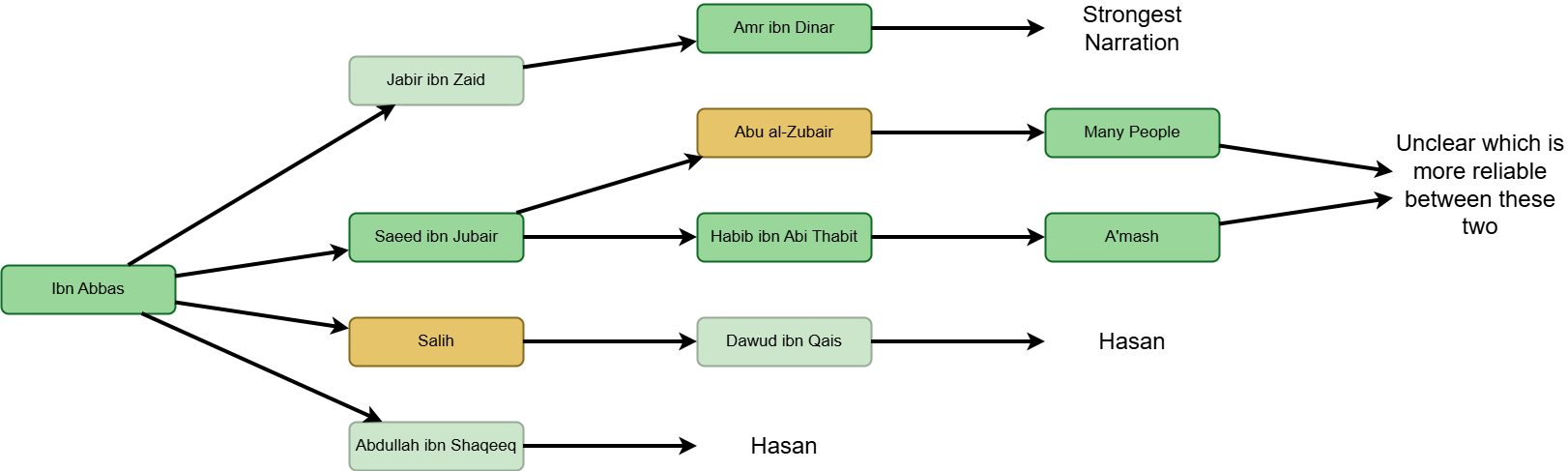
It is necessary to note the wording of each transmission closely.
Transmission of Jabir ibn Zaid > Ibn Abbas
This transmission only mentions that the Prophet (SAW) prayed Zuhr and Asr together and Maghrib and Isha together while not travelling without mentioning any reason. However, the narrators theorize it to be apparent combination rather than actual combination:
عَنْ ابْنَ عَبَّاسٍ رَضِيَ اللَّهُ عَنْهُمَا , قَالَ : ” صَلَّيْتُ مَعَ رَسُولِ اللَّهِ صَلَّى اللَّهُ عَلَيْهِ وَسَلَّمَ ثَمَانِيًا جَمِيعًا وَسَبْعًا جَمِيعًا , قُلْتُ : يَا أَبَا الشَّعْثَاءِ أَظُنُّهُ أَخَّرَ الظُّهْرَ وَعَجَّلَ الْعَصْرَ وَعَجَّلَ الْعِشَاءَ وَأَخَّرَ الْمَغْرِبَ ، قَالَ : وَأَنَا أَظُنُّهُ “
Amr ibn Dinar > Jabir ibn Zaid > Ibn Abbas: The Prophet (SAW) prayed eight together (Zuhr and Asr) and seven together (Maghrib and Isha).
Amr said, “Jabir, I think he prayed Zuhr late and Asr early?” Jabir said, “I think that as well.”
Bukhari and Muslim
Ibn Uyainah, Hammad ibn Zaid, Ibn Juraij, Shu’bah, and others narrated it from Amr.
Hammad and others added “in Madinah,” however that is obviously implied from the fact that the narration does not mention the prayers being shortened.
This narration does not make clear whether it was actual combination or for what reason the Prophet combined the prayers.
Transmission of Several > Abu al-Zubair (hasan) > Saeed ibn Jubair > Ibn Abbas
Abu al-Zubair narrated from Saeed ibn Jubair something similar and negated the reason of travel or fear. Ibn Abbas also theorized the Prophet (SAW) did it so the ummah would not face hardship.
عَنِ ابْنِ عَبَّاسٍ ، قَالَ : ” صَلَّى رَسُولُ اللَّهِ صَلَّى اللَّهُ عَلَيْهِ وَسَلَّمَ الظُّهْرَ وَالْعَصْرَ جَمِيعًا ، وَالْمَغْرِبَ وَالْعِشَاءَ جَمِيعًا ، فِي غَيْرِ خَوْفٍ ، وَلَا سَفَرٍ ” .
Abu al-Zubair (hasan) > Saeed ibn Jubair > Ibn Abbas: The Prophet (SAW) prayed Zuhr and Asr together and Maghrib and Isha together in Madinah without being in a state of fear or travel.
Saeed asked Ibn Abbas, “Why did he do that?” Ibn Abbas said, “He didn’t want his ummah to be in hardship.”
Muslim
Malik, Ibn Uyainah, Thawri, Zuhair, and others narrated this hadith like this from Abu al-Zubair, and it is a Hasan hadith because Abu al-Zubair was hasan.
Malik added after the hadith: I think it was because of rain.
This narration explicitly negates the reasons: travel and fear (i.e. war).
Transmission of Qurrah > Abu al-Zubair (hasan) > Saeed ibn Jubair > Ibn Abbas
Qurrah opposed the rest of the narrators of this hadith and said it was about travelling in the expedition of Tabuk instead of being about Madinah:
Qurrah > Abu al-Zubair > Saeed ibn Jubair > Ibn Abbas: The Prophet (SAW) combined between prayers in a journey he travelled, in the expedition of Tabuk. He combined Zuhr with Asr and Maghrib with Isha.
Saeed asked Ibn Abbas, “What made him do that?” He said, “He didn’t want his ummah to be in hardship.”
Muslim
Qurrah was a highly regarded narrator of hadith. However, he was not strong enough alone to outweigh the large number of imams like Thawri and Malik who narrated the hadith as being about Madinah.
It is possible Abu al-Zubair changed his narration of the hadith over time and Qurrah learned the early version while others learned the later version, but this is unlikely because both early narrators (like Thawri) and late narrators (like Ibn Uyainah) narrate it about Madinah. It is also possible Qurrah confused this narration with the aforementioned hadith of Muaz ibn Jabal that Qurrah and others narrated also from Abu al-Zubair. The hadith of Muaz was about the expedition of Tabuk.
Transmission of Habib > Saeed ibn Jubair > Ibn Abbas
Habib ibn Abi Thabit supported the narration from Saeed ibn Jubair about combining prayers in Madinah but his narration says it was not because of fear or rain:
عَنِ ابْنِ عَبَّاسٍ ، قَالَ : ” جَمَعَ رَسُولُ اللَّهِ صَلَّى اللَّهُ عَلَيْهِ وَسَلَّمَ بَيْنَ الظُّهْرِ وَالْعَصْرِ ، وَالْمَغْرِبِ وَالْعِشَاءِ بِالْمَدِينَةِ ، فِي غَيْرِ خَوْفٍ ، وَلَا مَطَرٍ “
A’mash > Habib ibn Abi Thabit > Saeed ibn Jubair > Ibn Abbas: The Prophet (SAW) prayed Zuhr and Asr together and Maghrib and Isha together in Madinah without being in a state of fear or rain.
This contradicts Abu al-Zubair’s transmission which only says “not fear or travel” while this says “not fear or rain.”
There are three possible solutions to resolve this inconsistency:
- Prefer Abu al-Zubair’s version: Not fear or travel
- Then, rain is a possible theory for why the Prophet (SAW) combined them.
- Prefer Habib’s version: Not fear or rain
- Then, rain is not a possible theory.
- Combine: Not fear or travel or rain.
- Then, rain is not a possible theory.
It is difficult to resolve the hadith to any particular solution.
Transmission of Salih mawla Tau’amah (acceptable) > Ibn Abbas
Salih also narrated that Ibn Abbas negated rain as the reason:
عَنِ ابْنِ عَبَّاسٍ ، قَالَ : ” جَمَعَ رَسُولُ اللَّهِ صَلَّى اللَّهُ عَلَيْهِ وَسَلَّمَ بَيْنَ الظُّهْرِ وَالْعَصْرِ ، وَالْمَغْرِبِ وَالْعِشَاءِ فِي ، غَيْرِ مَطَرٍ وَلَا سَفَرٍ . قَالُوا : يَا أَبَا عَبَّاسٍ ، مَا أَرَادَ بِذَلِكَ ؟ قَالَ : التَّوَسُّعَ عَلَى أُمَّتِهِ “
Dawud ibn Qais > Salih mawla Tau’amah (weak): Ibn Abbas said, “The Prophet (SAW) combined between Zuhr and Asr and between Maghrib and Isha without rain and without travelling.” People asked, “What did he mean by that?” Ibn Abbas said, “To make ease for his ummah.”.
Salih had poor memory at the end of his life so this is a weak narration.
This either supports Habib’s narration from Saeed or it provides reason to suspect he mixed up the content of this hadith with that hadith.
Transmission of Abdullah ibn Shaqeeq (hasan) > Ibn Abbas
Abdullah ibn Shaqeeq narrated the hadith with extra context which indicates Ibn Abbas himself used the hadith to combine while not travelling with no mention of rain.
عَنْ عَبْدِ اللهِ بْنِ شَقِيقٍ، قَالَ: خَطَبَنَا ابْنُ عَبَّاسٍ يَوْمًا بَعْدَ الْعَصْرِ، حَتَّى غَرَبَتِ الشَّمْسُ، وَبَدَتِ النُّجُومُ، وَعَلِقَ النَّاسُ يُنَادُونَهُ: الصَّلَاةَ الصَّلَاةَ، وَفِي الْقَوْمِ رَجُلٌ مِنْ بَنِي تَمِيمٍ، فَجَعَلَ يَقُولُ: الصَّلاةَ الصَّلاةَ، قَالَ: فَغَضِبَ، قَالَ: أَتُعَلِّمُنِي بِالسُّنَّةِ؟ «شَهِدْتُ رَسُولَ اللهِ ﷺ، جَمَعَ بَيْنَ الظُّهْرِ وَالْعَصْرِ، وَالْمَغْرِبِ وَالْعِشَاءِ» قَالَ عَبْدُ اللهِ: فَوَجَدْتُ فِي نَفَسِي مِنْ ذَلِكَ شَيْئًا فَلَقِيتُ أَبَا هُرَيْرَةَ فَسَأَلْتُهُ، فَوَافَقَهُ
Hammad ibn Zaid > Zubair ibn al-Khurait > Abdullah ibn Shaqeeq (hasan): Ibn Abbas gave us a sermon (in Basra) after Asr and the sun set and the stars appeared. People started saying “Salah! Salah!” He became angry and said, “Do you teach me the Sunnah?? I saw the Prophet (SAW) combine between Zuhr and Asr and between Maghrib and Isha.” (Abdullah said) I felt some unease in my heart, so I met Abu Hurairah and asked him about it and he confirmed it.
Muslim (supporting)
The hadith mentions Ibn Abbas delayed prayer until the stars appeared. It is unclear whether the time of Isha started or not.
عَنْ عَبْدِ اللَّهِ بْنِ شَقِيقٍ الْعُقَيْلِيِّ ، قَالَ : قَالَ رَجُلٌ لِابْنِ عَبَّاسٍ : الصَّلَاةَ ، فَسَكَتَ ، ثُمّ قَالَ : الصَّلَاةَ ، فَسَكَتَ ، ثُمّ قَالَ : الصَّلَاةَ ، فَسَكَتَ ، ثُمّ قَالَ : لَا أُمَّ لَكَ ، أَتُعَلِّمُنَا بِالصَّلَاةِ ، ” وَكُنَّا نَجْمَعُ بَيْنَ الصَّلَاتَيْنِ عَلَى عَهْدِ رَسُولِ اللَّهِ صَلَّى اللَّهُ عَلَيْهِ وَسَلَّمَ ”
Imran ibn Hudair > Abdullah ibn Shaqeeq (Hasan): The same story as above, and Ibn Abbas said, “We used to combine prayers in the time of the Prophet (SAW).”
Four Imams
Combining Prayers While Travelling
Abu Hanifah
The best source for understanding the early Hanafi mazhab is Muhammad al-Shaybani and his writings.
Abu Hanifah’s view was clearly recorded by his students, including Shaybani, that he said it is not allowed to combine any two prayers in the time of one of them, except for Zuhr and Asr at Arafah in the time of Zuhr and Maghrib and Isha at Muzdalifah in the time of Isha.
Abu Hanifah said it is allowed to combine prayers while travelling only in the sense that you delay Zuhr to the later part of its time and bring Asr up to the earlier part of its time so you pray them in one stop on your journey. The same applies to Maghrib and Isha. This is termed apparent combination. But, he said it is not allowed to ever delay prayers outside their time or pray them before their time starts.
His view was that the designated timings of the five prayers are fixed and missing them is not justified in any situation, and the times at Arafah and Muzdalifah are changed as part of the ritual of Hajj not due any general allowance for the time to change like that.
His view is in line with the students of Ibn Masud who did not combine prayers when travelling. Ibrahim al-Nakha’i narrated that Aswad (one of the students of Ibn Masud) and his companions never combined prayers while travelling. In line with this, Ibrahim himself opined that you cannot combine prayers while travelling.
Abu Hanifah studied with Hammad ibn Salamah who studied with Ibrahim al-Nakha’i.
Abu Hanifah’s view is also somewhat in line with the hadith of Abd al-Rahman ibn Yazid from Ibn Masud that the Prophet (SAW) never moved the time of any prayer except Maghrib and Fajr in Hajj. It is, however, unclear to me whether Abu Hanifah and his students used this report directly, and their view appears to contradict the report in allowing people to combine Zuhr and Asr at Arafah while the report does not mention this.
The underlying reason for the view of Ibn Masud’s students and Abu Hanifah is that the times of prayer are strongly established from the Sunnah of the Prophet (SAW) and the Quran itself so changing them would require very strong evidence. In the absence of such evidence, it cannot be allowed to pray any prayer outside its time.
In Hajj, the time change is strongly established by the actions of the Muslims since the time of the Prophet (SAW) and reports from numerous Sahabah, hence it is allowed to make an exception for that case.
For travel, the time change is not strongly established. We will discuss their evaluation of the reports on this topic in a later section.
Evidence Early Hanafis Did Not Use
Firstly, I did not find Shaybani use the verse ⟪Prayer is upon the believers a timed obligation.⟫ (4:103) explicitly in any of his writings. The earliest use I could find was by Jassas (d. 370).
However, this is, in my opinion, not because this verse was not an important basis but because the fact that prayer is a timed obligation was self-evidently obvious even from consensus and did not require explicit mention.
Secondly, the hadith of Ibn Masud was only used as evidence much later, and that is expected since it contradicts the Hanafi view on combining Zuhr and Asr at Arafah.
Malik
Malik’s view on the topic of combining prayers is unclear. Different reports from Malik imply different views.
In Ibn al-Qasim’s Mudawwanah (one of the major books recording Malik’s views), Malik recommended combining prayers only when you are in a hurry on a journey. Malik also recommended combining prayers only in the form of apparent or pseudo-apparent combination. However, Malik allowed true combination in certain necessary situations as well.
فَأَحَبُّ مَا فِيهِ إلَيَّ أَنْ يَجْمَعَ بَيْنَ الظُّهْرِ وَالْعَصْرِ فِي آخِرِ وَقْتِ الظُّهْرِ وَأَوَّلِ وَقْتِ الْعَصْرِ يَجْعَلُ الظُّهْرَ فِي آخِرِ وَقْتِهَا وَالْعَصْرَ فِي أَوَّلِ وَقْتِهَا إلَّا أَنْ يَرْتَحِلَ بَعْدَ الزَّوَالِ فَلَا أَرَى بَأْسًا أَنْ يَجْمَعَ بَيْنَهُمَا تِلْكَ السَّاعَةَ فِي الْمَنْهَلِ قَبْلَ أَنْ يَرْتَحِل
Ibn al-Qasim narrated from Malik: What I prefer in [combining prayers] is to combine Zuhr and Asr in the ending time of Zuhr and beginning time of Asr, so he can pray Zuhr at the end of its time and Asr at the start of its time, except if he is leaving on his journey after the decline of the sun (i.e. Zuhr time started), then I don’t see any harm in combining them at that time at the watering place before leaving.
قال عليٌّ، عن مالك فِي مَنْ أراد أَنْ يركب البحر في وقت الظهر، فأراد أَنْ يجمع بين الصلاتين في البَرِّ، لما يعلم من مَيَدٍ يأخذه، يمنعه القيام، فليجمع بينهما في البر قائمًا، خير من أَنْ يصلي العصر في وقتها قاعدًا.
Ali ibn Ziyad narrated from Malik: If a person plans to board a ship in the time of Zuhr and he knows that a storm will take him in the sea which will prevent him from standing for prayer, he should combine them on land while standing. That is better than praying Asr in its time sitting.
You can see that Malik said you can combine Zuhr and Asr if you leave in the beginning of Zuhr time if you may not be able to pray Asr properly later (either because you won’t have easy access to water or ability to stand).
The reason Malik only recommended combining when in a hurry is obviously because of the hadith of Ibn Umar where he only said the Prophet combined prayers when in a hurry. The reason he allowed combining outside the time when needed is because of the general corpus of narrations which indicate there is some sort of allowance to combine Zuhr and Asr or Maghrib and Isha in times of need.
Other narrations from Malik indicate that if someone combines outside the time without a genuine excuse even while travelling, he should repeat the prayer.
قال عنه عليٌّ: وإن جمعهما في أول الوقت، فإن صَلَّى العصر في أول وقت الظهر، والعشاء أول وقت المغرب، أَعَادَ الآخرة ما كان في الوَقْتِ، وإنْ لم يكُنْ عجَّلهما أول الوقت، فلا يُعِيدهما.
Ali ibn Ziyad narrated from Malik: If a person combines two prayers in the beginning time, like praying Asr in the beginning time of Zuhr or Isha in the beginning time of Maghrib, he should repeat the second as long as he is within the time (If he does not repeat within the time, the prayer is valid and does not need to be repeated). But, if he did not combine them in the earliest time, he does not need to repeat.
ومن الْعُتْبِيَّة ابن القاسم عن مالك قال: إني لأكره جمع الصلاتين في السفر، وذلك في الشتاء أخفُّ، ومن جمع ففي وسط ذلك بين الصلاتين.
Ibn al-Qasim narrated from Malik: I dislike combining prayers while travelling. Whoever combines, he should do it in the middle [time] between the two prayers.
The reason for this dislike of combining prayers outside their time probably has the same reason as Abu Hanifah. The designated times for prayer are strongly proven, and it would require very strong evidence to overturn those laws.
The current Maliki school interprets all of Malik’s statements as being about the ideal. Meaning, combining prayers is not ideal and the ideal way of combining prayers is apparent combination. As for whether truly combining prayers while travelling is just allowed, the current Malikis hold about the same view as Shafi’i, that it is unrestrictedly allowed for a traveler to combine Zuhr and Asr or Maghrib and Isha. That view will be discussed in the next section.
Shafi’i
Shafi’i said, as recorded in his Umm, that a traveler can combine Zuhr and Asr or Maghrib and Isha in either of their respective times, whether praying in the earlier time or the later time, as long as he is a traveler.
His view was based on 1) the general evidence from the Sunnah of the Prophet combining prayers while travelling, 2) qiyas (analogy) to the combination of prayer during Hajj, and 3) ruling out the conditions or restrictions provided by others based on the evidence.
Firstly, there are many narrations that mention the Prophet (SAW) combining prayers while travelling including the hadith of Muaz ibn Jabal, Ibn Umar, Anas ibn Malik, and others.
After these hadith, someone might ask: What does combining mean? Is it in the middle time, in the early time, or in the later time?
Shafi’i said we do not need to speculate about the nature of the combination. We can know it by referring to the well-known combination of the Prophet (SAW) that everyone agrees about, that is the one he did at Hajj. For Zuhr and Asr, he combined in the early time. For Maghrib and Isha, he combined in the later time. Through this qiyas, Shafi’i argued combination is allowed both in the early time and in the later time.
Finally, Shafi’i looked at the restrictions people provided for combining prayers: Is it only when the traveler is in a hurry? Is it only when he is on the road and not when he is stopped somewhere?
Shafi’i used the hadith of Muaz ibn Jabal to negate the existence of all these conditions. Muaz ibn Jabal narrated:
We journeyed with the Prophet (SAW) in the expedition of Tabuk and he used to combine prayers. He would pray Zuhr and Asr together and Maghrib and Isha together.
One day, he delayed prayer, then came out and prayed Zuhr and Asr together, then went back in(side his tent). Then, he came out and prayed Maghrib and Isha together.
Muslim
This hadith makes it clear that the Prophet (SAW) combined prayers while travelling even when he was camped and in no particular hurry.
Additionally, you are not on a journey while at Arafah nor are you particularly in a hurry and still the Prophet (SAW) combined prayers.
As a result of this, Shafi’i argued that the narrations that mention the Prophet (SAW) combined prayers while in a hurry cannot be used as evidence to limit combining prayers to when you are in a hurry. Rather, the Prophet sometimes combined prayers when he was in a hurry and sometimes when he was not. So, we are allowed to combine prayers while travelling regardless of whether we are in a hurry.
Ahmad
Imam Ahmad generally allowed combining prayers when travelling. In addition to the arguments mentioned before, he also argued that combining prayers while travelling is a concession for convenience and apparent combination is not very convenient.
قال إسحاق بن منصور: قُلْتُ: أيجمعُ بين الصلاتين؟ قال: نعم، يجمع ولا يكون الجمع إلا في وقت إحدى الصلاتين فلو كان صلى كل صلاة في وقتها، أين كانت تكون الرخصة؟ !
Ishad ibn Mansur asked Ahmad, “Can you combine two prayers (i.e. while travelling)?” He said, “Yes, you can combine, and combination can only be in the time of one of the two prayers. If he had to pray every prayer on its own time, what would be the convenience!?”
This argument was developed a lot by later scholars, and some even said combining prayers is a more useful concession than shortening prayer, so it would not make sense if combining prayers was only apparent combination.
That being said, there are many narrations that indicate that Ahmad believed apparent or pseudo-apparent combination is the best and more recommended option if you are going to combine, like Malik also recommended and Abu Hanifah obligated.
سَأَلت ابي عَن الْجمع بَين الصَّلَاتَيْنِ فِي السّفر
فَقَالَ اكثر مَا جَاءَ انه يُؤَخر الظّهْر الى وَقت الْعَصْر ثمَّ يجمعهما فِي وَقت الْعَصْر وَكَذَلِكَ الْمغرب وَالْعشَاء وَالْآخِرَة يُؤَخر الْمغرب حَتَّى يغيب الشَّفق ثمَّ يجمع بَينهمَا
وَقد رُوِيَ عَن ابْن عَبَّاس ان النَّبِي ﷺ جمع بَين الظّهْر وَالْعصر وَفِي وَقت الظّهْر
قَالَ ابي وَالَّذِي يعجبنا ان يُؤَخر الظّهْر الى وَقت الْعَصْر وَالْمغْرب الى وَقت الْعشَاء على فعل ابْن عمر
Abdullah ibn Ahmad asked his father about combining prayers while travelling. Ahmad said, “Most of what has been narrated on this topic is that you can delay Zuhr until the time of Asr then combine them and the same with Maghrib and Isha. You can delay Maghrib until the twilight disappears then combine the two. It has also been narrated from Ibn Abbas that he combined Zuhr and Asr in the time of Zuhr. What I prefer is that you delay Zuhr until the time of Asr and Maghrib until the time of Isha according to the actions of Ibn Umar.”
قال أبو داود: سمعت أحمد بن حنبل سأله رجل عن الجمع بين الصلاتين في السفر؟ قال: أخر المغرب حتى تصليهما جميعًا.
Abu Dawud said someone asked Ahmad whether you can combine prayers while travelling. Ahmad said, “He should delay Maghrib until he prays the two (Maghrib and Isha) together.”
Evidence Early Shafi’is and Hanbalis Did Not Use
The clearest evidence for combining prayers outside their time (specifically, actual early combination) is the hadith of Qutaibah mentioned before.
However, it was never used by Shafi’i himself as evidence. It is doubtful he even heard of the hadith.
The scholars of hadith including Abu Dawud and Tirmidhi recorded the hadith, but none of them gave it much value. Neither Bukhari nor Muslim included the hadith in their Sahih. Tirmidhi called the hadith Ghareeb, and Abu Dawud noted, “No one narrated this hadith except Qutaibah alone.”
Ahmad also did not use the hadith of Qutaibah as evidence even though he included it in his Musnad. Despite knowing it, he only said there’s a narration from Ibn Abbas on the topic when asked.
Shafi’i also only used as supporting evidence the hadith of Husain ibn Abdullah from Ikrimah or Kuraib from Ibn Abbas which contains almost the same content as the hadith of Qutaibah. However, the hadith is weak and he most likely knew it, so he did not center his argument around it but centered it around the reasoning I mentioned before.
Combining Prayers While Not Travelling
How to deal with the hadith of Ibn Abbas that the Prophet (SAW) combined prayers even when not travelling?
Abu Hanifah
Abu Hanifah and the early Hanafis would have had no problem with the narration since the only combining they believed in was apparent combination.
Apparent combination is allowed any time, even if it is not recommended. So, it is possible the Prophet (SAW) may have just done that to show people it is allowed when needed.
Malik
Malik theorized the reason for combining prayers in the narration of Ibn Abbas was rain. He also narrated in the Muwatta that Ibn Umar used to combine prayers when it was raining.
Ibn Umar’s actions and the general practice of the people of Madinah would have been enough evidence for Malik to conclude it is allowed to combine prayers while raining.
It is possible he did not have access to or did not give much value to the narrations that say it was not rain.
Shafi’i
Shafi’i agreed with Malik and argued the reason for combining prayers while not travelling in this hadith was only rain, and he did not allow combining for any other reason.
He argued that the hadith that the Prophet prayed the prayers at specific times are well-known including the hadith of Jibril where he showed the correct times of prayer, and in fact, some of them are narrated by Ibn Abbas himself.
So, there must have been a distinguishing quality between this hadith where the Prophet combined and those other ahadith where the Prophet prayed them individually, and that can only be rain.
As for reasons other than rain like sickness, Shafi’i ruled them out by saying the default is to pray prayers individually. Other excuses are not like rain in that they are individual (like sickness) while rain affects everyone, and there was sickness in the time of the Prophet (SAW) but we have no reports of him or anyone else combining for that reason.
This argument is difficult as you can see. If we don’t have reports of the Prophet combining for any other reason than rain, we also don’t have any explicit report of him combining for rain!
Ahmad
Ahmad allowed combining prayers for any good excuse, whether rain or sickness.
قلت: قوله: صليت مع النبي -ﷺ- سبعًا جمعيًا وثمانيًا جميعًا بالمدينة من غير خوف ولا مطر؟ (٣)
قال: قد جاءت الأحاديث بتحديد المواقيت للظهر والعصر والمغرب والعشاء، فأما المريض فأرجو.
Salih asked Imam Ahmad, “What does the hadith mean when it says the Prophet combined prayers while not travelling and there was no rain?” He said, “There are many narrations that specify the times for Zuhr, Asr, Maghrib. and Isha. As for the sick person, I hope (combining is allowed for him based on this hadith).”
قال الأثرم: قلت لأبي عبد اللَّه: أي شيء تقول في حديث ابن عباس أن النبي -ﷺ- صلى ثمانيًا جميعًا، وسبعًا جميعًا من غير خوف ولا سفر؟ فقال: ابن عباس كما ترى قد أثبت هذا أو صححه، وغيره يقول: ابن عمر ومعاذ وغير واحد يقولون إنه في السفر.
فقلت: أيفعله الإنسان؟
فقال: إنما فعله لئلا يحرج أمته.
Athram asked Ahmad, “What do you say about the hadith of Ibn Abbas that the Prophet combined Zuhr and Asr and Maghrib and Isha without any fear and without travelling?” He said, “This is what Ibn Abbas said. However, Ibn Umar, Muaz ibn Jabal, and many others said this (combining prayers) is only for travel.” Athram asked, “Can a person do this (combine outside travel)?” He said, “He only did it to not put hardship on his ummah.”
So, the Hanbalis argued based on Ibn Abbas’s statement (that the Prophet did it not to place hardship on the ummah) that it is allowed to combine prayers for any legitimate reason that would cause hardship if the prayers were not combined, specifically sickness and rain and severe wind, etc.
Ibn Abbas’s statement is used as evidence either because it is assumed to have prophetic basis (marfu’ hukman) or because companions are evidence in the absence of other evidence.
Why is there difference of opinion?
Whenever there is difference of opinion on a topic, it is because of four reasons which can be classified into two categories:
- Difference in Usul
- Difference in Usul al-Hadith: Two scholars disagree about the conditions of a hadith being authentic.
- Difference in Usul al-Fiqh: Two scholars disagree about how evidence can be used.
- Difference in Application
- Difference in Authentication: Two scholars disagree about whether a specific hadith is authentic.
- Difference in Interpretation: Two scholars disagree about how to understand some specific evidence.
All of these are at play to different extents in this discussion of whether prayers can be combined.
Difference in Usul
Difference in Usul al-Fiqh
Definitive General Rule vs. Solitary Narrations
Different scholars differed on the question: Do you prefer to keep the general rule proven by strong evidence or do you make exceptions based on evidence much weaker than the general rule?
Hanafi Usul al-Fiqh states that general rules proven through definitive evidence, like clear Quran or Sunnah or consensus, can only be overturned by equally clear evidence even to make exceptions.
Shafi’i Usul al-Fiqh distinguishes between two types of overturning: 1) Abrogation, and 2) Making exceptions.
As for the first, they agree with the Hanafis that a definitively proven rule can only be overturned or abrogated by equally proven evidence. So, it would not be allowed for an individual Sahih hadith to abrogate a rule of the Quran.
As for the second, the Shafi’is say it is allowed for authentic evidence to create exceptions within definitively proven general rules. So, it would be allowed for an individual Sahih hadith to give an exception for a general rule in the Quran.
The underlying source for this difference is whether they believe general statements definitively include everything under them or just assumptively include everything under them.
The Hanafis say a general statement definitively includes everything under it. So, if Allah says something general and a hadith provides an exception, the hadith is in fact overturning the rule of the Quran that was in the general rule. Hence, it is only allowed if definitive evidence gives exceptions to definitive rules.
The Shafi’is say a general statement only assumptively includes everything under it. So, if Allah says something general, you presume it includes everything under it but do not rule out the possibility of exceptions. As such, when a hadith provides an exception, the hadith is just clarifying that the original statement did not include this exception. Hence, there is no abrogation involved, hence there is no need for equally definitive evidence to provide exceptions.
In the combination question, Hanafis say there is a general rule proven in the Quran, Sunnah, and many hadith that the times for Zuhr, Asr, Maghrib, and Isha are defined in proper ways. To make exceptions to that general rule would require equally definitive evidence, and there is no such evidence.
Shafi’is could respond in terms of usul or in terms of application. In terms of usul, they can just disagree that definitive general rules require definitive evidence to overturn as already mentioned. In terms of application, they can respond: Even if we grant your legal theory, there is no definitively proven general rule since we both agree prayers can be combined in Hajj. So, there is no definitivel general rule, only an assumptive one. Hence, you can overturn it with Sahih hadith.
Hanafis can respond by saying the combination at Hajj is only a part of the rituals of Hajj and thus neither provides evidence for generally combining prayer while travelling nor removes the general rule from being definitive.
Are the companions evidence?
The Hanafis and Malikis believe the views of the companions are evidence in Islam.
Hanafis used the view of Ibn Masud and his students against true combination of prayers.
Malikis used the view of Ibn Umar and his students in favor of true combination of prayers while travelling and during rain. Hanafis might respond by saying Ibn Masud was more senior and more knowledgeable than Ibn Umar, may Allah be pleased with them both.
Shafi’is said the views of the companions are not evidence in Islam, and they used the fact that companions differed in topics like this to show that they are not evidence.
Some scholars said the views of the companions are evidence if there is no Quran or Sunnah on the topic and if the companions do not disagree. Allah says ⟪O believers, obey Allah and obey the Messenger and those in authority among you. If you disagree over anything, refer it to Allah and the messenger.⟫ (4:59)
Some said the companions are just supporting evidence but they are not binding evidence like the Quran and Sunnah are.
Is precedence evidence?
Malikis famously believed that the precedence and practices of Madinah are evidence.
Hanafis did not explicitly believe the precedence of Kufa was evidence but they often closely stuck to Kufan legal tradition as we have seen in this case.
Shafi’i did not believe any legal precedence was evidence.
Malikis argued that Madinah was the place where the Prophet (SAW) and most of the major Sahabah lived and died. If the people of Madinah agreed on doing something, it is strong evidence that came from prophetic knowledge or has basis in Islam.
Hanafis said Ibn Masud was one of the greatest scholars among the Sahabah and he was one of the four people the Prophet (SAW) recommended learning Quran from, and his students were also respected scholars of Islam. As a result, the legal tradition of Kufa, which usually represents the views of Ibn Masud, should be taken seriously.
Shafi’is argued that legal traditions often contradict each other like in this case. There is no point trying to figure out whose legal tradition holds more value. Rather, we should just look at actual evidence from the Quran and Sunnah.
In this case, the legal precedent in Madinah was that prayers were combined during rain, so the Malikis allowed it.
In Iraq, most scholars did not allow actually combining prayers for rain or for travel, and the Hanafis also do not allow it.
Difference in Usul al-Hadith
Problem of Gharabah
The view of the early hadith scholars was that the authenticity of a hadith can be called into question if the chain of a hadith is solitary in a way that the reliability of the narrator does not overcome it.
Many later scholars did not mind this condition properly and authenticated hadith only based on the narrators being reliable.
For example, Qutaibah narrated from Layth > Yazid > Abu al-Tufail > Muaz ibn Jabal that the Prophet used to combine Zuhr and Asr in Zuhr time before leaving on a journey during the expedition of Tabuk.
Qutaibah was a very reliable narrator of hadith and a teacher that transmitted hadith to the likes of Imam Ahmad, Ali ibn al-Madini, Ibn Maeen, Ibn Abi Shaibah, Bukhari, Muslim, Abu Dawud, Tirmidhi, Nasai, and many others.
There is no question Qutaibah was reliable. However, the scholars of hadith realized that even reliable narrators could make mistakes, that is why they considered other aspects of a hadith like solitariness and contradiction by other narrators.
This hadith by Qutaibah has two problems from this perspective:
- Layth was a major teacher of hadith with many students but none of them narrated this hadith from him. If this hadith existed, it would have a nice chain, so everyone would have wanted to narrate it. But, no one narrated it except Qutaibah from Layth. Additionally, no one narrated it from Yazid except Qutaibah through Layth. As for Abu al-Tufail, Abu al-Zubair narrated from him the hadith of the Prophet (SAW) combining prayers in Tabuk but did not mention the details of Qutaibah.
- Others narrated something similar from Layth > Hisham ibn Sa’d (weak) > Abu al-Zubair > Abu al-Tufail. This makes more sense in light of the fact that many people narrated the hadith from Abu al-Zubair.
Because of these problems, Qutaibah likely made a mistake in this hadith.
Qutaibah used to say (when people doubted this hadith), “This hadith has the stamp of Ahmad ibn Hanbal, Ali ibn al-Madini, Yahya ibn Maeen, Ibn Abi Shaibah, and Abu Khaithamah on it. They all wrote down this hadith from me.” Abu Abdullah al-Hakim noted after this narration, “The scholars of hadith only listened to this hadith from Qutaibah because they were surprised by its chain and content.” Meaning, they did not consider it Sahih.
Bukhari asked Qutaibah, “Who were you with when you wrote down this hadith of Layth?” He said, “I wrote it down with Khalid al-Madayini.” Bukhari said, “And Khalid al-Madayini used to interpolate hadith with teachers.” Meaning, he used to wrongly read the hadith of other narrators in their classes, which would lead people to wrongly think those hadith belonged to those teachers.
Abu Hatim al-Razi, one of the scholars of ilal, said the hadith is probably a mistake.
However, some later scholars graded the hadith Sahih anyway despite its problems because they did not give proper due to the problems of gharabah and contradiction or they tried to argue the other (weak) narrations which mention the Prophet combining Zuhr and Asr in Zuhr time provide support for it.
Ibn al-Qayyim argued in Zaad al-Ma’aad that the hadith is acceptable due to the supporting narrations. Albani also argues the hadith is Sahih since all the narrators are Sahih and said, “Qutaibah was extremely reliable, so being solitary cannot hurt the hadith as is proven in the science of hadith.”
Whether this hadith is graded Sahih or acceptable or weak can change the final judgement on this topic.
Connection of an Unproven Chain
If a narrator narrates something from someone there is no evidence of him meeting without explicit words of connection, should we assume the chain is connected?
Some took the strict position that no chain is connected until proven otherwise. Others took the middle position that a chain is connected as long as it is reasonably possible the two met and the narrator is not known for tadlees (narrating from those he did not meet).
In the hadith of Qutaibah, the chain includes Yazid ibn Abi Habeeb narrating from Abu al-Tufail using the word عن.
There is no other hadith Yazid narrated from Abu al-Tufail, and there is no proof they ever met.
People who did not believe gharabah to be a source of weakness but still considered the hadith weak, like Ibn Hazm, used this problem in the hadith to weaken it. However, clearly, this problem in the hadith is secondary to the main problem that Qutaibah was alone in this hadith.
Addition of a Reliable Narrator
Scholars also differed on the question: If a reliable narrator adds something to a hadith his peers did not add, is that addition accepted as strongly as if it was a Sahih hadith or is it rejected because his peers did not have it?
A group of scholars said that the addition of reliable narrators is accepted as long as there is no contradiction.
The reason for this is that absence of evidence is not evidence of absence. If you have two people and one said, “I saw apples and oranges in the fridge,” while the other said, “I saw apples, oranges, and grapes in the fridge,” you would believe there are grapes in the fridge since the first one did not negate grapes. Even if the first said, “I did not see grapes in the fridge,” you would still prefer the second witness since the first could have just failed to notice the grapes.
Another group of scholars said there can be cases where the addition of a reliable narrator is too suspicious to accept. For example, if three reliable narrators agree on something and another person adds something none of the others said, it is suspicious why the three reliable narrators missed what this person added. Hence, that addition should be viewed with suspicion.
Most of the early scholars of hadith acted on a case-by-case basis and did not generally accept the addition of any reliable narrator.
In this debate, the hadith of Anas (RA) and others only says the Prophet (SAW) prayed Zuhr before leaving, while the hadith of Ibn Abbas and Qutaibah says he prayed Zuhr and Asr before leaving.
The first group would say the Prophet (SAW) also praying Asr is additional information, so we should accept the addition by the hadith of Ibn Abbas. The second group would argue that if the Prophet had indeed prayed Zuhr and Asr before leaving, Anas (RA) would have mentioned it clearly. But, the absence of this in the hadith indicates he did not pray Asr before leaving on a journey.
Another example: The hadith of Ibn Abbas about praying while not travelling has different transmissions from the two students of Saeed ibn Jubair, Abu al-Zubair and Habib ibn Abi Thabit.
Many imams of hadith narrated from Abu al-Zubair that he said, “not in fear or travel.” Based on Abu al-Zubair’s version Malik and Shafi’i opined that the Prophet (SAW) combined because of rain.
A’mash narrated from Habib that he said, “not in fear or rain.” Based on Habib’s version, the Maliki and Shafi’i theory is wrong and the reason the Prophet (SAW) combined prayers that time was not rain.
Some people can prefer Abu al-Zubair’s version because many imams of hadith narrated it from him. Some can prefer Habib’s version because Habib himself was more accepted as reliable than Abu al-Zubair. Bukhari included hadith from Habib in his Sahih but only included Abu al-Zubair for supporting narrations.
Difference in Application
How can Hanafis deal with the specific narrations?
There are a few questions the Hanafis need to answer about the narrations:
- What do all the narrations that mention the Prophet (SAW) combined prayers mean?
- What do the narrations mean when they say Maghrib was delayed until twilight disappeared or Zuhr was delayed until the time for Asr?
- What do the narrations mean when they say the Prophet prayed Zuhr and Asr in Zuhr time before leaving on a journey?
- How is apparent combination convenient?
Problem 1: What do all the narrations that mention the Prophet (SAW) combined prayers mean?
The Hanafis say the vast majority of narrations on the topic can easily refer to apparent combination rather than true combination:
- Ibn Umar said the Prophet (SAW) used to combine Maghrib and Isha when he was in a hurry. This can refer to apparent combination. Some versions of the hadith even specify that it was apparent combination.
- Anas (RA) said the Prophet would delay Zuhr until the time of Asr if he left before Zuhr time started but would pray Zuhr before leaving if he left after Zuhr time. This perfectly matches apparent combination. In fact, the fact this narration specifies he only prayed Zuhr before leaving disproves the view of those who say you can pray both Zuhr and Asr in Zuhr time when travelling. This narration along with Ibn Umar’s narration are the strongest narrations on this topic.
- Muaz ibn Jabal said the Prophet used to combine Zuhr and Asr and Maghrib and Isha in the expedition of Tabuk, and he said that the Prophet delayed prayer one day until he combined them. This is perfectly compatible with apparent combination.
- Ibn Abbas said the Prophet combined Zuhr and Asr together and Maghrib and Isha together while not travelling in Madinah and Ibn Abbas said that was to not cause the ummah hardship. This is exactly compatible with apparent combination since it can be done whether travelling or not whenever there is an excuse, since each prayer is still within its time. In fact, this hadith is very difficult to interpret for those who believe in actual combination.
They can also argue that you are forced to interpret the hadith of Ibn Abbas to be about apparent combination rather than actual combination since it rules out rain and other possibilities. When you do that, the hadith proves that combining prayers meant apparent combination in the language of the companions.
Problem 2: What do the narrations mean when they say Maghrib was delayed until twilight disappeared or Zuhr was delayed until the time for Asr?
As for Maghrib being delayed until twilight disappeared, this is only found in the narration of some students of Nafi and one student of Ibn Umar. Others do not clearly mention this, and yet others specify that it was apparent combination where he prayed Maghrib right before twilight disappeared and prayed Isha right after it disappeared. So, these conflicting narrations cannot be used as evidence against the Hanafi view.
As for delaying Zuhr until the time of Asr as mentioned in a few narrations, that can easily mean it was delayed until the time of Asr was about to start and does not necessarily mean Asr time must have started when he prayed Zuhr.
Problem 3: What do the narrations mean when they say the Prophet prayed Zuhr and Asr in Zuhr time before leaving on a journey?
This information is only found explicitly in the hadith of Ibn Abbas as transmitted by Husain ibn Abdullah (weak) and Abu Qilabah (possibly never learned from Ibn Abbas) and the hadith of Muaz ibn Jabal as transmitted by Qutaibah (strangely alone in the content and chain of his hadith) and Hisham ibn Sa’d (weak and contradicted by stronger narrators).
In addition to all of these having clear problems, the authentic hadith from Anas (RA) only says the Prophet (SAW) prayed Zuhr before leaving and does not mention Asr!
When all these issues are taken into account, those narrations cannot be used as evidence to overturn the established times of prayer.
Problem 4: Combining prayers is meant to be a concession for convenience, and convenience can only be from the ability to pray in whichever time you want. As for only praying one at the end of its time and the other in the beginning of its time, how is that convenient at all?
The Hanafi response is that when travelling or when on a journey, it becomes inconvenient to do stop and do wudhu and pray. As a result, the concession is that instead of having two stops on a journey, you have one stop by delaying the first prayer to the end of its time and bringing up the second prayer to the beginning of its time.
When you have one stop instead of two, you are able to travel quicker as mentioned in the hadith of Ibn Umar that he used to combine prayers when he was in a hurry.
As for the fact that combining in any time you wish being more convenient, no one can deny that. However, the law cannot be changed based on what is “more” convenient. We cannot say Isha is 1 rakah while travelling because 1 rakah is more convenient than 2 rakahs when there is no evidence for 1 rakah.
In addition to all of this, the most authentic hadith on this subject (the hadith of Ibn Umar) makes it clear the Prophet (SAW) did not make combining prayers a general action but did it in some exceptional circumstances (when he was in a hurry). So, it was not meant to be a general concession such that preserving it can become enough concern to overturn the general laws about the times of prayer!
How can Shafi’is deal with the specific narrations?
The Shafi’is interpret most of the hadith on the subject we discussed before as evidence that Zuhr and Asr or Maghrib and Isha can be combined together in either of their times since they mention the Prophet combined those prayers when travelling.
However, the Shafi’is need to deal with three questions with regards to the narrations on this topic:
- Why do most of the narrations plausibly refer to apparent combination and why isn’t true combination clear in any Sahih narration?
- Why does the Sahih hadith of Anas (RA) only say the Prophet (SAW) used to pray Zuhr before leaving on a journey in Zuhr time? In their view, it should be allowed to pray both Zuhr and Asr.
- How to explain the hadith of Ibn Abbas about the Prophet “combining” prayers while neither on a journey or in rain or in fear? If “combining” means in either of two times instead of apparent combination, what does this hadith mean?
Problem 1: Why do most of the narrations plausibly refer to apparent combination and why isn’t true combination clear in any Sahih narration?
There are two possible responses.
One possibility is to say that people understood what combining prayers meant without needing it spelled out because it was prominently done in Hajj. So, whenever they mention combining prayers, it is assumed that you know combining prayers is done in either the earlier time or the later time.
Another possibility is to say that the Prophet (SAW) generally did not truly combine prayers. Most of the time, he used apparent combination or pseudo-apparent combination, but that does not negate that actual combination is still allowed.
In fact, they can argue that the lack of details in the narrations supports their understanding of combining prayers. If prayer could only be combined at a very specific time as apparent combination entails, it would be necessary for the companions and narrators to make it clear. The fact that they just mention combination in general without any specification of time indicates that there was no particular limitation to when prayers were combined.
Problem 2: Why does the Sahih hadith of Anas (RA) only say the Prophet (SAW) used to pray Zuhr before leaving on a journey in Zuhr time?
The hadith of Anas (RA) says the Prophet used to pray Zuhr before leaving while the hadith of Ibn Abbas and the narration of Qutaibah says he used to pray both Zuhr and Asr before leaving.
Even if admittedly the hadith of Ibn Abbas (RA) and the narration of Qutaibah are weaker, the principle is you accept the addition of reliable narrators for reasons mentioned before.
Problem 3: How to explain the hadith of Ibn Abbas about the Prophet “combining” prayers while neither on a journey nor in rain nor in fear?
Shafi’i did not seem to know about the narrations that explicitly rule out rain. Nawawi mentions that Shafi’i scholars tried to deal with those narrations in two ways: 1) preference or 2) reconciliation.
In terms of preference, Bayhaqi said the narration of Habib ibn Abi Thabit should be disregarded in favor of the narration of Abu al-Zubair which is more famously narrated by the major scholars of hadith. Nawawi preferred this argument and noted that Bukhari did not include this narration in his Sahih despite it meeting his conditions in terms of chain.
The second way was to reconcile the two narrations somehow while saying only combining in rain is allowed:
- Ghazali posited one narration is about truly combining prayers during rain and the other narration is only about apparent combination when there is no rain.
- Some people said “not in rain” just means “not in continuous rain.” Meaning, it is allowed to combine even in discontinuous rain.
- Some people said they prayed inside with a roof that prevented them from being in the rain!
All of these interpretations are difficult as you can see.
The Shafi’i position that combining prayers is only allowed in rain is difficult to uphold without appealing to the actions of companions (even though Shafi’is do not believe their actions are evidence!) while the Hanbali view that it is allowed to combine for any excuse is far easier to defend in terms of the hadith of Ibn Abbas.
As for the Malikis, they would have no problem appealing to the fact that Ibn Umar and other companions combined prayers when it was raining because they accepted the views of companions, and in fact, the precedent of the people of Madinah as evidence.
Conclusion
Importance of Usul
It is easy to fall into the trap of imagining Islamic law is as simple as reading a verse in the Quran or a hadith of the Prophet (SAW) and making a ruling out of what you understand from the verse or hadith.
However, the reality is that things are far more complicated than that. Scholars spent centuries discussing and developing usul and proper legal theory to understand and interpret evidence in Islam.
Before even looking at evidence, you have to properly define the topic of debate. Not having proper definition is one of the first pitfalls people fall into.
Then, when looking at evidence, it is necessary to determine what counts as evidence and whether a hadith is authentic and what even makes a hadith authentic. All of those are necessary before making any judgement of the evidence.
Summary of Evidence
The first piece of evidence on this topic is that Allah says prayer is a timed obligation.
The second piece of evidence is that the Muslims agree that Zuhr and Asr are combined in Zuhr time at Arafah and Maghrib and Isha are combined in Isha time at Muzdalifah during Hajj. Shafi’is extend this by analogy to all travel. Hanafis say it is only part of the rituals of Hajj, not due to travel.
The third piece of evidence is the list of reports from the Prophet (SAW).
Most of the reports generally mention the Prophet (SAW) combined Zuhr and Asr and Maghrib and Isha while travelling. Was that actual or apparent combination?
Some reports indicate he used to delay Zuhr until the time of Asr and Maghrib till the time of Isha. Does that mean he delayed them beyond their time or just prayed them near the end of their respective times?
A few reports indicate that he used to pray Zuhr and Asr together in Zuhr time. Are these reports authentic?
Fourthly, there is a confounding factor in the hadith of Ibn Abbas that the Prophet (SAW) combined prayers while not travelling as well. Does this only mean apparent combination or does it mean actual combination for some excuse? If the latter, what was the excuse? Some scholars theorize the reason was rain but a few transmissions of the report say “not because of rain.”
Combination Question
The combination question is a useful topic to understand how Usul al-Fiqh and Usul al-Hadith interact to cause difference of opinion among scholars.
It is unique in the sense that no other topic has so many different levels and types of hadith and so many possible interpretation at play.
May Allah guide us to the right path and help us properly understand his religion.

Pingback: linezolida